A small backyard makes people give up on a pool before they’ve asked a single question. The thinking goes: pools are for big yards, mine is the size of a parking space, so that’s that. Then summer arrives, the patio is too hot to sit on, and the daydream returns.
Here’s what usually gets missed. A pool doesn’t have to be a rectangle you swim laps in. Plenty of homeowners are happy with something far smaller: a deep soak, a place to cool off after work, a spot where the kids splash while the adults sit on the edge with their feet in. Those jobs need much less water and much less ground than a standard backyard pool.
The real puzzle is fit. Tiny pools live or die on the details around them, such as how much deck you keep, where the equipment goes, how close the neighbors are, and whether the fence rules in your area leave any room to work with. A beautiful pool squeezed in badly feels worse than no pool at all.
Below are 12 ideas, from stock tanks to plunge pools to swim spas, each with sizing, materials, and the mistakes people tend to make. After that you’ll find a comparison table, a buying guide, and answers to questions that come up before almost every small-pool project. One note first: rules about fencing, setbacks, and permits vary by town, so check locally before you fall in love with a plan.
1. The Plunge Pool
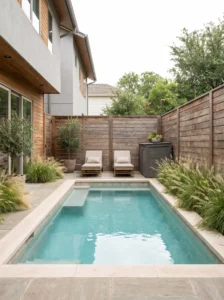
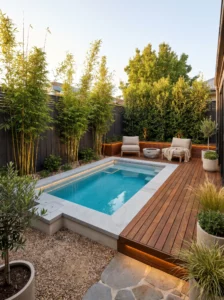
A plunge pool is built for cooling off rather than swimming, and that single decision is what lets it shrink. Most run somewhere around 8 by 12 feet, with a depth near 4 to 5 feet, enough to stand, sit on a ledge, and float. Small footprint, genuine pool feel.
It suits narrow side yards, tight townhouse lots, and corners where a conventional pool would never fit. Concrete, fiberglass, and tile finishes all work, and a bench running along one side makes it more comfortable than a bare rectangle. Pale interiors keep the water bright, while darker ones look more like a natural pond.
Place it where it gets decent sun but not full afternoon glare, and keep the equipment pad out of sight behind a screen or a tidy fence panel. People often skimp on the surrounding space. Leave at least a few feet of deck or paving on the longer sides so you can walk around it without feeling like you’re stepping into the water by accident.
The daily payoff is the quick dip. You can be in and out in ten minutes after work, without a cover-removal ritual or a cleaning marathon.
2. A Stock Tank Pool
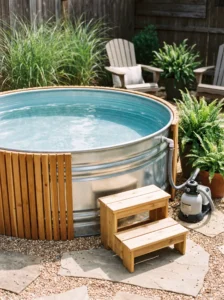
Galvanized stock tanks became popular for a good reason: they cost a fraction of a traditional pool and arrive ready to fill. A round tank around 8 feet across holds a few adults sitting up to their shoulders, and sizes go down from there for tighter patios.
They work best on flat, firm ground. Gravel, pavers, or a compacted base underneath keeps the tank level and stops it from settling. Fill it with a hose, run a small filter pump to keep the water clear, and add a cover for nights and cold weeks.
Style depends on what surrounds it. Wrap it in cedar slats for a cleaner look, or keep the raw metal and plant ferns and tall grasses around it for a farmhouse feel. A simple step stool or built-in stair saves a lot of awkward climbing.
Mistakes to avoid include skipping the filter, which turns the water green faster than you’d expect, and placing it under a messy tree. Leaves and sap are a constant chore. For households that want something low-commitment, it’s a fun, practical way to test how much you’d actually use a pool.
3. A Swim Spa
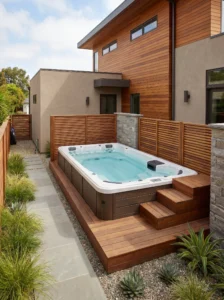
If exercise is part of the appeal, a swim spa gives you a small tank with a current to swim against, so a pool the size of a parked car still delivers a real workout. The jets create resistance, and you swim in place instead of turning at the end of a lane.
Models vary from compact versions to longer ones, so measure the space and the access route before ordering. Some sit above ground on a firm pad, while others are sunk partially into a deck. Heated versions extend the season into cool months, which is where they pull ahead of most small pools.
Think about noise and power. The pumps run harder than a standard soaking tub, and the electrical supply needs to be installed by a licensed electrician. Place it away from bedroom windows if neighbors are close.
A common mistake is buying the longest model that technically fits, then discovering there’s no room left to climb in and out. Leave clear access on at least one side.
Used consistently, it doubles as a therapy pool for sore muscles and a morning lap spot, which is why it tends to get used more than a plain pool.
4. A Narrow Lap Pool Along the Fence
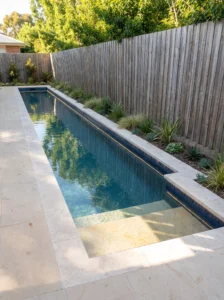
When the yard is long and skinny, a narrow lap pool follows the shape instead of fighting it. Think 8 to 10 feet wide and as long as you can manage, running parallel to the fence or house.
It’s a clean, contemporary look. Straight edges, a single color of tile, and a long bench or planter on one side give it a modern, architectural feel. Light-colored coping stones and a dark interior make a striking contrast, and a few recessed lights bring it to life after sunset.
For swimming, aim for at least 25 feet of usable length if you can. For simple cooling off, shorter works fine. Add a ledge at one end so kids or guests have somewhere shallow to sit.
Don’t ignore drainage. Long, narrow pools can shift water toward one side during rain, and a poorly planned deck pools it against the house wall. Slope the surrounding paving away from the structure.
The unexpected perk is how it reads from inside. Looking out a window, a long strip of water acts like a reflecting pool, making a modest backyard feel longer than it is.
5. A Cocktail Pool With a Tanning Ledge
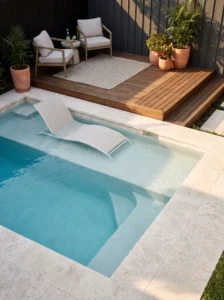
A cocktail pool is a small, shallow, social pool designed for lounging rather than swimming. Typical depth is around 3 to 4 feet, with a built-in ledge a few inches under the surface, perfect for a lounge chair or a low seat.
It suits small backyards because the whole thing is only as large as a generous patio table plus a couple of chairs. Pair it with a compact deck, a few planters, and an outdoor rug on the dry side, and it’s more of a living room than a pool.
Choose light finishes if the ledge will see lots of sun, since darker surfaces can get warm quickly. Slip-resistant tile or textured coping matters here, because wet feet and shallow steps go together.
The usual mistake is making the ledge too narrow. About 12 to 18 inches is a comfortable minimum for a lounger’s feet, and more if you want to sit without sliding.
Guests tend to love it. Drinks stay within reach, the kids stay safe on the ledge, and the adults stay cool without ever swimming a stroke.
6. A Spool, the Pool and Spa Hybrid
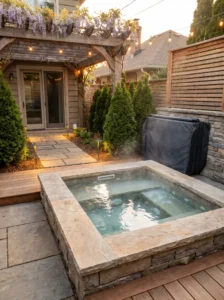
A spool sits between a hot tub and a plunge pool: roomier than a spa, cozier than a pool. It usually has jets, bench seating, and a heater, so you can use it year-round.
It works best in colder climates where a cold-water-only pool would sit idle for half the year. Dimensions typically run around 7 by 12 feet, though many manufacturers offer variations. It can be built in concrete or purchased as a fiberglass shell.
Placement is a design decision. Because you’ll use it in cooler weather, put it near the house door, with a short, well-lit walk. A pergola, privacy screen, or a few evergreen shrubs make it feel sheltered.
Be honest about running costs. Heating water through the winter adds up, so a good insulated cover isn’t a luxury but a requirement. Check the heater’s rating and your local energy prices before you commit.
A hybrid like this tends to change habits. Instead of an occasional summer dip, people end up sitting in warm water on a frosty evening, which is the moment they stop calling it a luxury.
7. A Pre-Made Fiberglass Pool
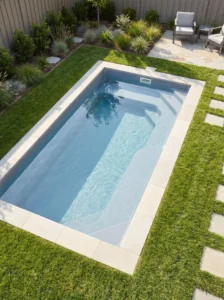
Fiberglass shells come from the factory in one piece, which speeds up installation and keeps the surface smooth. Small models start around the size of a large bathtub and run up to compact swimming lengths, with built-in benches, steps, and tanning shelves already molded in.
The smooth surface resists algae better than rough plaster, so cleaning is usually quicker. Colors run from white and soft gray to deep blue, and finishes can include a subtle sparkle.
Access is the big limit. The shell travels by truck and often by crane, so overhead wires, tight gates, and low branches matter. Ask the installer to check the route before you order.
Shapes are fixed, so you can’t change the dimensions later. Measure carefully and choose a model with the seating you want, because adding a bench afterward isn’t possible.
For small yards, the advantage is time. A shell can be in the ground and filled in a fraction of the time a poured pool takes, which means fewer weeks of an excavated lawn and fewer surprises with neighbors.
8. An Above-Ground Pool Wrapped in Decking
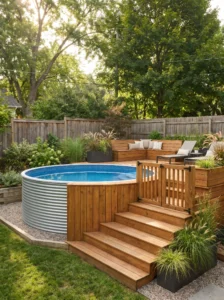
Above-ground pools get a bad reputation, but a good one surrounded by a deck looks entirely different. The deck hides the walls, adds seating, and turns a basic tank into a proper outdoor room.
It suits budgets that rule out digging, as well as rentals and temporary setups where you may move later. Choose a round or oval shape around 12 to 15 feet across for a small yard. Resin or steel frames last longer than thin vinyl-only versions.
Build the deck around at least two sides. Pressure-treated lumber is the cost-friendly option, while composite resists splintering and needs less upkeep. Add a bench along the edge, a few planters, and a low rail with a safety gate.
Common mistakes include placing the pool on uneven ground and underestimating the weight of full water. Prepare a level, firm base, and check local rules, since many places treat above-ground pools like in-ground ones for fencing and safety.
Done well, it feels less like a compromise and more like a smart shortcut, with a good chunk of the savings going into the deck that makes it look intentional.
9. A Natural Plant-Filtered Pool
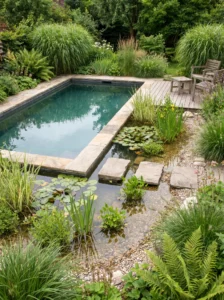
Natural pools replace chemicals with plants and a regeneration zone, a planted shallow area that cleans the water as it circulates. A small version can still fit in a modest backyard if it’s designed with care.
It suits people who want a garden feel and dislike chlorine. The look is softer: stone edges, gravel beaches, water lilies, and tall grasses at the margin. Fish aren’t required, though small ones can help control insects.
Expect a larger footprint than a conventional plunge pool, since the plant zone typically needs space of its own. A rough rule is to reserve part of the surface area for filtration, so a tiny yard may only fit a very compact system.
Mistakes include skipping professional design. Water chemistry and planting depth are easy to get wrong, and a poorly balanced system turns murky.
The reward is a pool that changes with the seasons, with dragonflies, rustling reeds, and a calm, garden-like atmosphere. People often describe it as a pond they can swim in, which says it all.
10. A Courtyard Pool With a Water Feature Wall
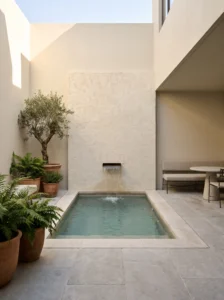
In an enclosed courtyard, a small pool paired with a wall-mounted fountain or sheet-falling spout adds sound and movement without needing space. The splash masks street noise, and the whole area feels cooler.
It suits narrow courtyards, town homes, and walled gardens where the backdrop is already there. A simple rectangular pool around 6 by 10 feet, backed by a stucco or stone wall with a slim spout, creates a resort-like focal point.
Keep materials limited. Light stone coping, one tile color, and a quiet planting scheme of ferns, olive, or bamboo in containers let the water do the talking. Tuck the pump discreetly behind the wall.
Mind the noise level. A strong spout sounds lovely at first but can irritate over time, so test the flow before finalizing. A gentler trickle is easier to live with, particularly in a space with neighbors close by.
On an ordinary evening, the effect is surprising. A small pool and a quiet fountain make a patio feel like a retreat, and people start eating dinner outside again.
11. A Dark-Finish Pool for Depth and Drama
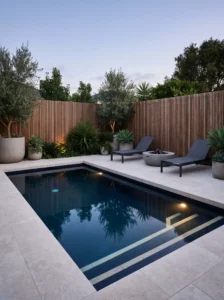
Interior color changes how big a pool looks and how it fits the yard. A dark interior, in charcoal, deep green, or midnight blue, reflects the sky and surroundings, giving a tiny pool a mirror-like surface that feels larger than it is.
It works best with modern or minimalist backyards. Pale decking and simple planting offset the dark water, and the contrast photographs beautifully. Choose a finish designed for pools, such as dark plaster, fine glass tile, or a pigmented fiberglass gelcoat.
The trade-off is heat and visibility. Dark water absorbs more sunlight, which can make it warmer, a plus in cooler regions and a minus in hot ones. Dirt and debris show up easily, so skimming becomes part of the routine.
A mistake is choosing a dark finish without thinking about safety. Very dark water makes it harder to see the bottom, so ensure steps and ledges have visible edges and good lighting.
At night, with underwater lights, the surface glows. It has a quiet, upscale look that makes a small pool feel considered rather than squeezed in.
12. Layered Lighting and Privacy Planting
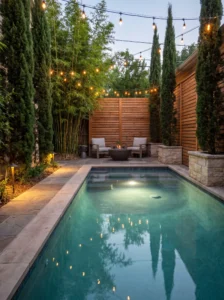
A small pool in a close-quarters yard often fails because people feel watched, not because of the water itself. Privacy and lighting turn a pool from a visible hole in the yard into a retreat.
Start with the screen. Tall, narrow plants such as clumping bamboo in containers, columnar evergreens, or slatted wood panels block sightlines without taking much ground. Avoid plants that drop lots of leaves into the water.
Then add layered lighting. A pair of low-voltage underwater lights, a few path lights, and string lights overhead give the space a gentle, warm glow. Keep the colors warm and the brightness low so neighbors don’t feel the glare.
Check rules around fencing, gates, and barriers before building any screen. Safety requirements often dictate heights and latching, and your screen may need to be in addition to, not instead of, the required fence.
Evenings are where this pays off. With soft light on the water and a green screen around the edge, the yard feels private, and a dip after dinner becomes something you’ll plan around.
Quick Comparison: Which Tiny Pool Type Suits You?
| Type | Best Use | Material | Style/Vibe | Difficulty Level |
|---|---|---|---|---|
| Plunge pool | Cooling off in tight yards | Concrete, fiberglass, or tile | Modern, resort-like | Advanced |
| Stock tank pool | Budget trial, casual soaking | Galvanized steel | Rustic, relaxed | Easy |
| Swim spa | Exercise and year-round use | Acrylic shell, insulated cabinet | Sporty, functional | Moderate |
| Fiberglass shell pool | Quick installation, easy cleaning | Fiberglass with gelcoat | Smooth, clean | Moderate |
| Above-ground pool with deck | Budget-friendly, renters | Steel or resin frame, wood or composite deck | Casual, backyard-friendly | Moderate |
| Natural plant-filtered pool | Garden lovers, chemical-free swimming | Stone, liner, plants | Organic, wild | Advanced |
How to Choose the Right Tiny Pool
Start with the space around the pool, not the pool itself. Measure the yard, then mark the footprint with rope or spray paint and live with it for a few days. You need room for walking, equipment, and furniture, and you’ll discover quickly whether it feels cramped.
Match the type to how you’ll actually use it. If you want to float and cool off, a plunge pool or stock tank will do. If you want exercise, a swim spa makes more sense. For year-round soaking, consider a spool with a heater.
Materials come down to durability and upkeep. Concrete is custom and long-lasting but takes longer to build. Fiberglass is quick to install with a smooth, easy-to-clean surface. Steel tanks and above-ground frames are affordable but may need replacing sooner. Whatever the shell, ask about warranties and what they cover.
Think about ongoing costs, too. Pumps, heaters, chemicals, covers, and electricity add up, so compare the total cost over several years rather than just the purchase price. A cheaper pool with high running costs isn’t always cheaper.
Budget for the extras: fencing, gates, access for equipment, electrical work, landscaping, and permits. People often set aside money for the pool and forget everything around it.
Quality versus price matters most in the parts you can’t easily replace, such as the shell, plumbing, and electrical work. Save on furniture, planters, and accessories, which are easy to upgrade later.
Common regrets include skipping a cover, picking a pool that’s too big for the yard, ignoring access for delivery, and forgetting to check local rules. Get several quotes, ask to see completed projects, and take your time.
Wrapping It Up
A small yard doesn’t rule out a pool. It just changes the question from “how big can I go?” to “what do I actually want from it?” A plunge pool, stock tank, or cocktail pool handles cooling off. A swim spa gives you exercise. A spool stretches the season, and a courtyard pool with a quiet water feature turns a tight space into a retreat.
Whatever you choose, the details around the water carry most of the weight: a safe fence, a firm base, discreet equipment, privacy planting, and light for evenings. Those choices separate a pool that feels designed from one that was squeezed in.
Start with your real habits. If you’d use it mainly for quick dips, keep it small and simple. If you’d soak year-round, build in heat and a good cover. Check local rules early, since fence and setback requirements shape what’s possible, and request written quotes that spell out what’s included.
Before committing, mark the outline in the yard, set out chairs where the pool would go, and spend an evening there. You’ll learn more from that than from any drawing.
A small pool that fits well gets used far more often than a large one that dominates the yard. When you find yourself heading outside after work without a second thought, you’ve made the right choice.
FAQs
How much space do I need for a small pool?
A plunge pool or stock tank can fit in an area around 8 by 12 feet, plus room to walk around. Always add space for equipment, a fence, and access. Local setback rules may change what’s allowed.
Do tiny pools need fences?
In most places, yes. Many areas require barriers around any pool above a certain water depth, including some portable ones. Check your local rules before you buy anything.
Are stock tank pools safe and durable?
They can be a reliable, low-cost option if installed on a level base and kept clean with a filter. Galvanized steel can rust or scratch over time, so check the finish and inspect it regularly.
Is a plunge pool worth it?
For cooling off and relaxing, many people find it’s well worth the cost. It’s less suited to swimming laps. Think about how you’d use it most days.
How much does it cost to maintain a small pool?
It depends on the type, climate, and equipment. Expect costs for chemicals, power, cleaning, and a cover. Get an estimate from the supplier, and compare long-term costs, not just the upfront price.
Can I heat a small pool?
Yes. Plunge pools, spools, and swim spas can be heated, and small volumes warm up faster than large ones. An insulated cover keeps heating costs lower.
What is the biggest mistake with small pools?
Overlooking the space around it. People focus on the water and forget about walkways, equipment, fencing, and seating. Mark everything out first, and leave comfortable room on at least two sides.
Do I need a permit to build a small pool?
Often, yes, even for modest sizes. Rules differ by town and sometimes by pool type, so call your local building office early. Your installer can usually guide you through the paperwork.