A piano looks like the hardest piece of furniture to place in a living room. It’s big, it’s heavy, and you can’t just shove it into a corner and forget about it. Here’s the good news, though: most living rooms already have a spot that works. An upright piano needs about 5 feet of wall, roughly 2 feet of depth, and enough room to pull out the bench. If you have that, you have options.
The trick is to stop thinking of the piano as a problem and start treating it like any other large piece — a sofa, a bookcase, a fireplace. Each one earns its place by sitting where it gets used, where it gets light, and where it doesn’t block the way you move through the room. Walk through the 12 spots below in order, from the window to the middle of the room, and you’ll find the one that matches your floor plan.
1. By the Window: Let Daylight Do the Work
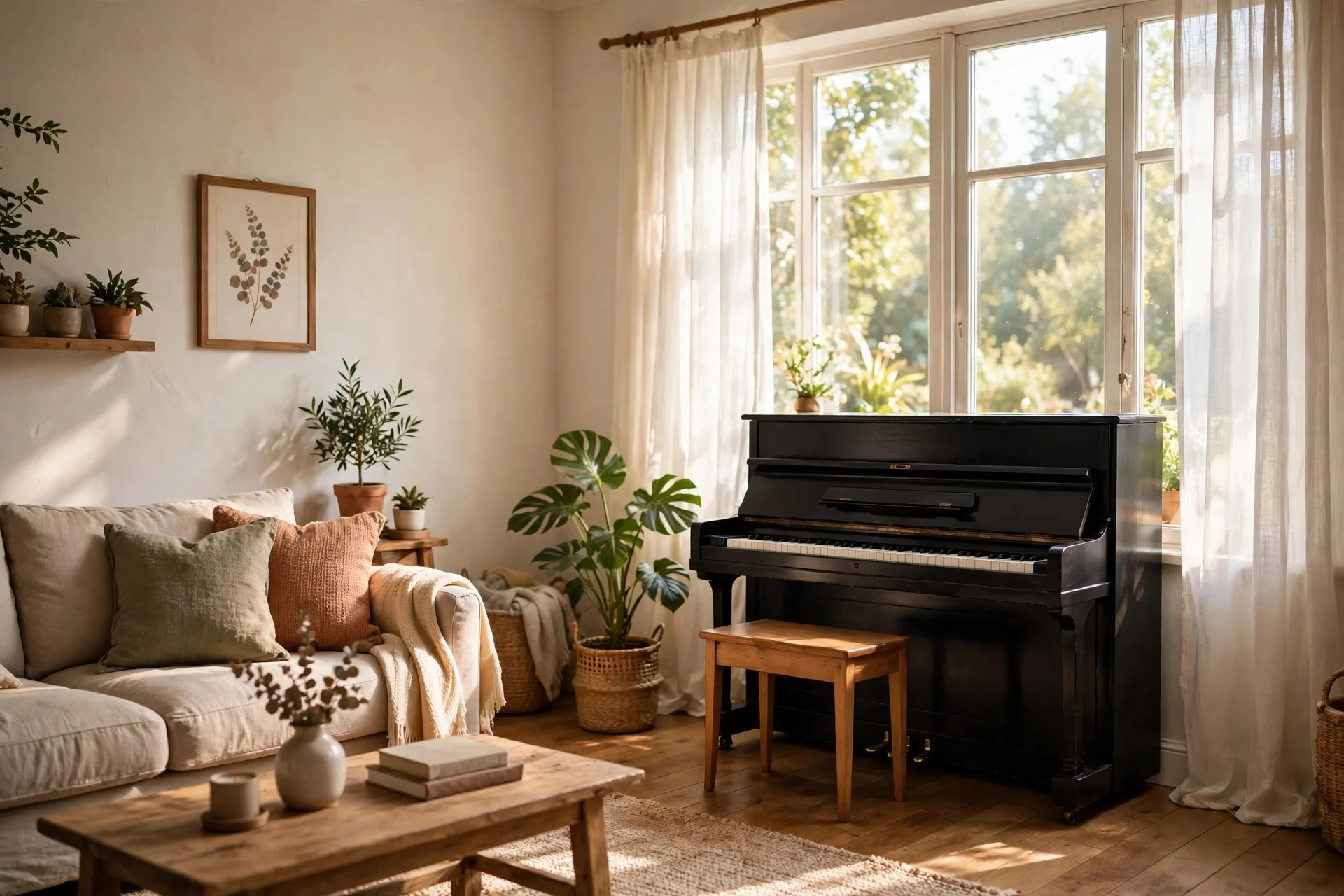
Start your walk at the window, because this is often the easiest win. An upright piano beside a large window gets natural light on the keys during the day, which makes practice far more pleasant, and the window frames the piano the way art frames a wall.
This is a weekend-afternoon job if the piano is already in the room — you’re mostly shifting furniture and hanging a curtain. Budget $30 to $120 for sheer curtains, which matter more than you’d think: they soften the light and keep direct sun off the piano’s finish. Tip: sit at the keys at different times of day before you commit, so you know when glare hits the music stand. Watch out for radiators under the window, since steady heat dries out the wood and throws tuning off faster.
2. Against the Long Wall: Make It the Piano Wall
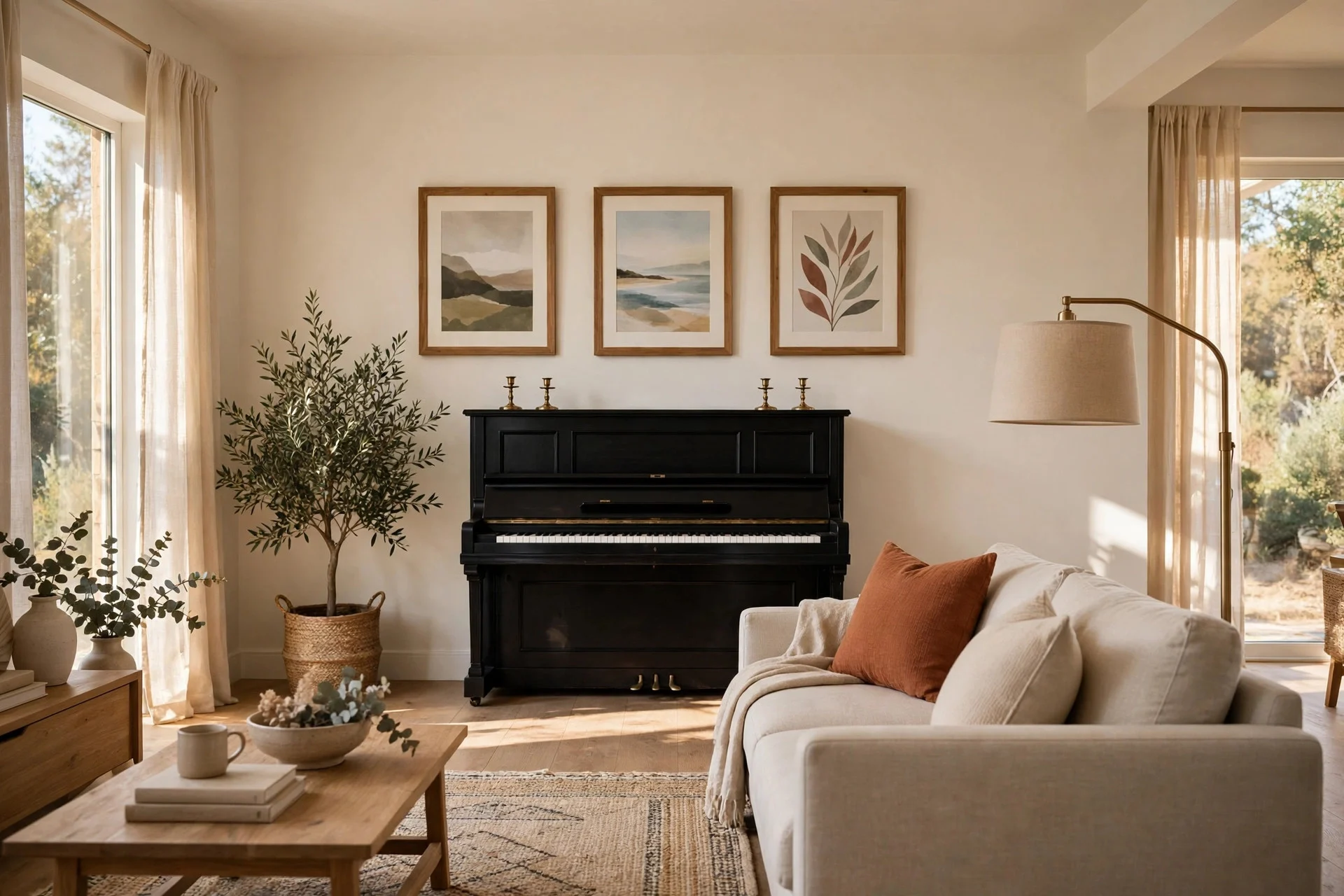
Every living room has one wall that’s longer than the rest, usually the one without a door or a fireplace. Give that wall to the piano. Centering the piano on it, with one piece of art or a pair of framed prints above, turns the instrument into the room’s anchor instead of an afterthought.
Cost stays low here: $40 to $200 for framed art, plus $150 to $400 if you need professional movers to shift the piano into place. Difficulty is easy once the piano is positioned — the rest is decorating. Tip: leave at least a couple of inches between the piano’s back and the wall so air can move and you can get a cloth behind it for dusting. If your wall is long enough, a narrow console or a pair of stools at one end keeps the arrangement from looking lopsided.
3. Tucked Into a Corner You Weren’t Using
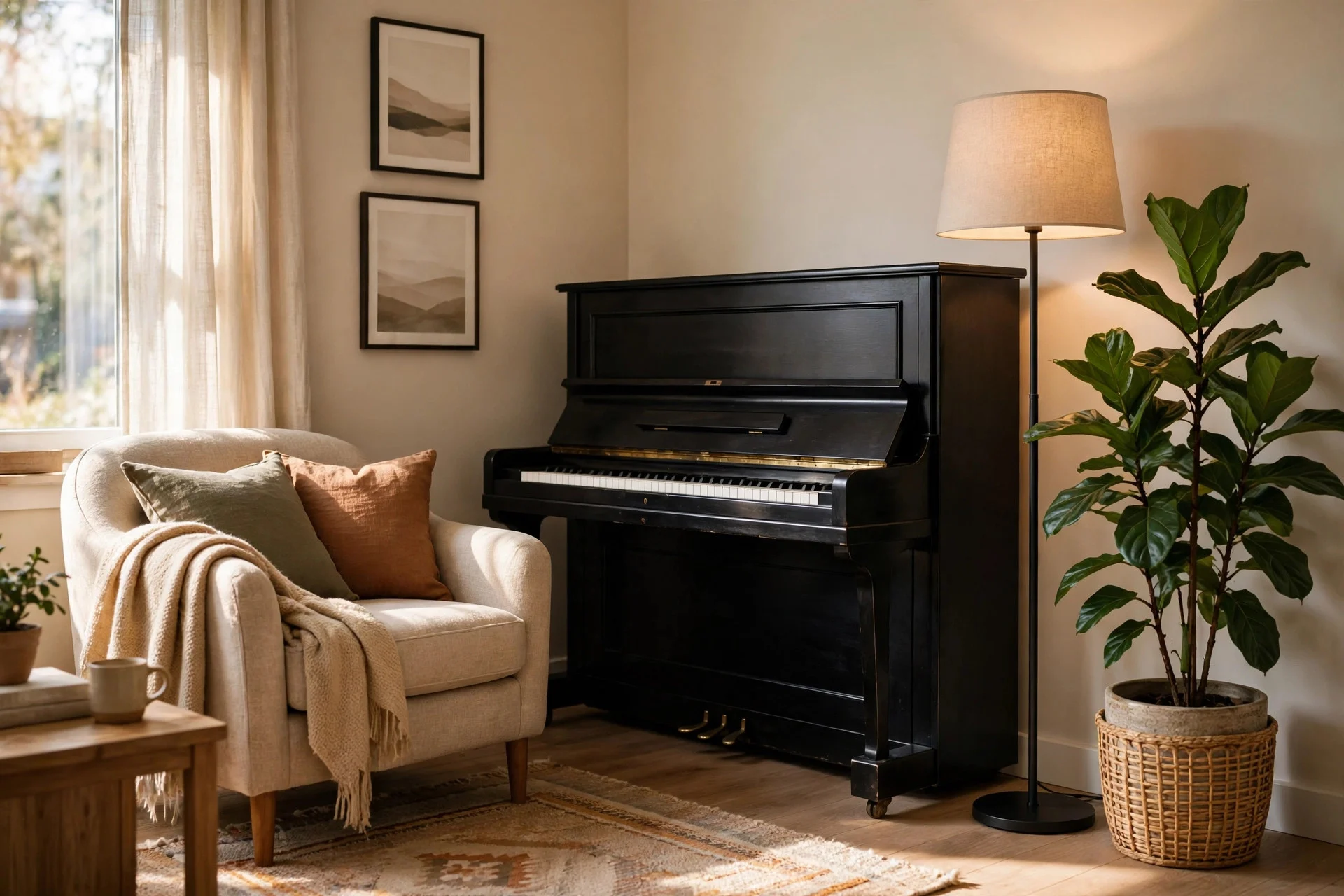
That dead corner — the one with a single chair nobody sits in — is often exactly piano-sized. Angle the upright slightly, so the keyboard faces into the room rather than sitting flat against one wall, and the corner becomes a small music station instead of wasted space.
Budget $40 to $150 for a good floor lamp and $25 to $80 for a plant in a decent pot. This is one of the simplest placements to try, and it works in rooms as small as 12 by 14 feet. Tip: measure the diagonal before you buy anything, because an angled piano eats more floor than a flat one. Watch out for air vents in the corner — don’t block one, and don’t park the piano where a vent blows warm air straight onto it.
4. As a Divider in an Open-Plan Room
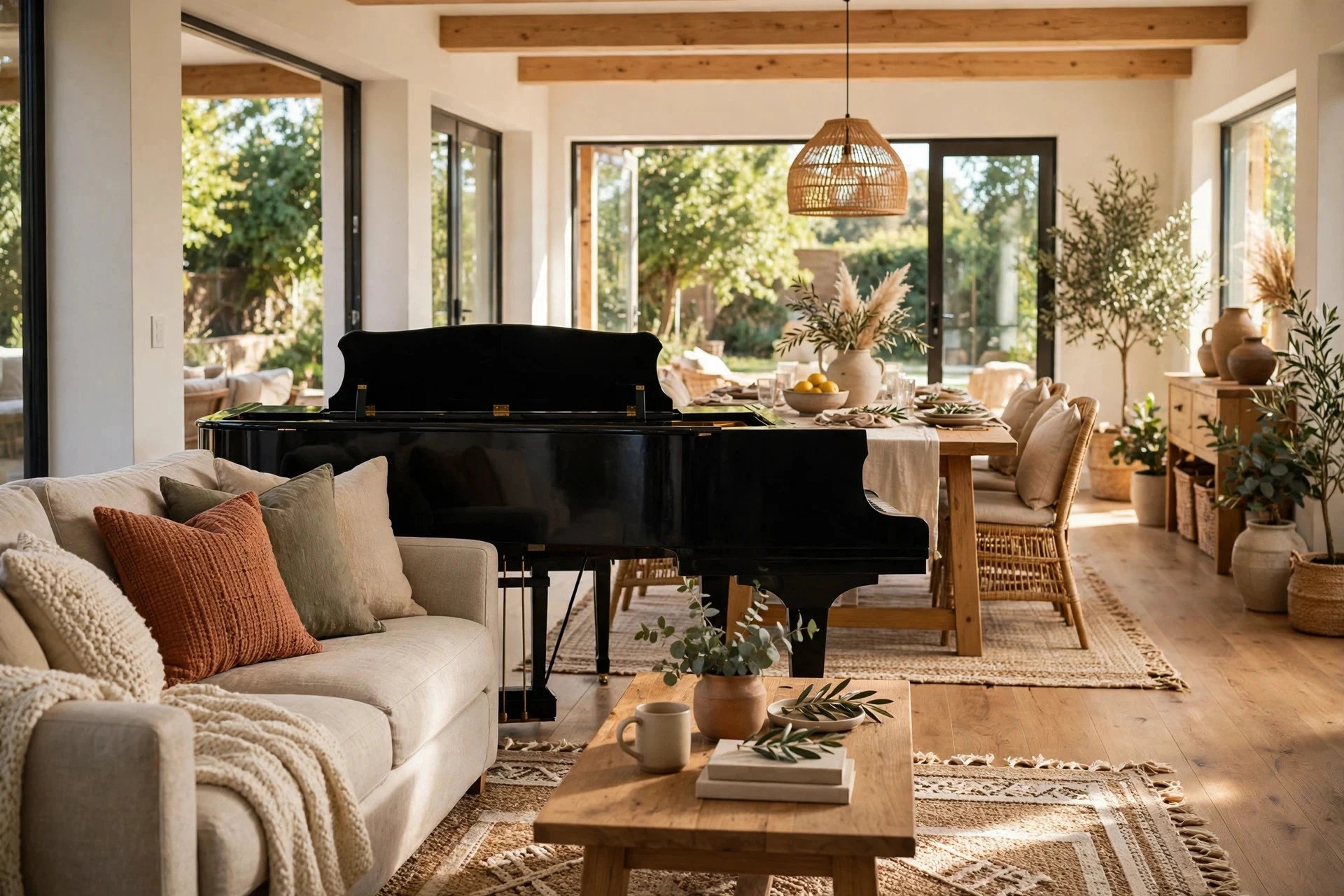
If your living room flows straight into a dining area with no wall between them, a grand piano can do the dividing for you. Set it with its curved side toward the seating and its straight back toward the dining table, and it reads as a beautiful boundary that doesn’t block light or conversation.
This one needs a bigger room — at least 16 feet in the piano’s direction — and moving a grand is a professional job, typically $300 to $800 for a local move. Add $200 to $700 for a rug that anchors the seating side. Tip: keep a clear path of about 3 feet around the curved side so people can walk past without squeezing. Watch out for the lid: when it’s raised, it throws sound toward the dining side, so agree on lid-up and lid-down times if dinner and practice overlap.
5. Beside the Fireplace: Two Focal Points, One Wall
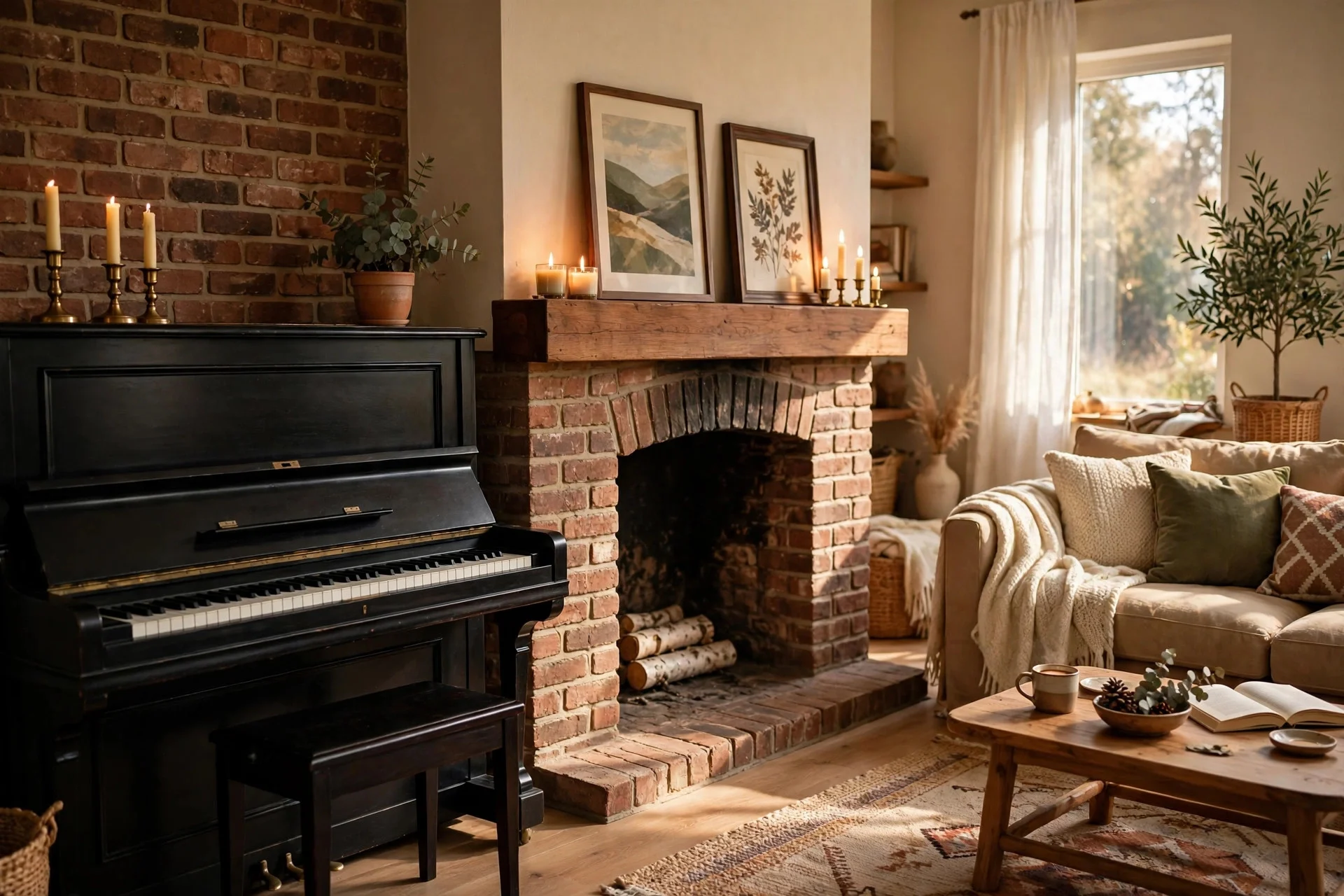
A fireplace and a piano are the two pieces in a living room that naturally draw people toward them, so putting them side by side can work surprisingly well. The piano sits on the wall next to the firebox, the mantel carries a few simple objects, and the seating angles to take in both.
Cost is mostly decorative: $30 to $100 for mantel pieces and a bench cushion. Difficulty is easy, but placement takes a little thought — leave at least a foot between the piano and the firebox surround. Tip: keep the piano’s side away from the hottest part of the fire, and skip this spot if your fireplace throws serious heat sideways. Watch out for soot with a wood-burning fire: a closed lid and a regular wipe-down keep the keys clean.
6. Behind the Sofa: The Piano as a Console
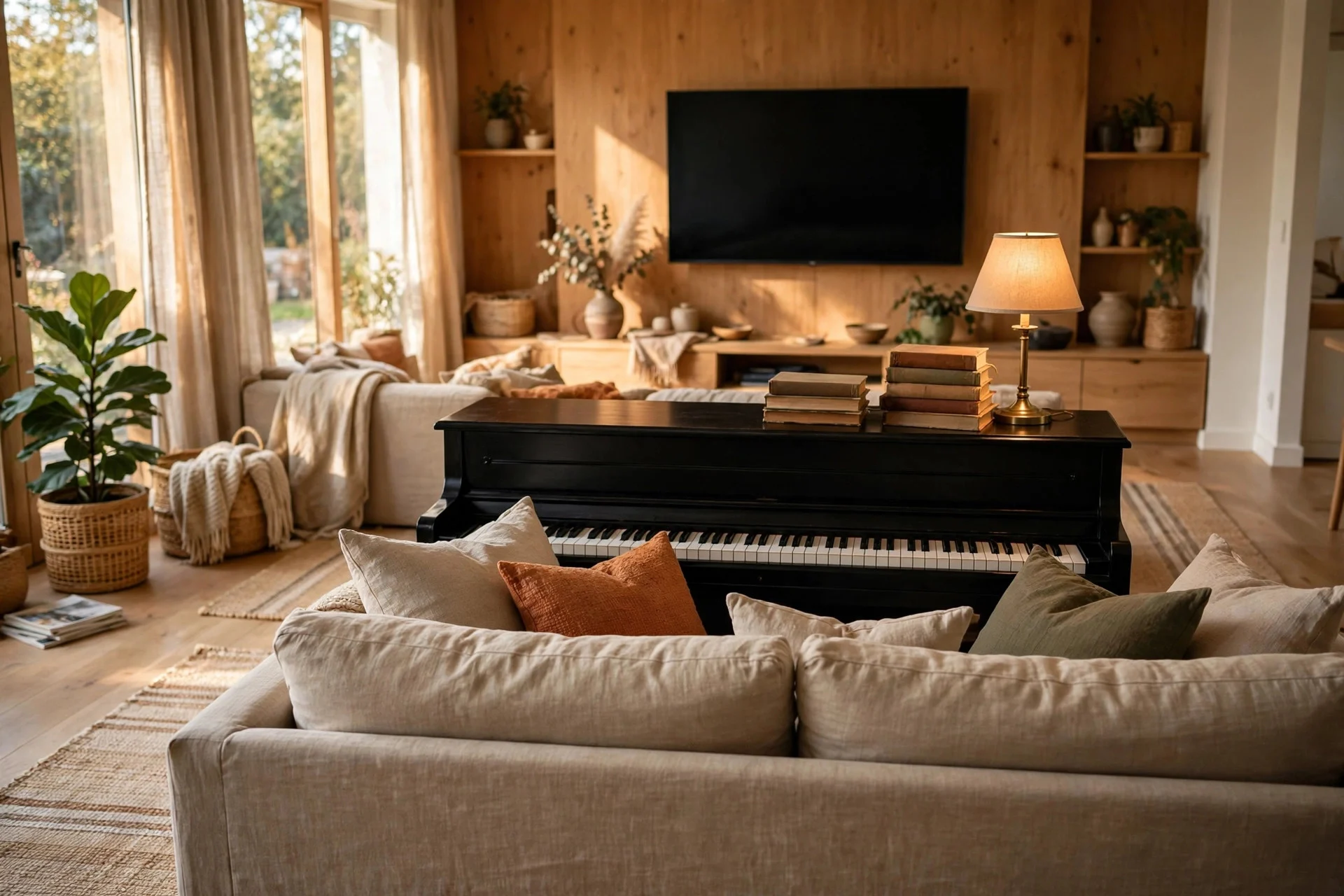
Here’s a placement most people never consider: put the upright directly behind the sofa, like a console table. It works in rooms where the sofa floats in the middle of the floor, facing a TV or a fireplace, because the piano fills the empty space behind it and gives the back of the sofa a finished look.
Budget $30 to $90 for a slim lamp — nothing tall enough to block the TV sightline from the sofa. Difficulty is low, but there’s one real catch: the player needs room to sit. Pull the bench out and check that nobody has to climb over the sofa to reach it. Tip: this setup suits households where the piano gets played a few times a week, not daily, since getting to the bench takes a few extra steps. If the sofa back is low, the piano shows above it and looks deliberate; if the sofa is tall, it hides the piano, so this spot suits low-back sofas best.
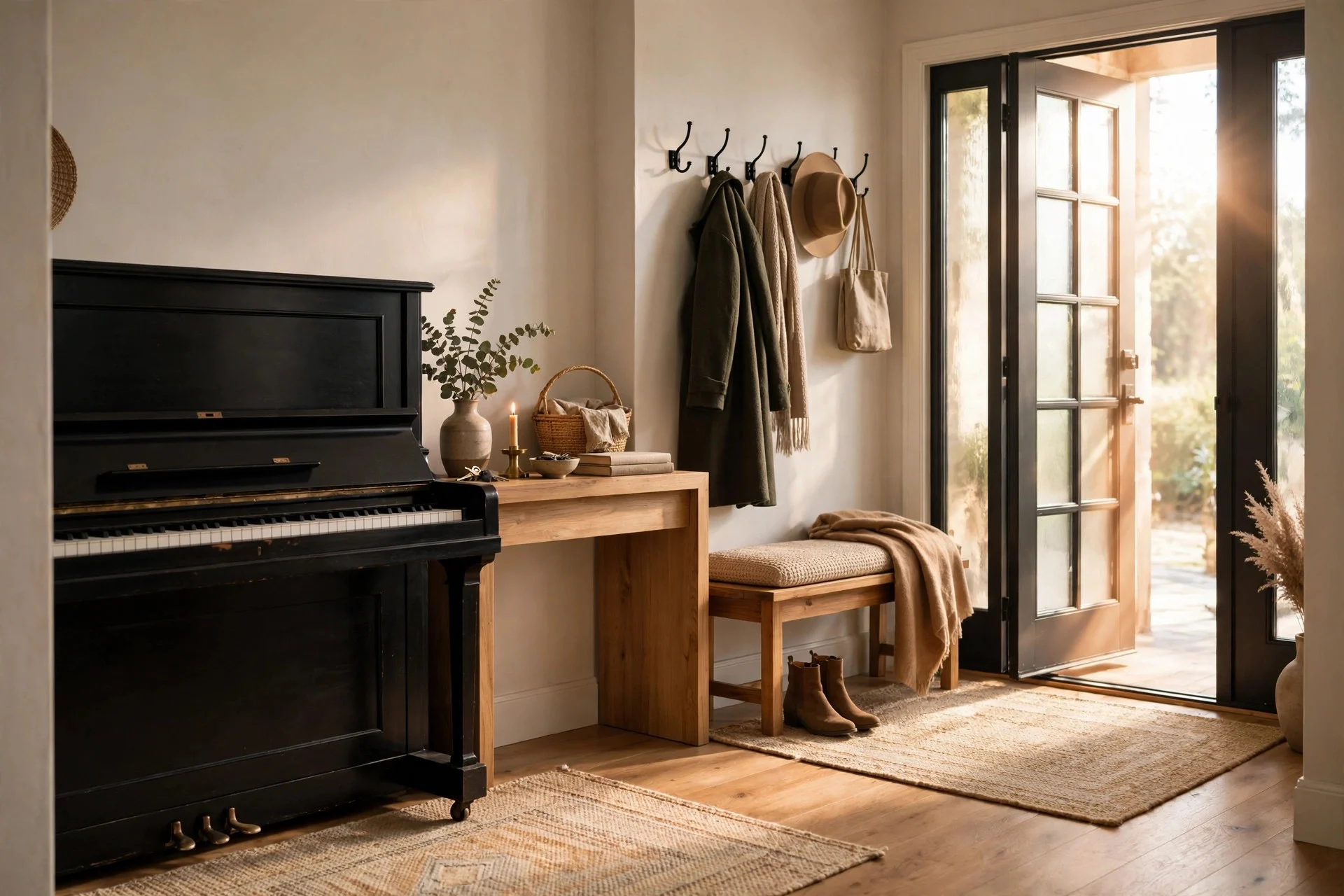
7. In the Nook by the Front Door
Some living rooms open straight off an entryway, and that first stretch of wall is often empty. A piano there makes a strong first impression — guests walk in and see it right away — and it keeps the instrument close to the front of the house, where deliveries and movers can reach it easily.
Budget $80 to $250 for a bench and $60 to $200 for a runner rug. Difficulty is easy. Tip: this spot is ideal if your entry gets good daylight, since it doubles as practice light. Watch out for drafts: a front door that opens often sends cold air straight at the piano, which can affect tuning, so keep a little distance from the door itself and add a draft stopper if yours is leaky.
8. Fitted Into an Alcove or Under the Stairs
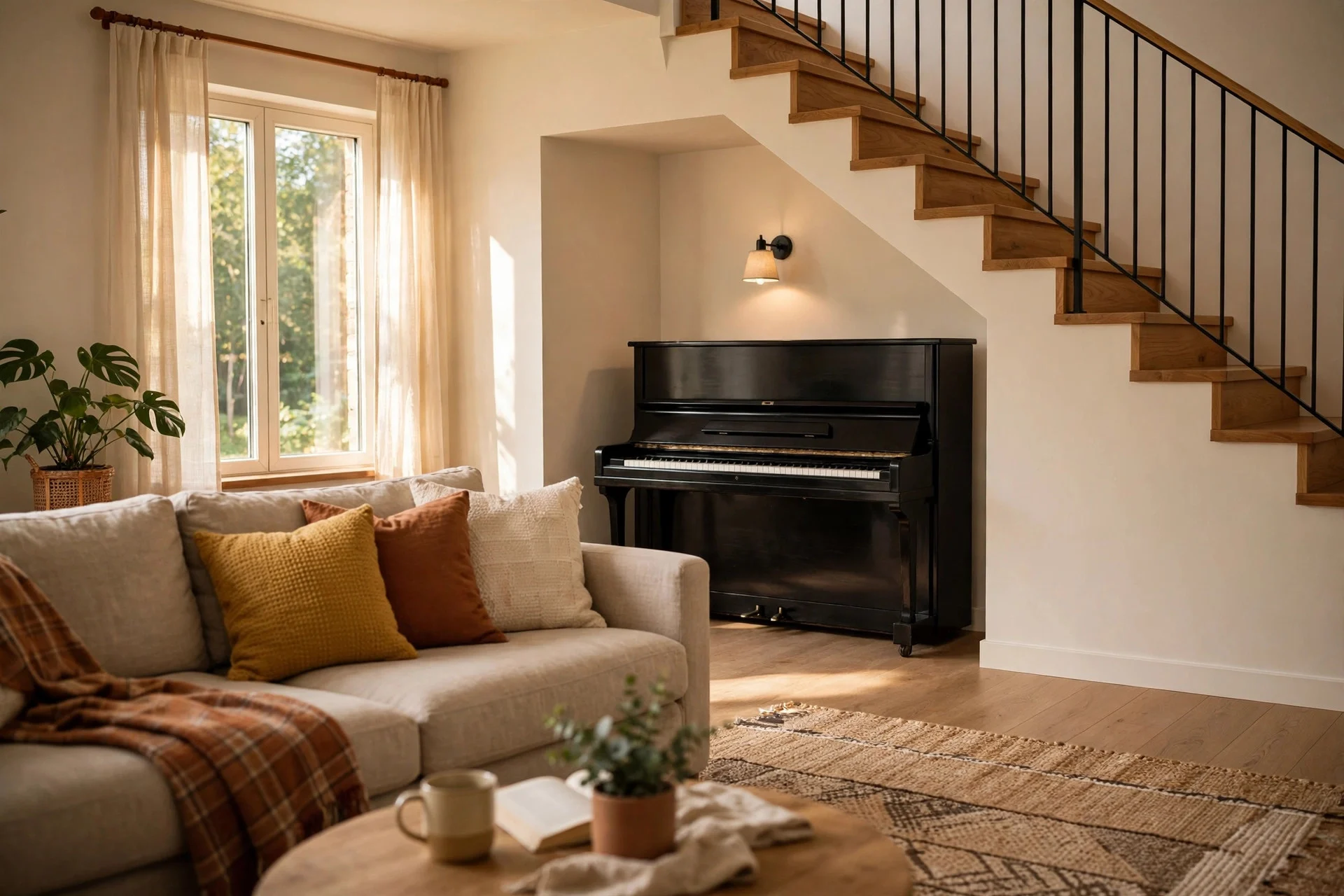
An alcove, a shallow recess, or the space under a staircase is often dismissed as too awkward for furniture — and that’s exactly why it suits an upright piano. The instrument’s height fills the vertical space, the walls on two or three sides make it feel built in, and the rest of the room stays free for seating.
Budget $40 to $120 for a sconce or a plug-in picture light. Before anything else, measure three times: width, depth, and height, including the lid when it’s open. Difficulty is moderate, because getting the piano into a tight alcove usually takes two strong people plus a mover’s dolly. Tip: leave a finger’s width on each side for airflow and for sliding the piano out when it needs tuning. Watch out for headroom under stairs — if the ceiling slopes, check that the tallest corner of the piano still fits with the lid up.
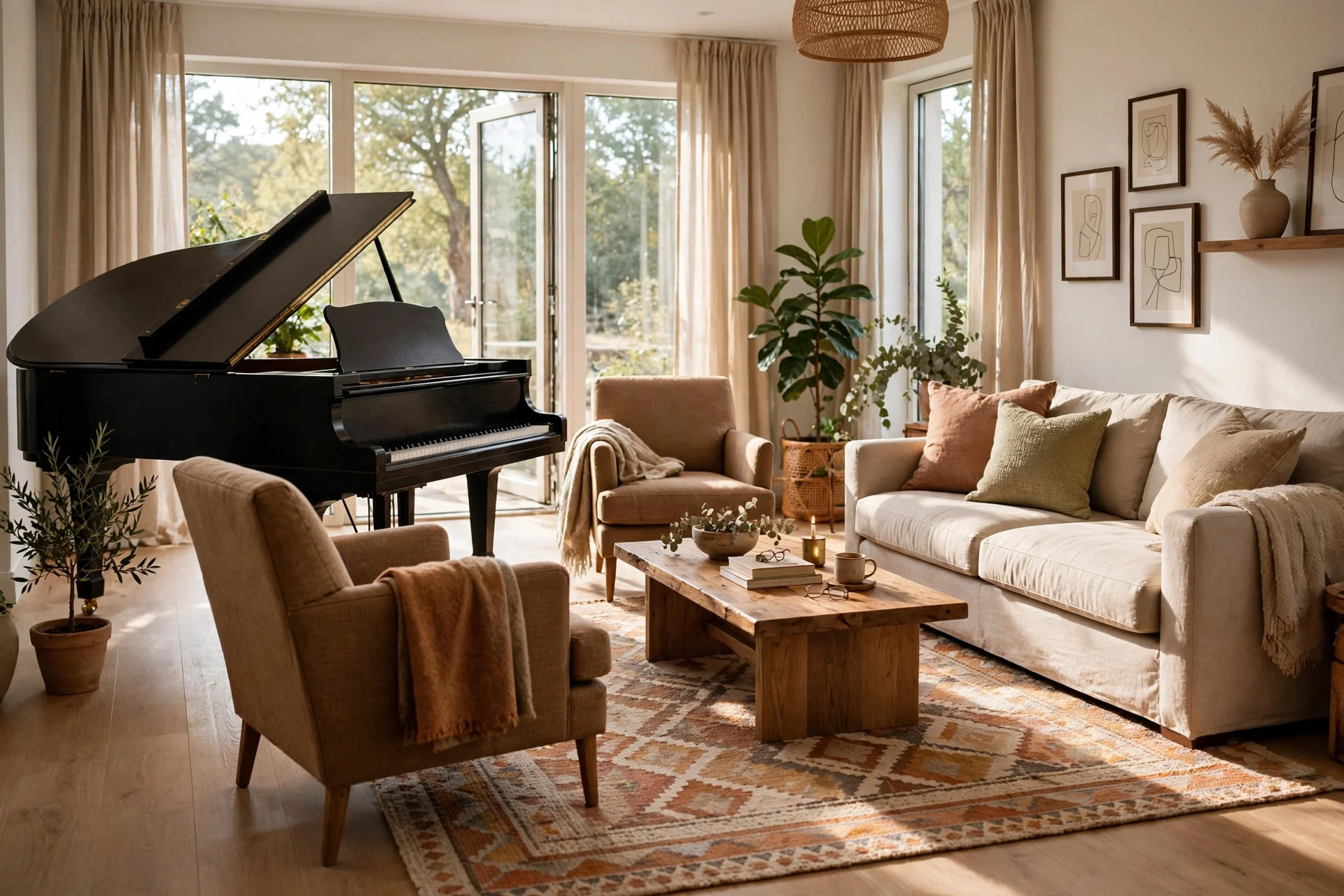
9. Facing the Seating: Let People Watch and Listen
Turn the piano around and let it face the room. With the keyboard toward the sofa and armchairs, the piano becomes the evening’s entertainment — someone plays, everyone else listens, and nobody has their back to the music.
Budget $100 to $300 for an adjustable bench, since players of different heights will share it. Difficulty is easy; you’re really just arranging seating. Tip: angle the armchairs slightly toward the piano instead of lining them up in a stiff row, so the group feels like an audience rather than a waiting room. Watch out for the TV: if the piano faces the seating and the TV hangs on the same wall, the two compete, so pick one focal point for that wall and let the other live elsewhere.
10. Beside a Bay Window: Light on Three Sides
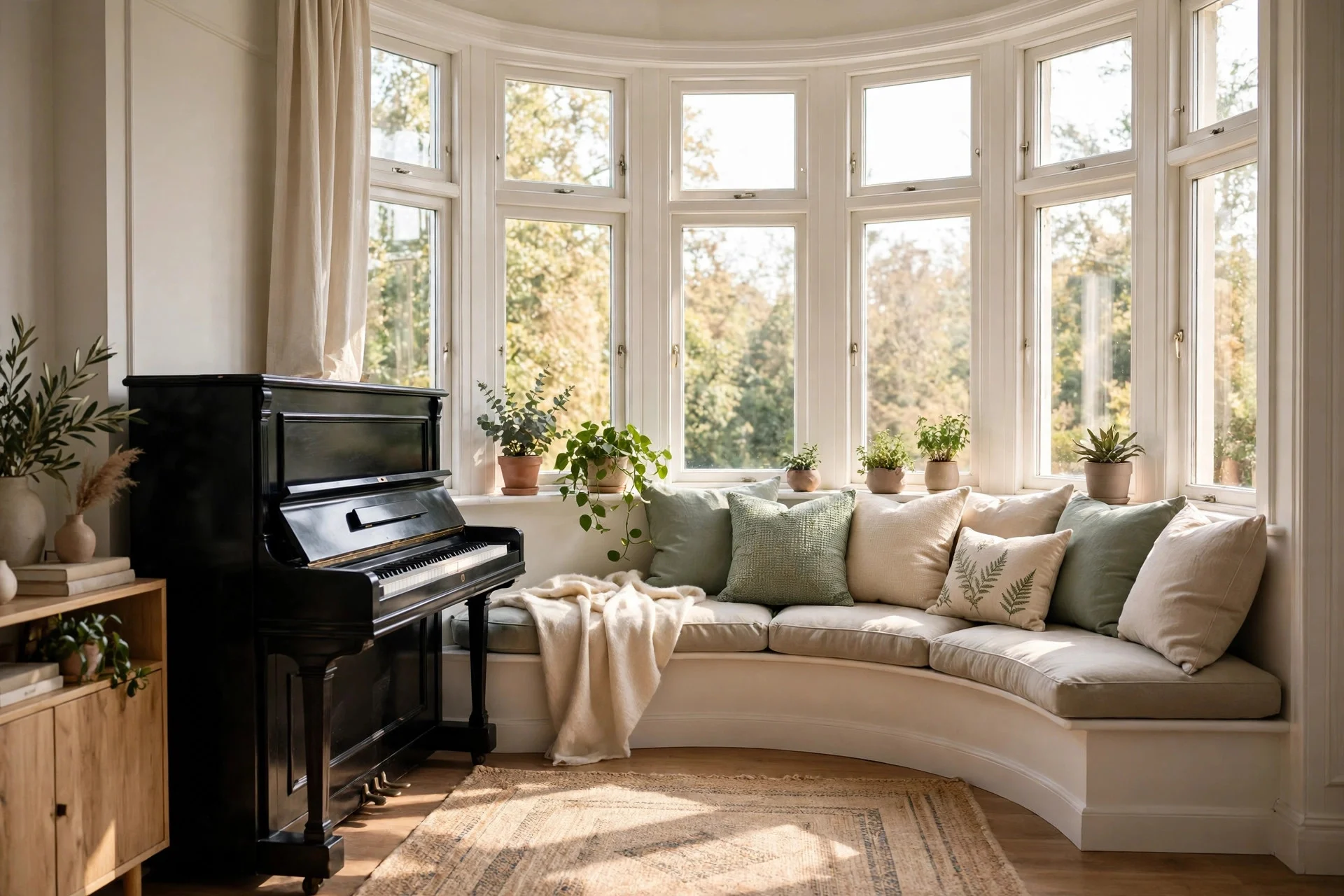
A bay window gives you something no flat wall can: light from three directions and a built-in seat. Put the piano on the wall beside the bay, not inside it, and the player gets daylight without glare on the sheet music. The window seat becomes the audience’s perch, or a reading spot when nobody’s playing, and the whole corner feels bright even on grey days.
Budget $50 to $180 for window-seat cushions if yours are thin or missing. If you’re still planning the window area, these bay window living room ideas show how to dress the seat itself. Difficulty is easy. Tip: keep the piano a step away from the glass, since windows run colder than walls in winter. Watch out for condensation: if your bay windows fog up regularly, wipe the piano’s top more often and keep the room ventilated.
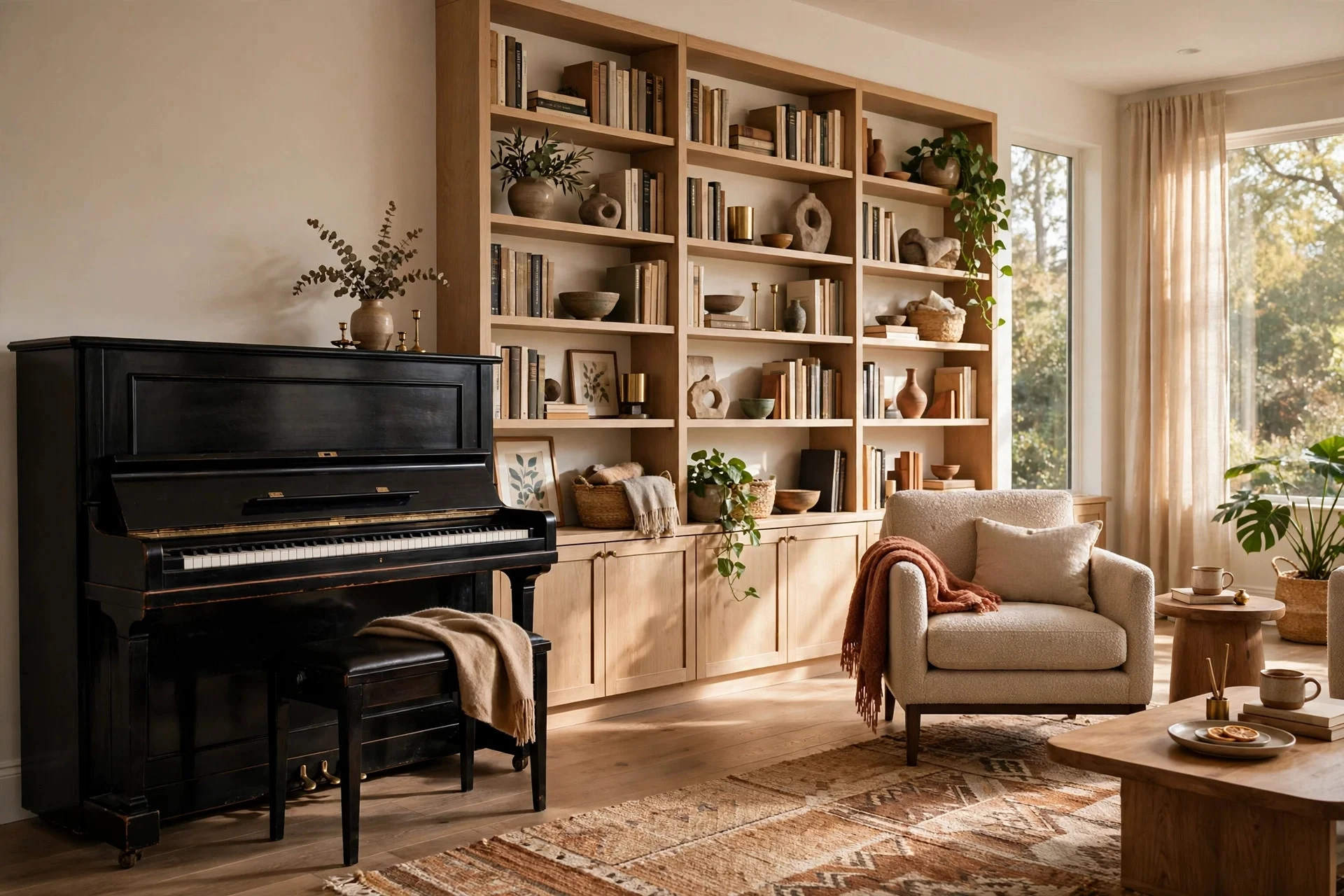
11. Next to the Bookshelves: A Quiet Culture Corner
Pianos and bookshelves belong together. Both are tall, both reward a slow evening, and both look better when they’re styled rather than stuffed. Put the upright at the end of a bookshelf wall, add a reading chair at an angle, and you’ve built a corner for music and reading in one move. The shelf gives the piano a visual partner, so it doesn’t stand alone on a bare wall.
Budget $20 to $80 for a few shelf objects and a plant to break up the rows of books — these living room bookshelf styling ideas cover the basics, and a reading corner chair completes the setup. Difficulty is easy. Tip: leave one shelf at piano-top height empty or lightly styled, so sheet music and a metronome have a home. Watch out for balance: if the bookshelf wall is very tall and dark, paint or paper the wall behind the piano a lighter shade so the corner doesn’t feel heavy.
12. Floating in the Middle of a Large Room
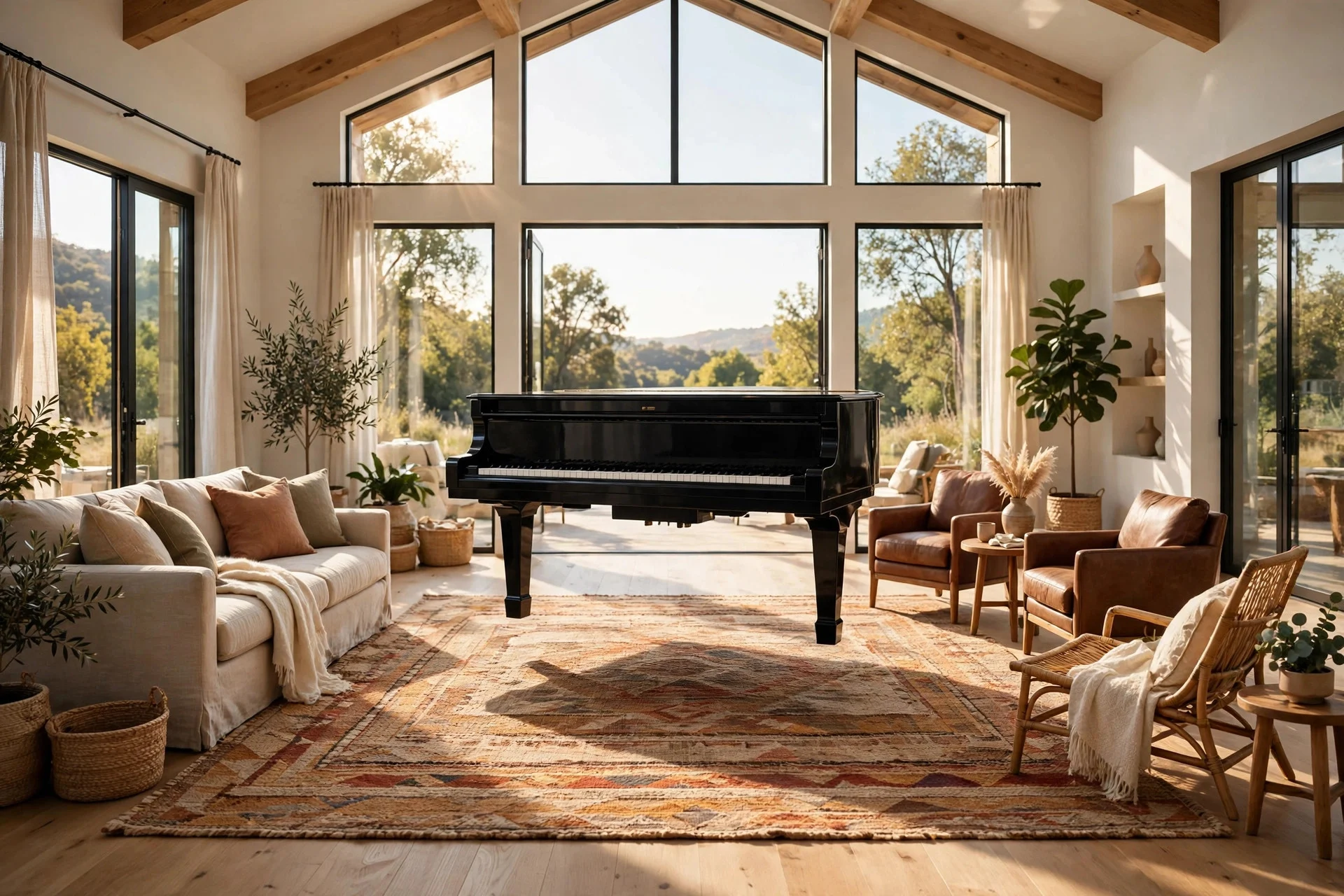
In a genuinely large living room — think 20 feet or more in each direction — a grand piano can float in the center and carry the whole space. Set it on a large rug, arrange seating around it in a loose circle, and the piano becomes the room’s centerpiece the way a dining table anchors a dining room. Nothing else in the room needs to compete, because the piano already holds the eye.
Budget $300 to $900 for a rug big enough to sit fully under the piano and its bench, and $400 to $1,000 for professional movers, since a grand in the middle of a room takes real planning to place. Difficulty is moderate to high — measure doorways, turning circles, and rug size before the movers arrive. Tip: run a floor lamp or a pair of slim table lamps at the room’s edges so the piano isn’t lit by a single harsh ceiling light. Watch out for traffic: keep the main path through the room clear of the piano’s curved side, or everyone will brush past it all day.
Frequently Asked Questions
How much floor space does an upright piano need?
Plan on about 5 feet of wall width and 2 feet of depth for the piano itself, plus another 2 feet in front for the bench and the player’s knees. That works out to roughly 5 by 4 feet of floor. A grand needs more — a baby grand is about 5 feet long, and larger grands run 6 to 9 feet, so measure your room before falling in love with one.
Can a piano go against an outside wall?
It can, but an inside wall is better. Outside walls swing colder in winter and warmer in summer, and those swings make a piano drift out of tune faster. If an outside wall is your only option, leave a small gap behind the piano for air to move, and keep it away from the window on that wall.
Will a piano damage my wood floors?
Usually not, as long as you protect the floor. An upright weighs roughly 500 to 700 pounds and a grand 700 to 1,400 pounds, so use caster cups under the wheels and a rug underneath if the piano sits in one place for years. Roll the piano on its casters only for short moves — for anything further, call a mover.
Is it okay to put a piano near a window or a radiator?
Near a window is fine if direct sun doesn’t fall on it for hours each day; sheer curtains handle that. Radiators, fireplaces, and heating vents are a different story — steady heat dries the wood and the soundboard, so keep the piano at least a few feet from any heat source.
A Quick Checklist Before You Move the Piano
Measure the piano, the wall, and every doorway it has to pass through. Pick an inside wall where you can reach the bench without climbing over furniture. Protect the floor with caster cups or a rug. Plan the light — daylight or a lamp aimed at the music, not at the player’s eyes. Move it with help, not hope: uprights need two or three strong people, grands need professionals. Then let the piano settle for a few weeks before booking a tuning, since a move knocks it out and it needs time to adjust to its new room.