Bay Window Living Room Ideas: 13 Ways to Use That Extra Light
It’s Saturday morning, the coffee is still hot, and the sun is doing something lovely across your living room. Except the brightest corner — that big, beautiful bay window — is sitting there empty. Maybe there’s a sad houseplant on the sill, or a curtain panel that never quite closes. You’ve seen plenty of bay window living room ideas online, but none of them told you the important part: what it takes to build, what it costs, and whether it’ll survive real life.
So here’s a different approach. Each of these 13 setups starts with the scene as you’d see it in a photo, then breaks down the three or four elements that make it work — and exactly how to copy them, with real price ranges, the time involved, and the one thing to watch out for. Start with whichever matches your life right now.
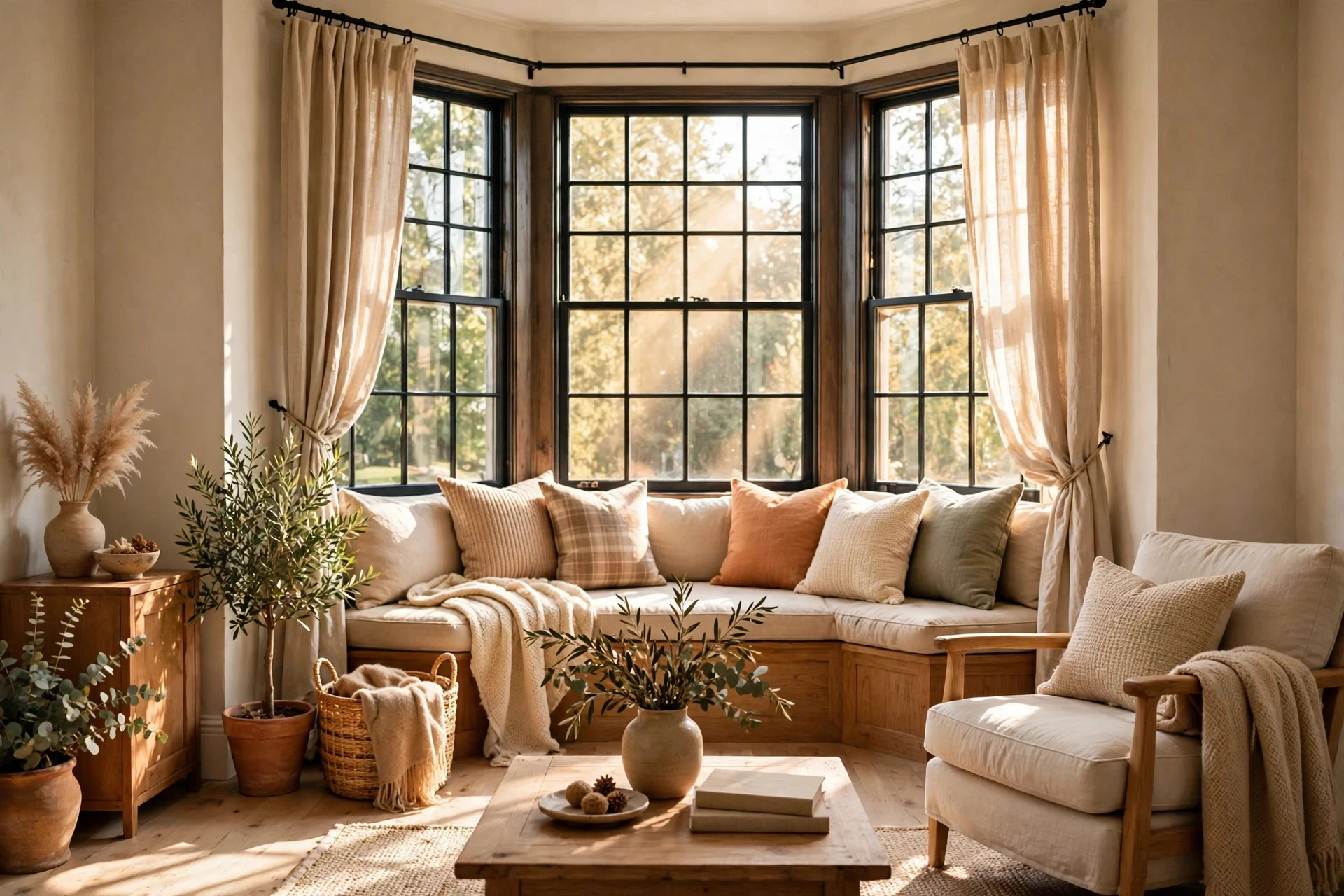
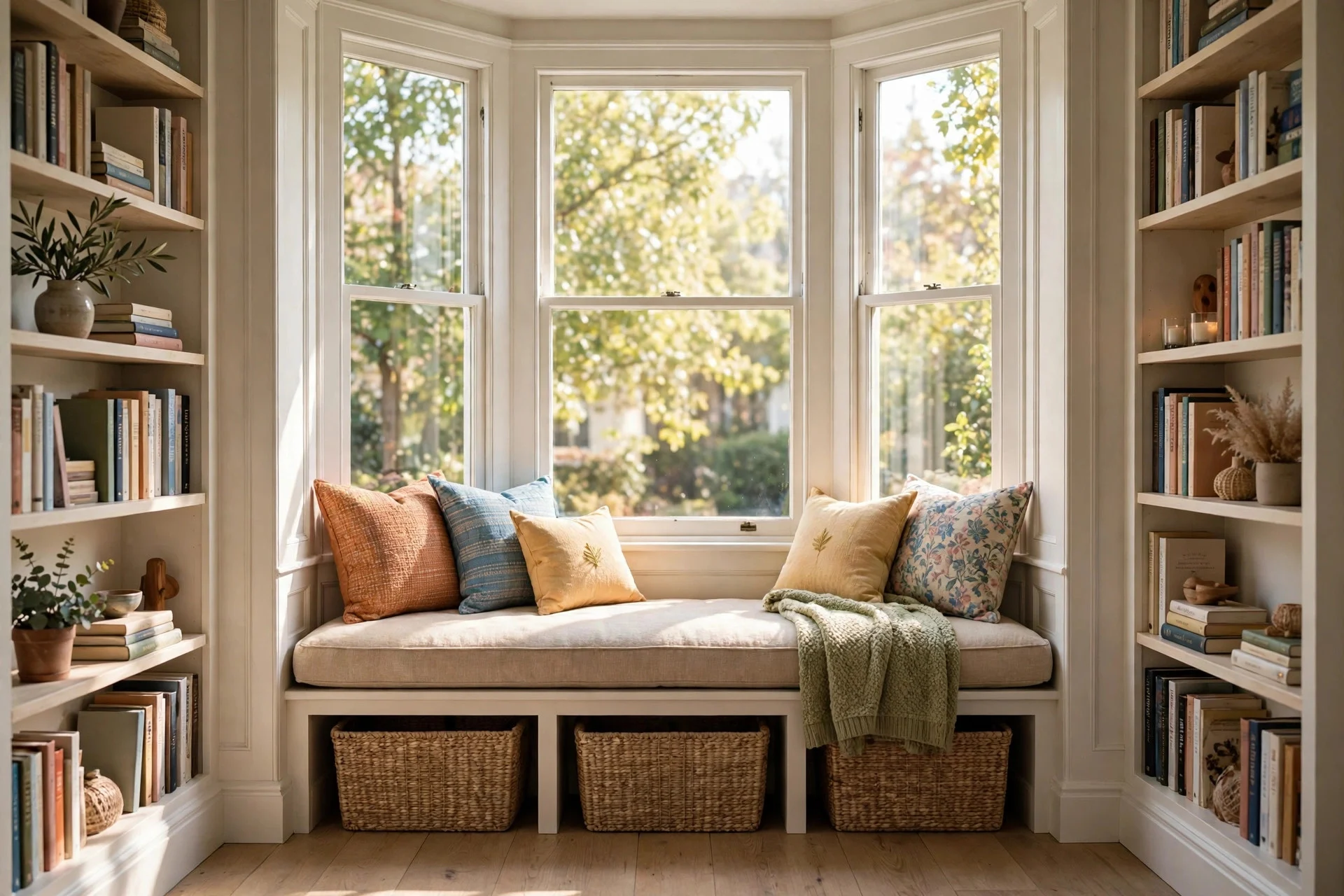
1. The Double-Duty Window Seat
A deep bench runs along the bay under a thick cream cushion, woven baskets tucked beneath, bookcases framing both sides. Morning light hits the throw pillows, and it looks like a library corner.
What makes it work
The bench. Full bay width means seating plus hidden storage in one piece. A proper cushion. Four inches of foam in a washable cover — thin pads slide around and feel cheap. Bookcases either side. They turn a bench into a reading corner, not a ledge. Soft layers. Two or three pillows and a throw make it inviting.
Copy it cheaply
Cost: $300–$700. Skip custom carpentry ($1,500+): join 24-inch-deep stock kitchen base cabinets, top with plywood and a cushion. One weekend, moderate difficulty. Tip: order the cushion an inch short on every side so fabric doesn’t bunch. Watch out: keep total seat height at 18–20 inches — lower, and nobody sits on it.
2. The Two-Chair Talk Spot
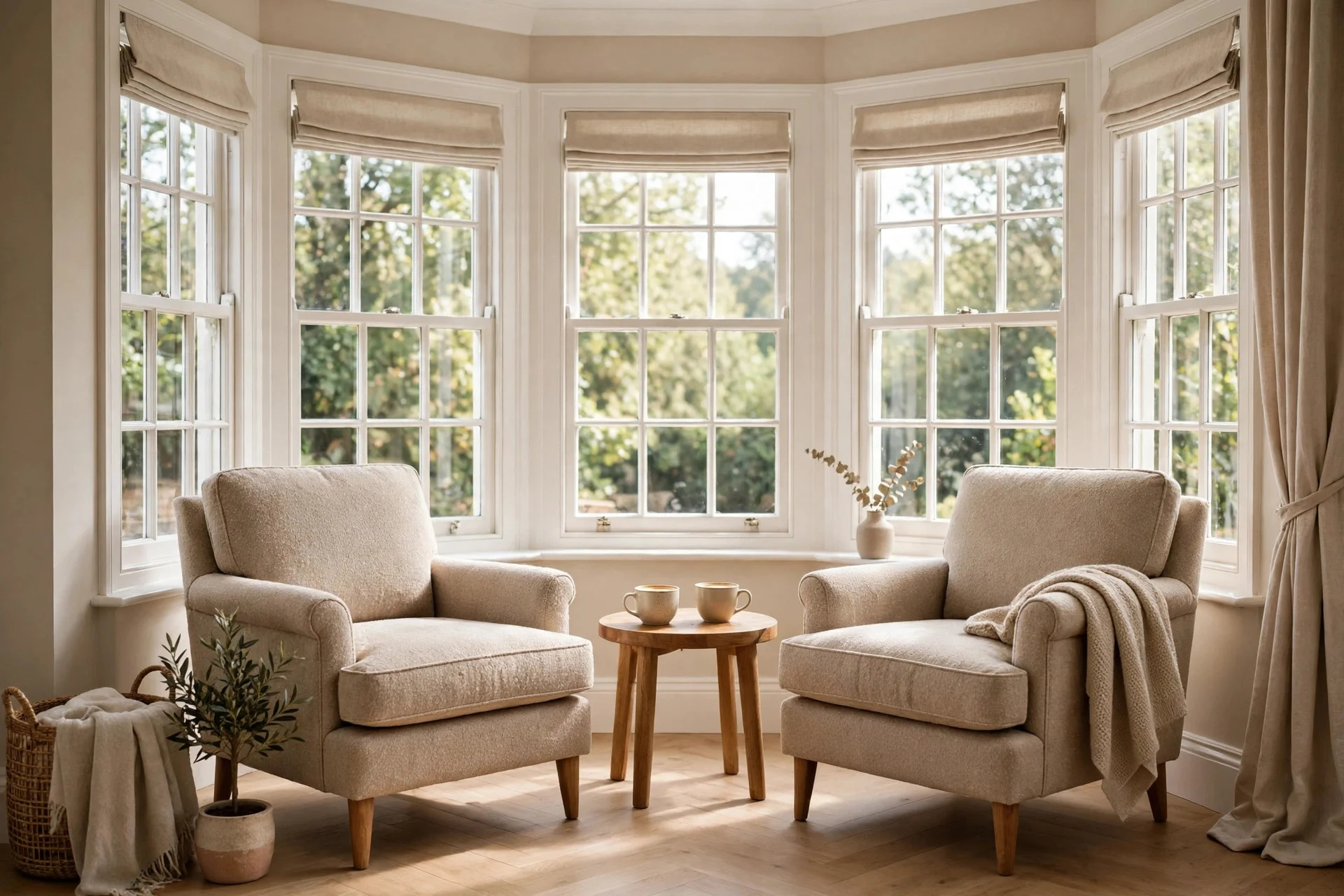
Two armchairs angle toward each other in the alcove, a small round table between them with coffee cups. It has the feel of a good café corner — the kind where conversations run long.
What makes it work
Chairs facing each other, not the TV. Two chairs angled inward make a zone for talking, separate from the rest of the room. A small round table. No corners to bump in a tight alcove, low enough not to block the view. Shared light. A small lamp or pendant keeps the corner usable after dark.
Copy it cheaply
Cost: $200–$400. Solid-frame armchairs run $80–$150 each at estate sales and marketplace listings; a thrift-store side table is $30–$60. One easy afternoon. Tip: leave 18 inches between the chairs’ front edges and the table so legs don’t cramp. Watch out: keep chairs 6 inches off the glass for curtains and cleaning.
3. The Daybed That Swallows Clutter
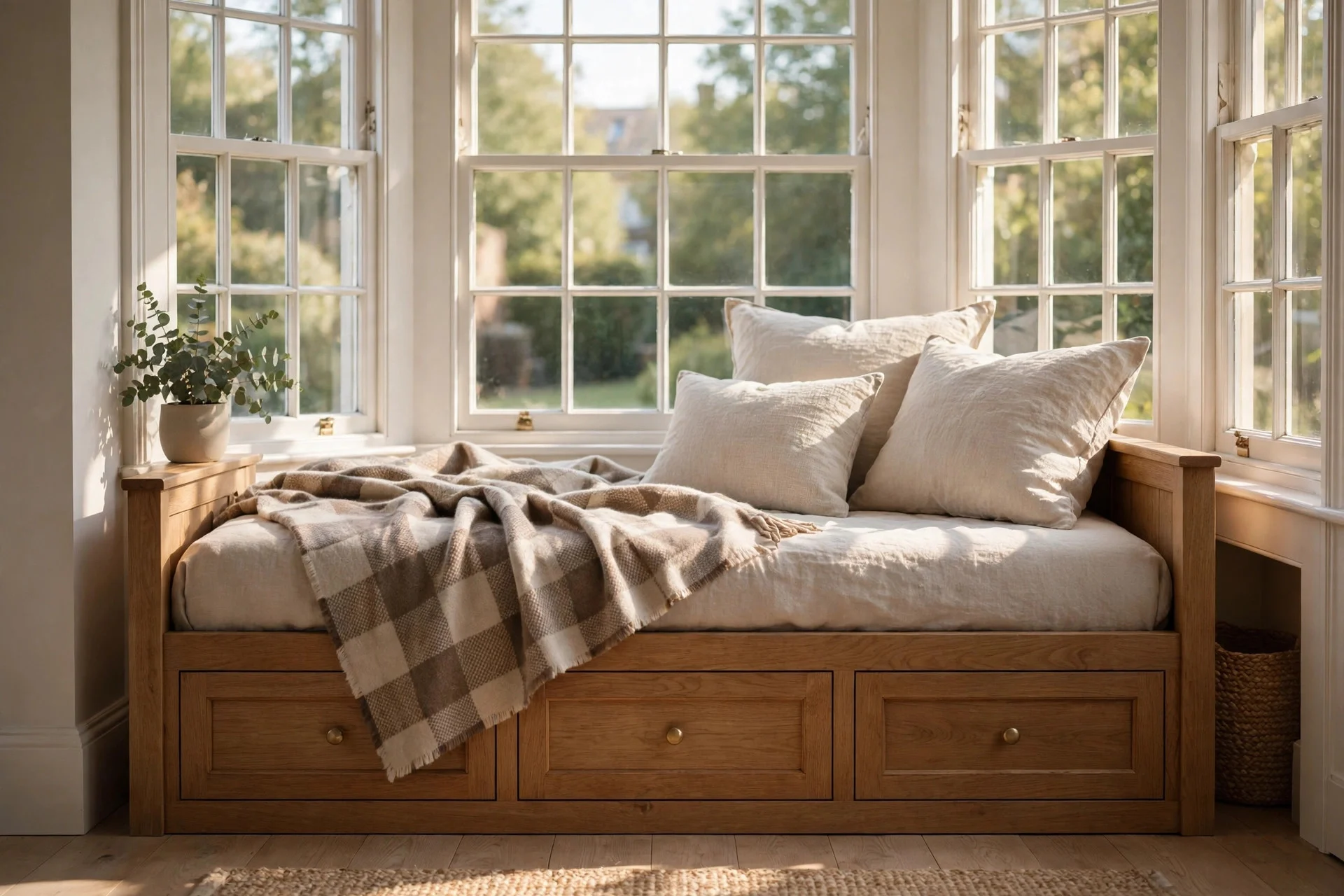
A wooden daybed fills the bay — plaid blanket, linen pillows, afternoon light across the whole thing. By day it reads as a sofa; the drawers beneath hide sheets, craft supplies, and board games.
What makes it work
The drawers. A bay this deep gives you three big drawers — genuinely useful storage. Twin proportions. Twin-size beds fit most bay widths without looking crammed. Bedding as upholstery. The plaid throw and pillows make it read “sofa,” not “forgotten guest bed.”
Copy it cheaply
Cost: $250–$600 for a flat-pack daybed with drawers, plus $40–$80 for a foam topper if you’ll sit on it daily. One Saturday with an Allen key. Tip: daybed mattresses are firm for lounging — add a 2-inch topper under the cover. Watch out: standard daybeds need ~40 inches of depth; a shallow Victorian bay may only give 30. Measure first.
4. The Sun-Loving Plant Corner
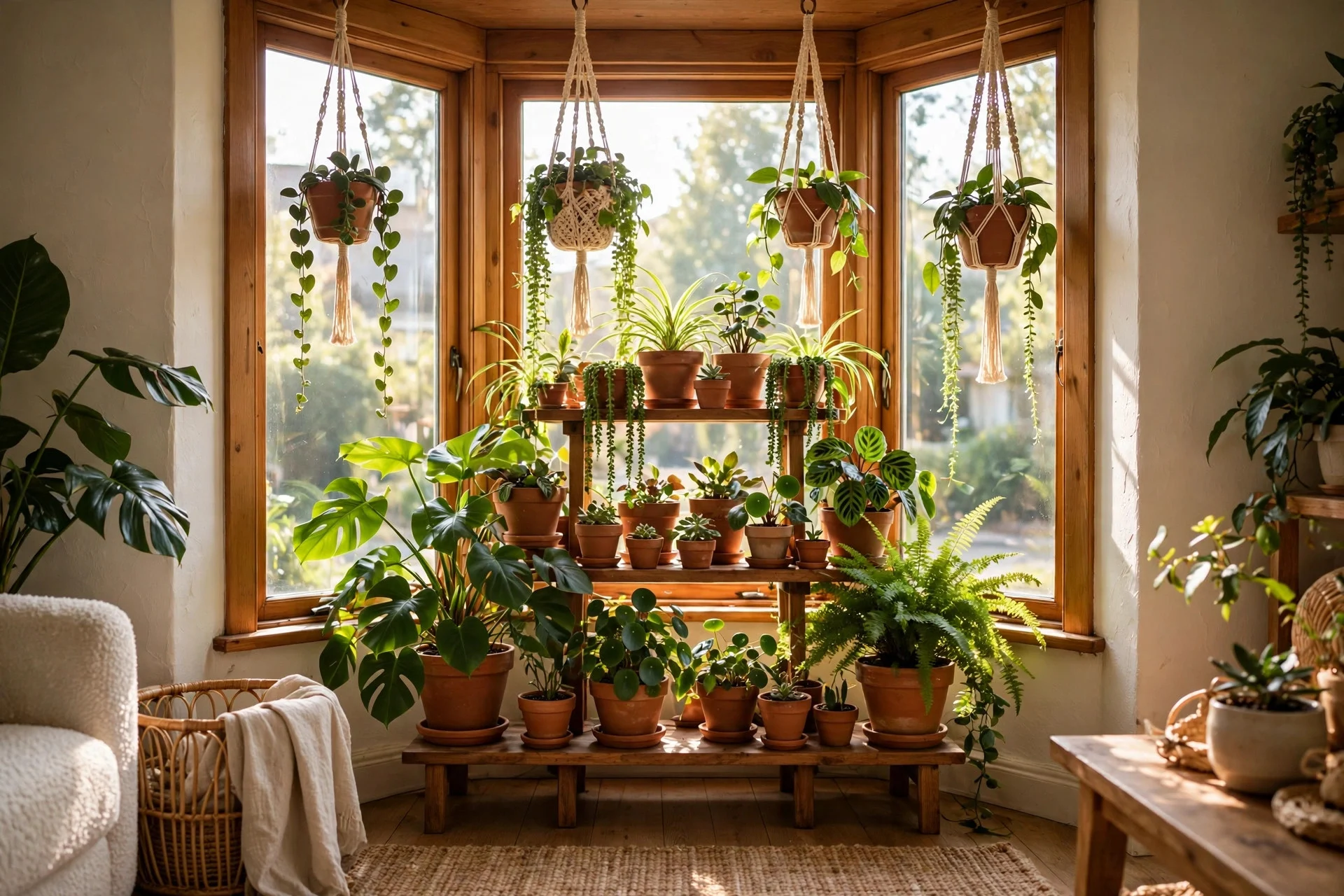
Tiered stands climb one side of the bay, heavy with terracotta pots — a tall bird of paradise, trailing pothos, a hanging planter swaying in the middle. Light filters through the leaves and throws shadows on the wall.
What makes it work
Varied heights. Tall at the back, medium in the middle, trailers up high — tiered stands create depth instead of a flat row. One pot material. Mostly terracotta keeps twenty plants from looking chaotic. Grouped by light. Sun-hungry plants at the glass; ferns and calatheas a step back where it’s gentler.
Copy it cheaply
Cost: $80–$250. Nursery starters ($5–$15 each) fill out in one season under that light; a three-tier bamboo stand is $40–$70. Easy — the work is watering, not building. Tip: rotate each pot a quarter-turn weekly for even growth. Watch out: a south- or west-facing bay can scorch leaves behind glass in summer. Move sensitive plants back a foot at the first crisp edges.
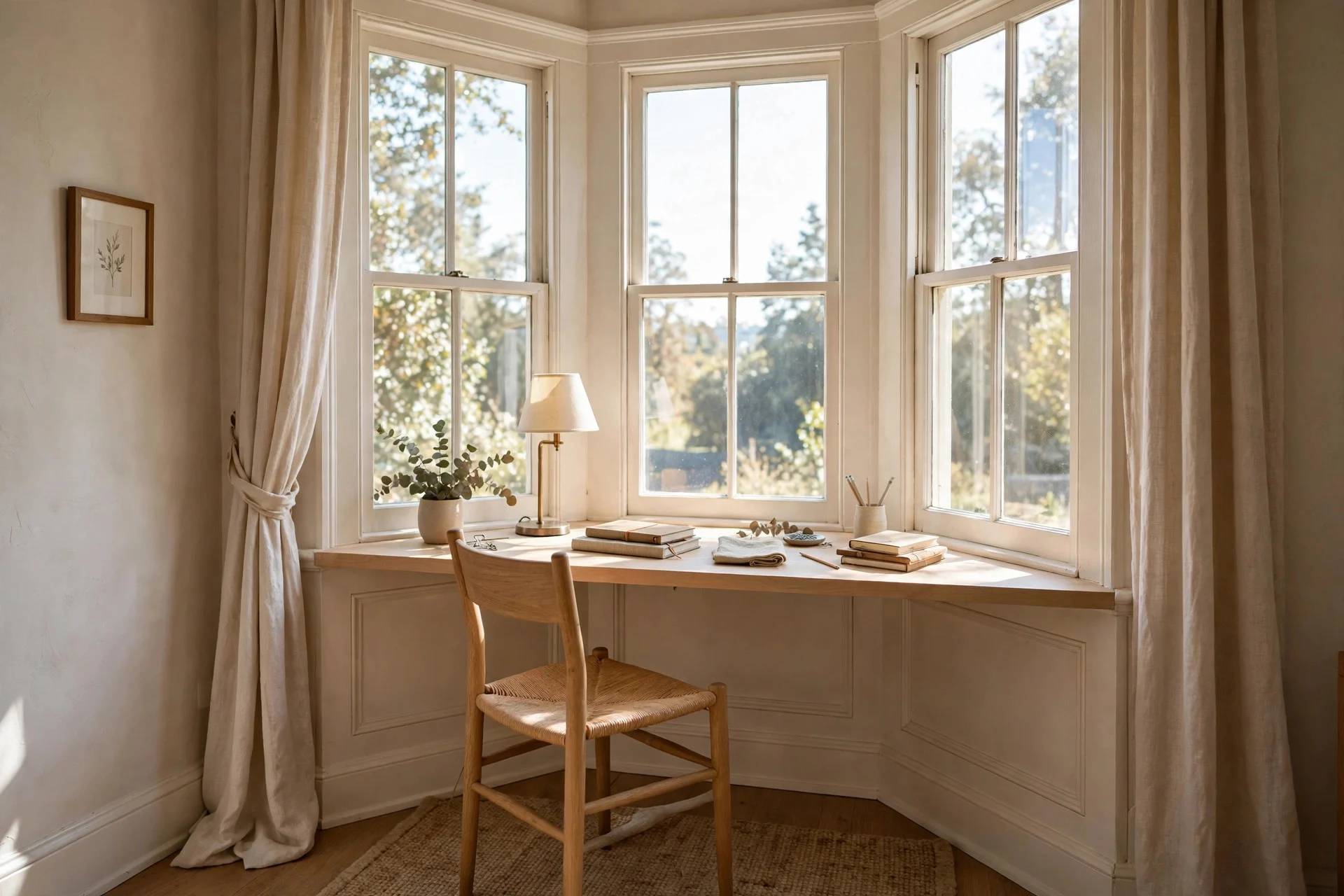
5. The Alcove Office
A slim desk sits across the bay with a chair tucked under, a small lamp glowing beside a closed laptop and a stack of notebooks. Through the window: the street, the sky. Calm.
What makes it work
The narrow desk. Twenty inches deep fits the bay without jutting into the room — room for a laptop and notebook, walkway stays clear. Natural task light. Daylight from three angles beats any desk lamp for eye strain. The lamp anyway. Evenings and gray days need a small warm lamp.
Copy it cheaply
Cost: $120–$350 — desk ($80–$200), task lamp ($25–$50), cable clips ($15) so cords don’t dangle. One easy afternoon. Tip: sit so daylight falls across your work from the side, not into your screen — side light kills glare. Watch out: if the bay ends a narrow room, a desk can make it feel like a corridor of clutter. Pull the chair fully under when done, and see how a long narrow living room layout keeps the traffic lane clear.
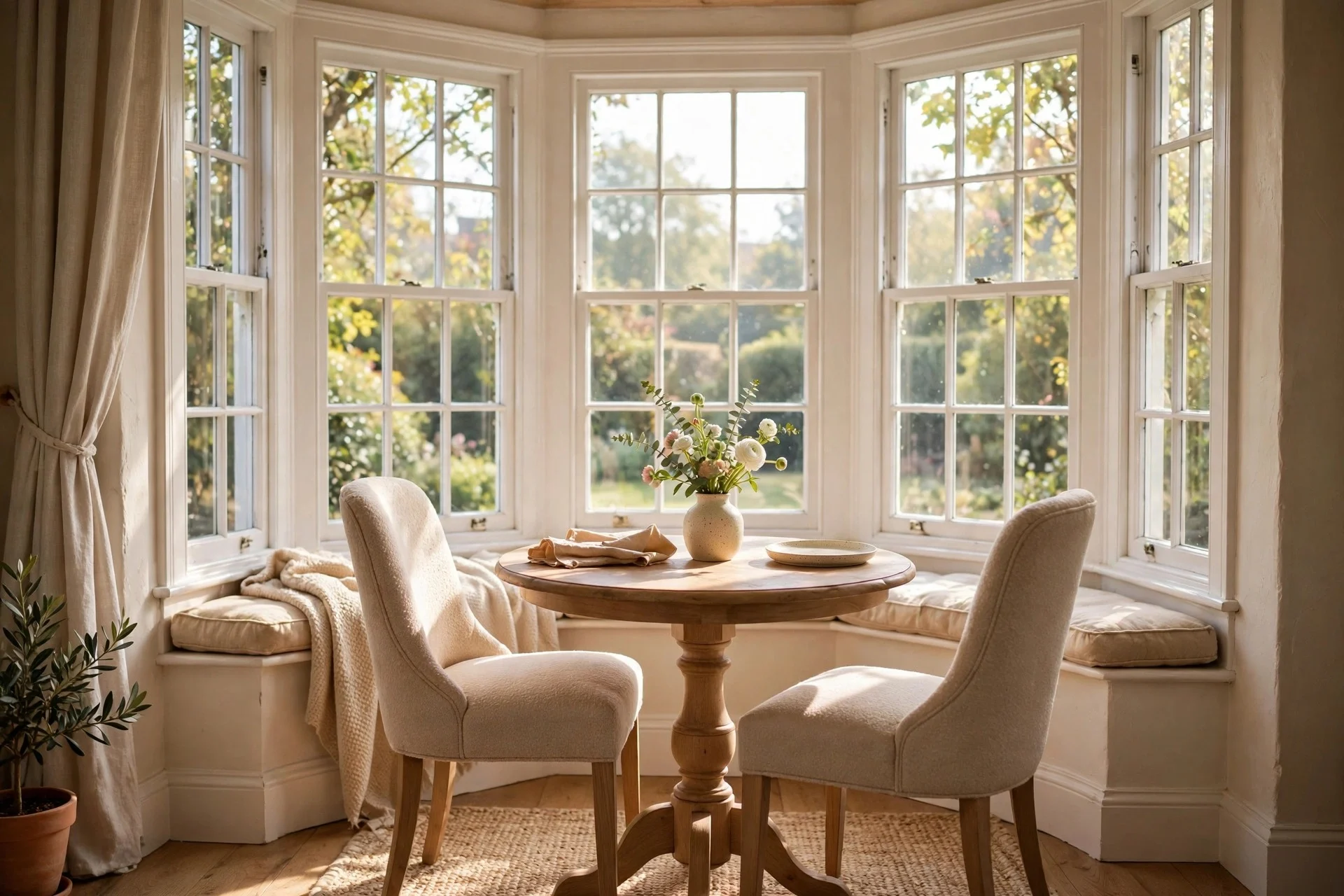
6. The Breakfast-for-Two Bay
A round wooden pedestal table with two upholstered chairs, a small vase of flowers in the middle. Morning sun hits the tabletop. You’d eat toast here every single day.
What makes it work
The pedestal base. One center post instead of four legs — knees fit anywhere and chairs slide in easily. Small-scale chairs. Armless or slim-armed so two genuinely fit side by side. A permanent centerpiece. A vase or candle makes the table look intentional, not waiting.
Copy it cheaply
Cost: $200–$500. Pedestal tables are $80–$200 secondhand; two simple dining chairs $60–$150 each. Easy. Tip: a 30-inch round seats two; go 36 only if you keep 24 inches of walkway behind the chairs. Watch out: pick a table light enough to pull aside for window cleaning — marble or solid oak never moves.
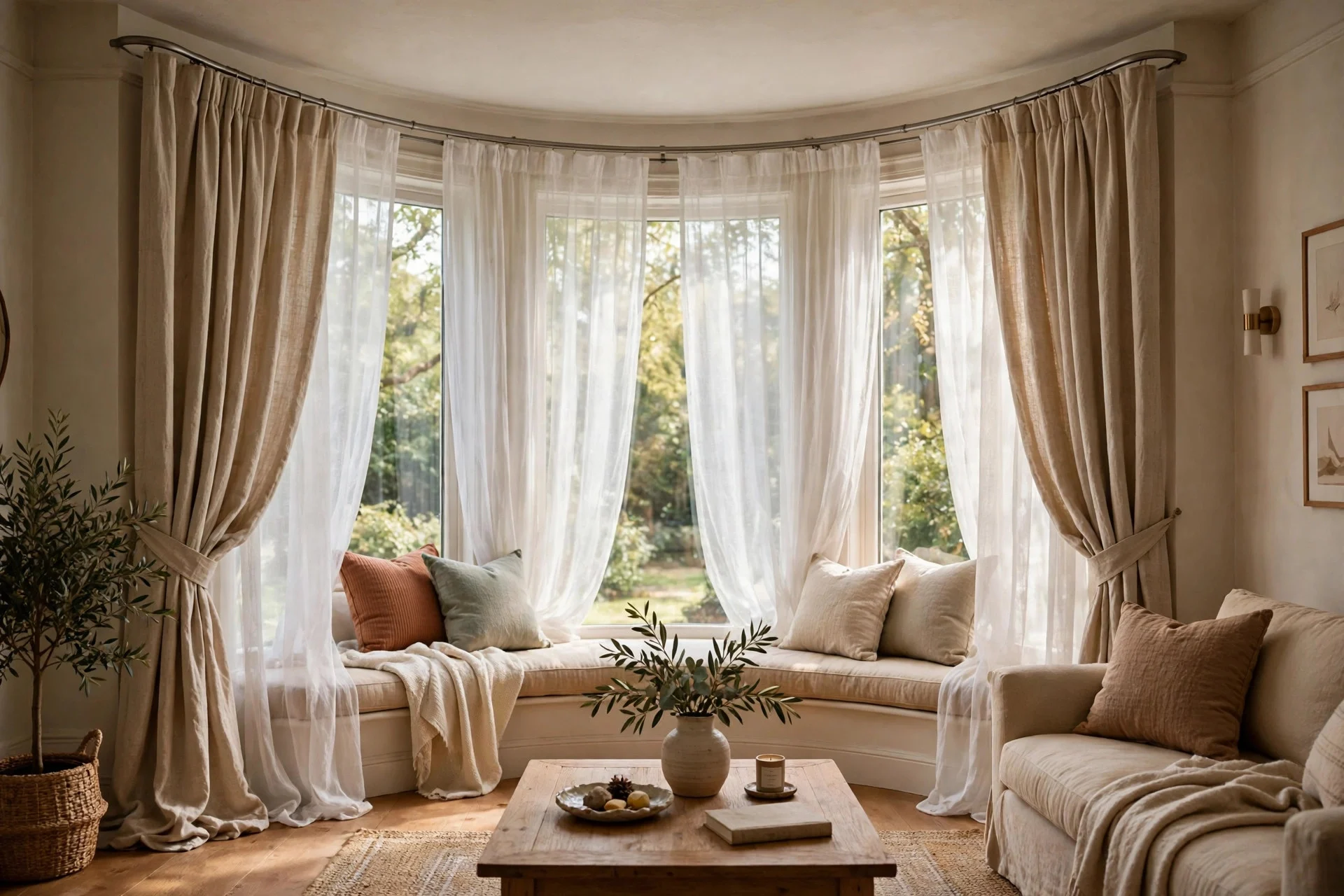
7. Curtains That Respect the Angles
Sheer panels hang from a ceiling-mounted track that bends around all three window sections, glowing with filtered light; heavier oatmeal drapes pull to the sides. The curtains follow the architecture instead of fighting it.
What makes it work
One continuous flexible track. A bendable track ($20–$40) follows the bay’s shape — no gaps where three rods meet at corners. Two layers. Sheers for daytime privacy and soft light, opaque drapes for night. Ceiling mounting. Panels near the ceiling make the window — and the room — feel taller.
Copy it cheaply
Cost: $120–$350: flexible track ($20–$40), sheers ($15–$30 each), heavier drapes ($25–$60 each). Before buying fabric, check a curtain fabric calculator — bays need more fabric than you’d guess. Moderate difficulty: mounting takes a drill, a stud finder, and patience. Tip: mount 4–6 inches from the ceiling and let panels kiss the floor — that long line makes the window look grand. Watch out: measure each section plus the corner curves, and buy 20% more track than your total.
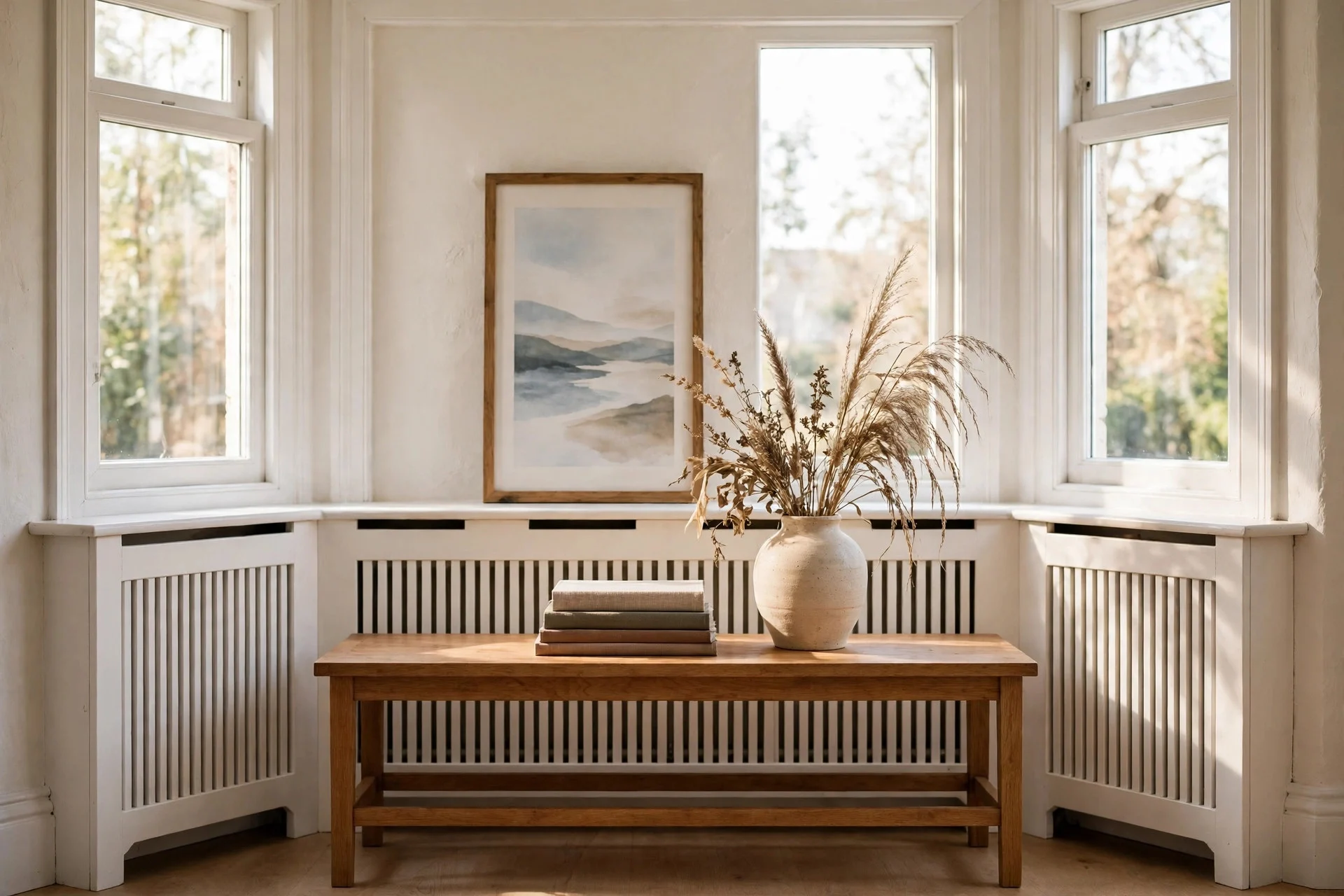
8. The Radiator-Cover Console
A low console hides the radiator behind a slatted cover, styled with stacked books, a vase of dried grasses, and a framed print leaning against the window. The radiator is a rumor.
What makes it work
The cover. A slatted or mesh-front radiator cover ($80–$200) turns the ugliest thing in the room into a shelf. Three objects, three heights. Books (low), vase (tall), leaning frame — the asymmetry is the whole trick. Leaning, not hanging. A frame leaned on the glass needs zero holes in the wall.
Copy it cheaply
Cost: $150–$400 — cover, a console or board on top, styling pieces from around the house. Easy. Tip: keep an inch of airflow gap on all sides, and use a removable or vented top so heat escapes. Watch out: no varnished wood or candles over a radiator that runs hot — check the surface on the coldest day first.
9. The Kids’ Sunbeam Nook
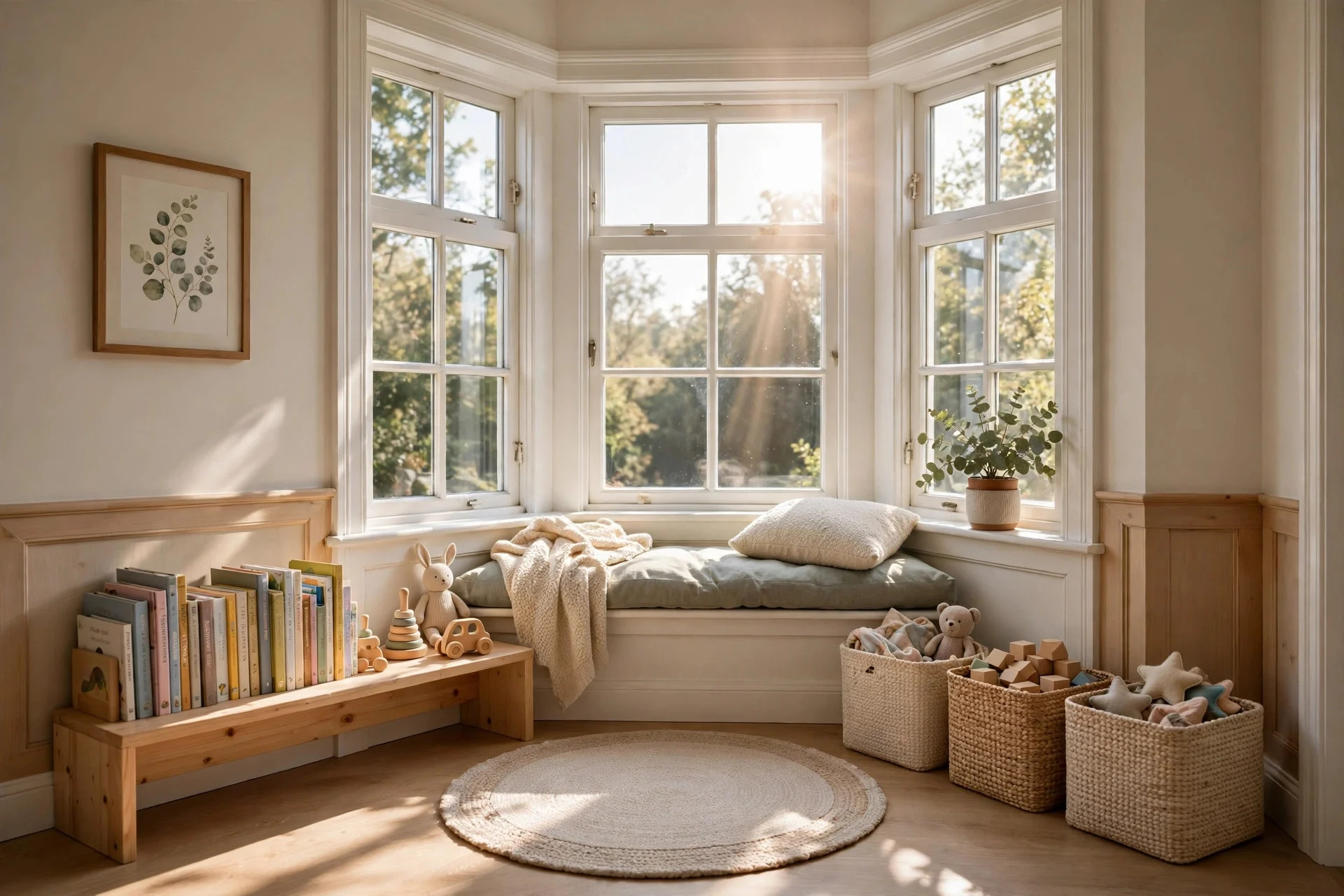
A round washable rug, two woven bins of books and blocks, a big floor cushion, stuffed animals lined along the low shelf. Sunlight lands exactly where a small person would sprawl with a book.
What makes it work
Everything at kid height. Rug, bins, cushion — nothing needs climbing, so it actually gets used. Contained storage. Two bins with a rule — toys live in the bins — keeps the nook from taking over the room. A washable rug. Spills and marker incidents become a non-event ($40–$90).
Copy it cheaply
Cost: $80–$200 — rug, two bins ($20–$35 each), floor cushion ($30–$60). An hour, easy. Tip: a low shelf against the middle window displays their stuff and keeps little hands off the glass. Watch out: cordless blinds or shades only in a kid zone. Corded blinds must be replaced — non-optional.
10. The Chaise Retreat
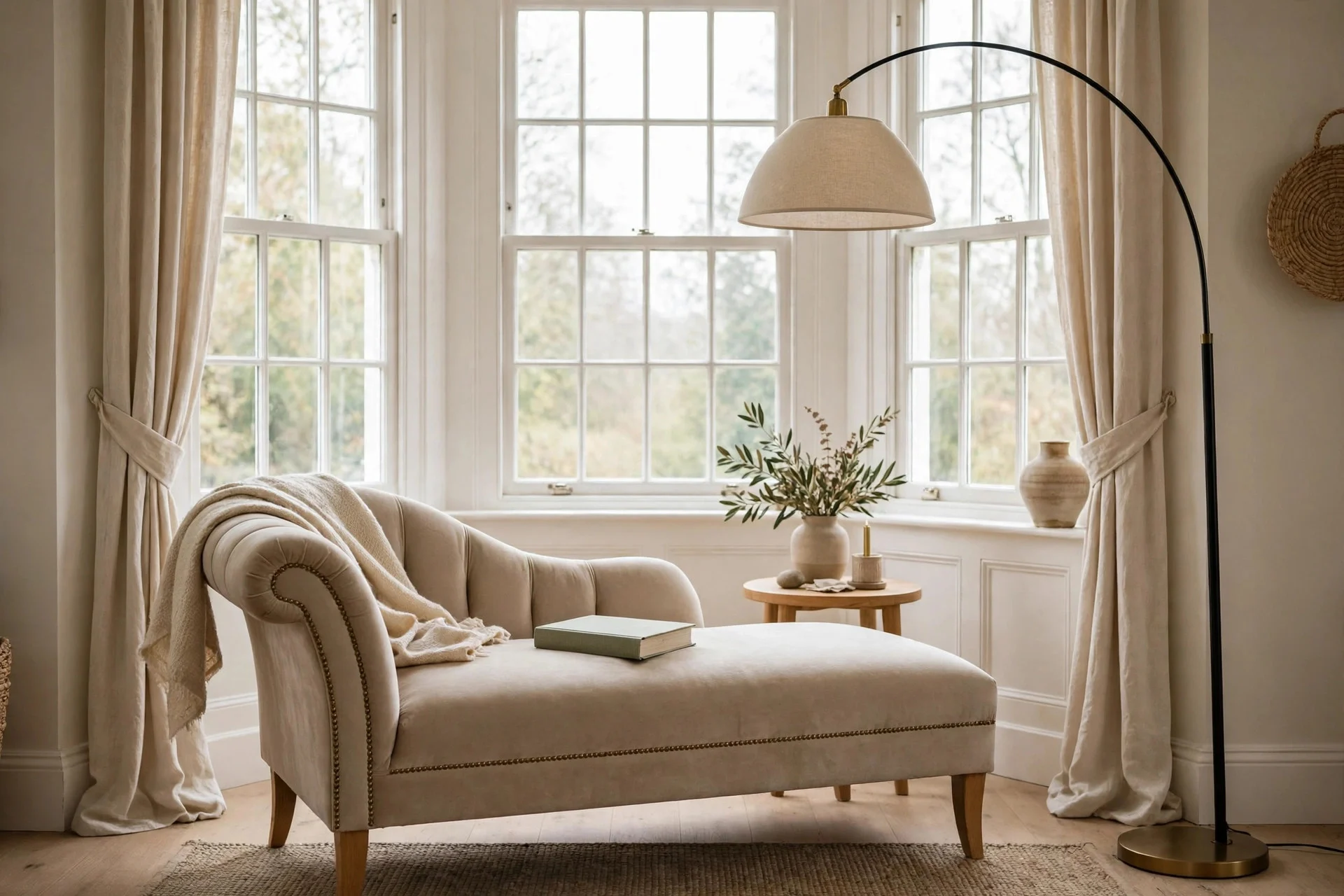
A chaise angles into the bay, an arc lamp curving over one end, a side table holding a book and a cup of tea. A private box for one reader and one long chapter.
What makes it work
The chaise. Longer than a chair, more upright than a sofa — built exactly for reading. The arc lamp. A floor lamp curving over your shoulder lights the page without eating table space. The angle. Turned slightly away from the room, the chaise claims the bay as its own.
Copy it cheaply
Cost: $300–$800 — chaise ($200–$500 secondhand or flat-pack), reading floor lamp ($60–$150), a side table you own. Easy. Tip: put the lamp arm on your non-dominant side so your hand doesn’t shadow the page. Watch out: measure the diagonal, not the width — a 65-inch chaise in a 60-inch-deep bay has to angle.
11. The Seasonal Sill Gallery
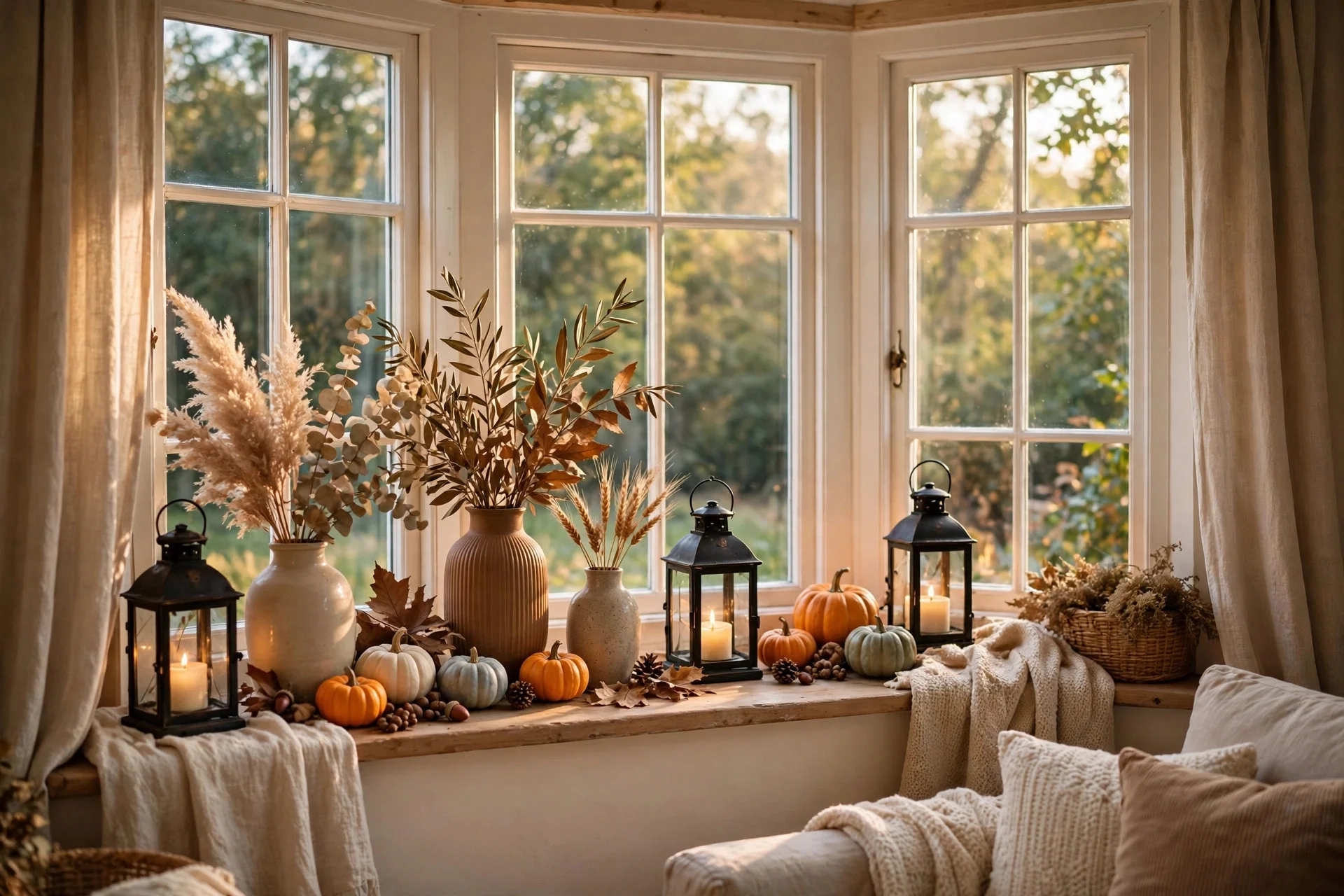
The wide sill holds amber and cream vases, two lanterns, a cluster of miniature pumpkins — swapped four times a year in twenty minutes. Guests always comment.
What makes it work
The deep sill. Six inches of ledge is plenty to actually style. Odd numbers, varied heights. Three vases, two lanterns, one pumpkin cluster — asymmetry reads curated, not lined up. The swap box. One labeled box per season in a closet. The system is the idea.
Copy it cheaply
Cost: $30–$100 per season with thrifted vases, candles, and foraged branches. Twenty minutes, easy. Tip: photograph each arrangement before taking it down — next year you’ll have a recipe. These cozy fall living room decor ideas pair nicely with an autumn sill. Watch out: keep open flames 12 inches from fabric, or use LED candles.
12. Roman Shades and a Rattan Chair
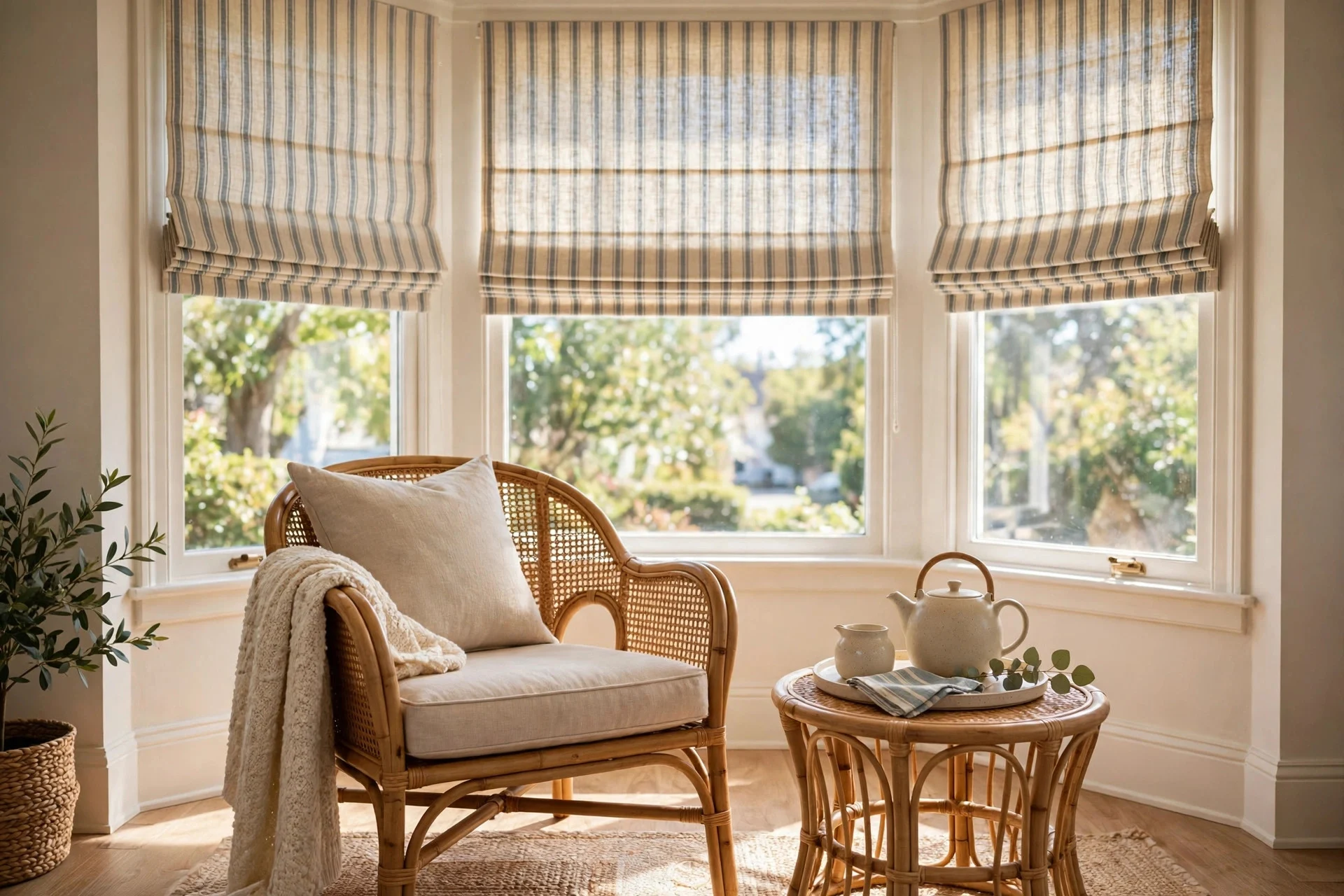
Striped linen roman shades sit inside each window frame, crisp and tailored. A rattan chair with a deep cushion faces the room, a side table beside it holding a tray with a teapot. Three pieces, one ritual.
What makes it work
Tailored shades. Roman shades follow the bay’s angles where curtains would bunch; a stripe adds interest without fighting the view. The textured chair. Rattan’s warmth balances the crisp shades. The ritual object. The tea tray gives the corner a reason to exist — without it, it’s just a chair.
Copy it cheaply
Cost: $180–$450 — inside-mount shades ($40–$90 per section), rattan chair ($100–$250). Moderate: exact measurements and a drill. Tip: template each window section on paper before ordering — bays are rarely square, and a quarter-inch error shows. Watch out: inside mounts need 2 inches of frame depth. Shallow frames? Outside-mount with 3 inches of overlap per side.
13. The Pets’ Sun Patch
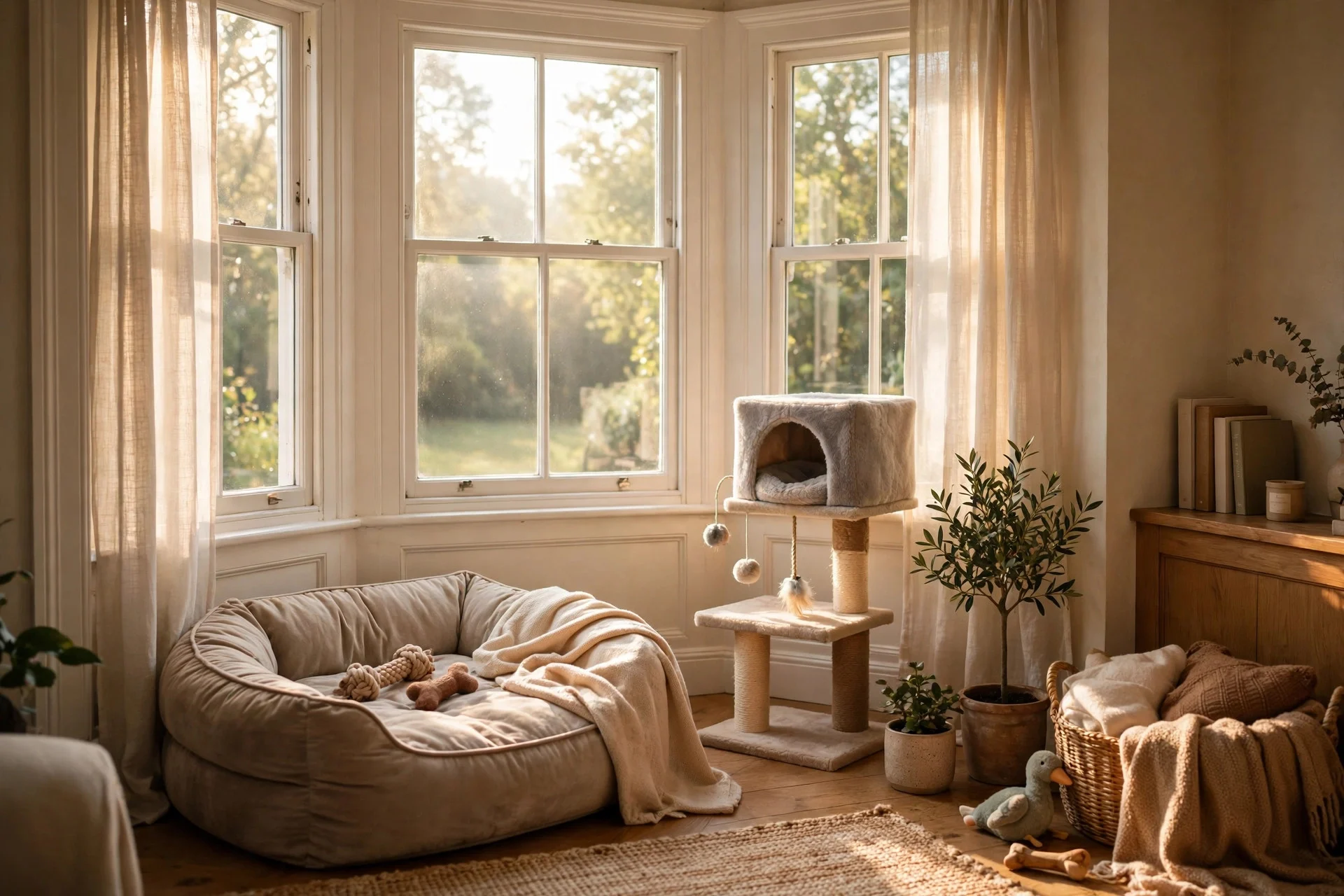
A plush dog bed sits in the sunniest corner, already indented from daily naps; beside it, a small cat tree rises to sill height for maximum bird-watching. The pets claimed it first — you’re just styling around them.
What makes it work
Washable, sun-proof fabrics. Removable-cover beds in medium tones hide fur between washes and don’t show sun-fade. Height for the cat. A sill-height perch turns the window into entertainment. Palette. Oatmeal, warm gray — never black (shows light fur) or white (shows everything).
Copy it cheaply
Cost: $60–$150 — washable dog bed ($40–$80), compact cat tree ($30–$60). Unbox and place. Tip: slide a washable throw under the pet bed — shake it out weekly instead of vacuuming the rug daily. Watch out: if you open bay windows, make sure screens are secure. A cat leaning on a loose screen is an emergency vet visit.
Bay Window Questions, Answered
What’s the best use of a bay window in a living room?
It depends on what your household is missing. Families get the most from a window seat or play nook — seating plus storage in one. If you work from home, the alcove office puts the room’s best light where you need it. And if seating is covered, a plant corner or seasonal sill gives the bay a job without furniture you don’t need.
How do you hang curtains on a bay window?
The cleanest method is a single flexible curtain track mounted on the ceiling, bent to follow the bay’s shape — no gaps where three rods meet at corners. Hang sheers closest to the glass for daytime privacy, heavier drapes in front for night. Mount near the ceiling and let panels just touch the floor.
How much does it cost to build a bay window seat?
A DIY seat from stock base cabinets, plywood, and a made-to-measure cushion runs $300–$700 with storage baskets. A carpenter-built custom seat typically costs $1,500–$4,000 depending on your area and finish. A prefab storage bench cut to fit lands around $400–$900 — nearly as good once the cushion is on.
Your Bay Window, This Weekend
You don’t need all thirteen. Pick the one that made you think “oh, that would actually get used” — that’s your project. Clear the bay this weekend, measure twice, and start with the anchor piece: the bench, the chairs, the desk, the plant stand. Style around it with things you already own before buying anything new.
Quick checklist before you start:
- Measure the bay’s width, depth, and sill height — write all three down.
- Check what’s under the window: vents, radiators, outlets. Plan around them.
- Give the bay one job: seating, work, plants, storage, or display.
- Buy the anchor piece first; style with existing items second.
- Keep the middle section clear if light matters more than storage.
And if the whole-room budget is tight, the bay is just one corner — you can decorate an entire living room on a $500 budget if you spend deliberately. Start with the spot that gets the best light in the house, and let it pull the rest of the room along.