10 Living Room Curtain Ideas for Sliding Glass Doors
Short answer: the best curtains for sliding glass doors go wider than the door frame, hang close to the ceiling, and match your fabric to how you use the doors — sheer linen for daylight, blackout for privacy, or a layered pair when you want both. Pick a heading that glides easily (ripplefold, grommet, or back-tab), because you’ll open and close these far more often than regular window panels.
Sliding glass doors are the hardest window to dress in a living room. They’re wide — often 6 to 12 feet — they get used constantly, and they’re usually the room’s biggest source of natural light. The rod needs to clear the door handles, the panels need to stack without blocking the walkway, and the fabric has to survive daily pulling. The ten ideas below cover every budget and style, each with realistic costs, honest difficulty ratings, and practical tips.
1. Breezy Sheer Linen Panels
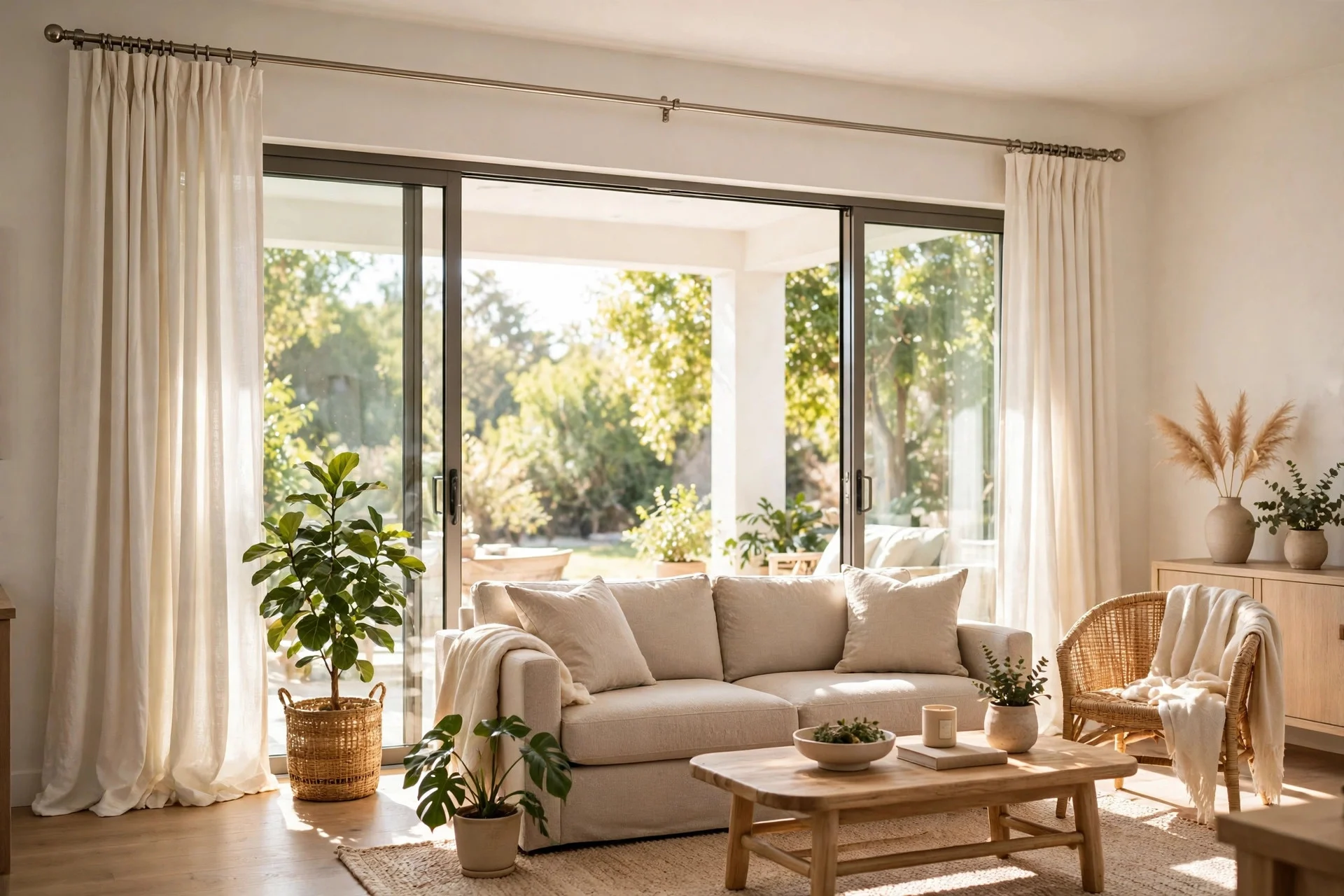
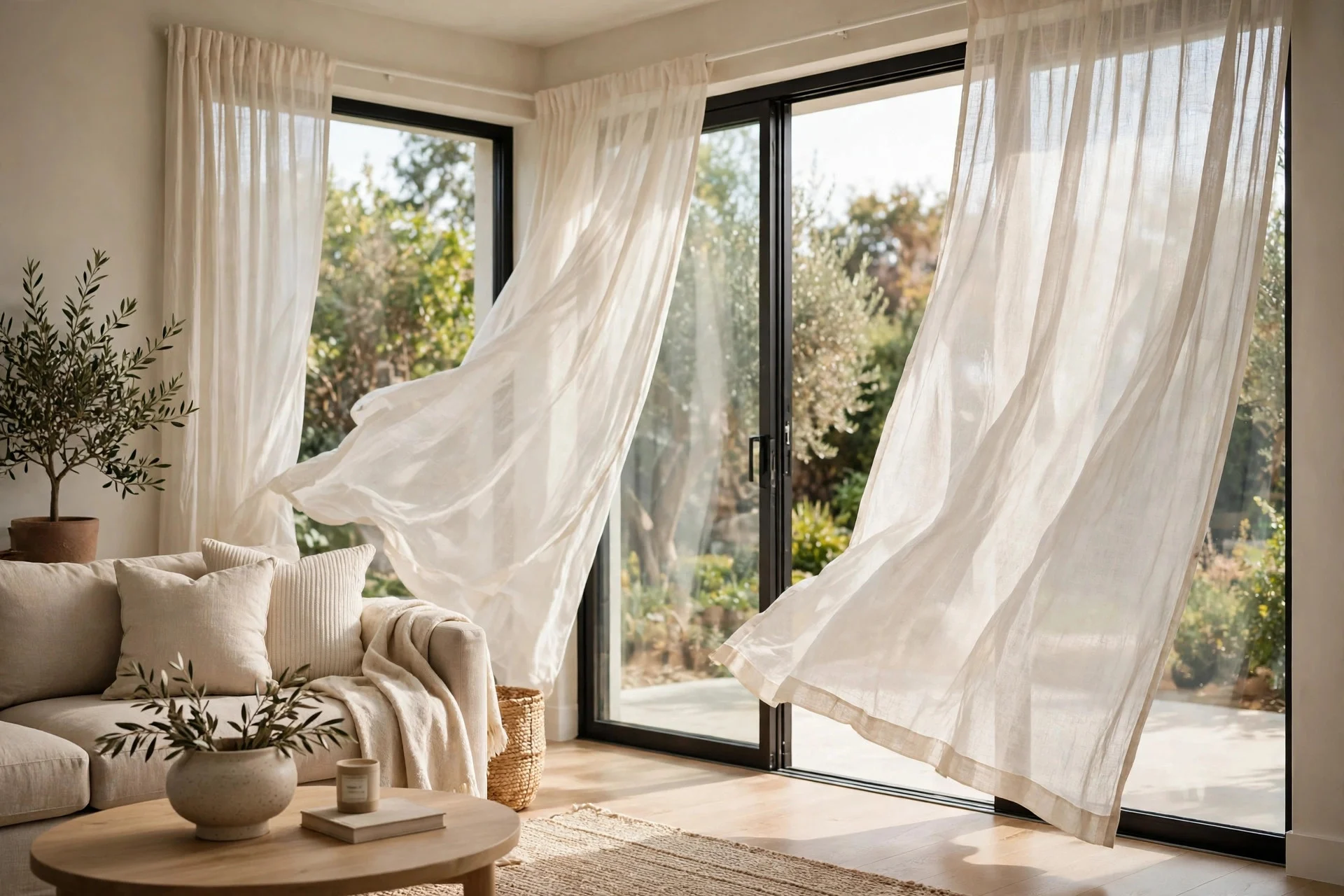
Sheers are the simplest starting point and, for a lot of living rooms, the only curtains the doors ever need. Lightweight linen or linen-look panels soften the glass wall, cut daytime glare, and give you daytime privacy while the view stays visible from inside.
This works because sliding doors are light sources first and windows second. Heavy fabric on a bright glass wall can make the whole room feel dim; sheers diffuse the light without blocking it. If your living room always feels a little dark, sheers plus a few more of these ideas for making a dark living room look brighter can change the mood completely.
Cost: $25–$80 per panel; most doors need 2–4 panels.
Difficulty: Easy — 30–45 minutes to hang the rod and panels.
Tip: Choose a linen blend rather than 100% linen if you hate ironing. The blend wrinkles less and costs about half as much, and from three feet away nobody can tell the difference.
Watch out: Sheers give you zero privacy at night once the lamps are on. If the doors face a neighbour’s windows, plan a second layer (see idea #3).
2. Blackout Panels for Total Privacy
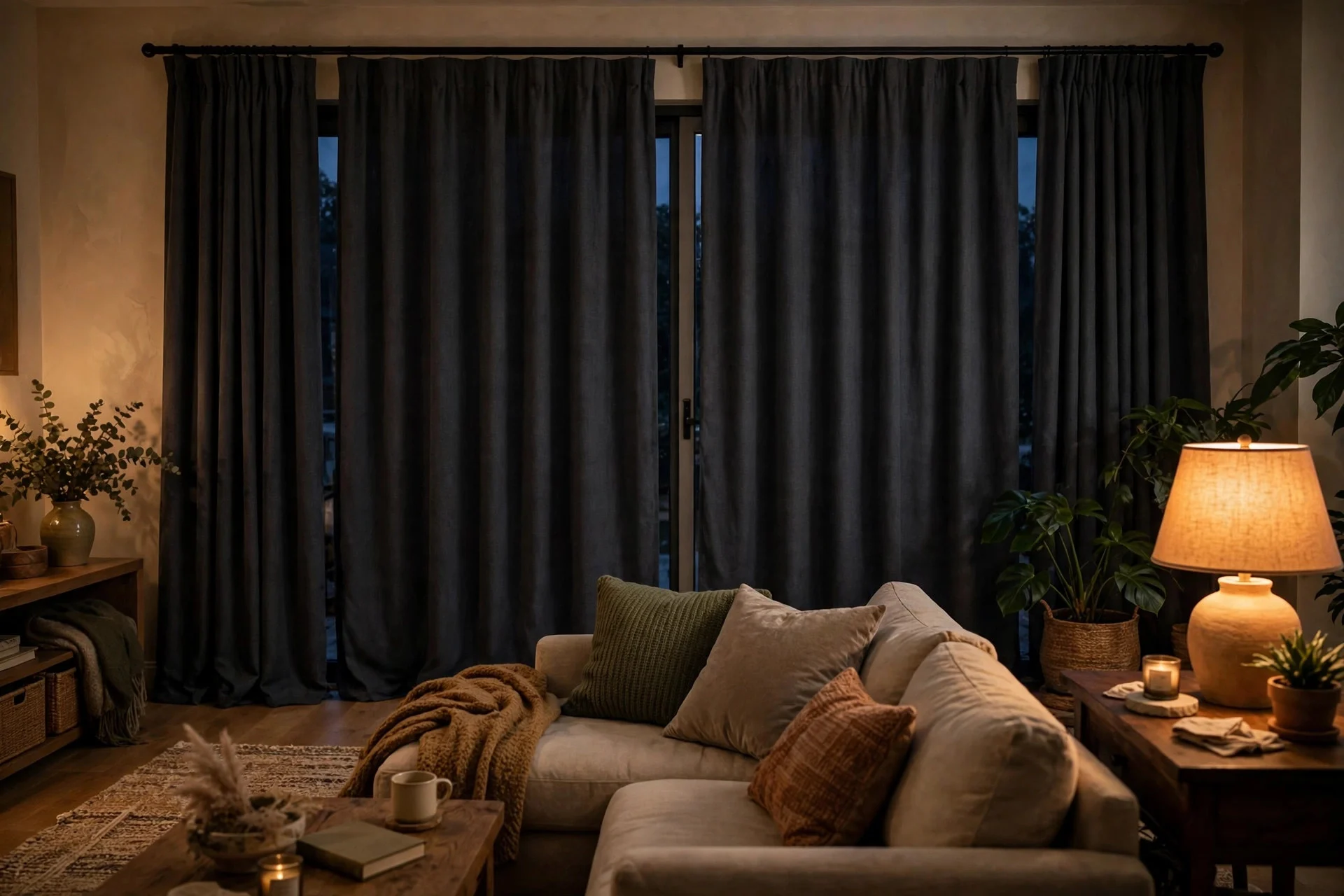
When the living room doubles as the TV room, or the doors face a busy street, blackout curtains earn their keep. Thick, lined panels shut out streetlights and headlights, kill screen glare during movie night, and make the room feel noticeably quieter — heavy fabric absorbs sound better than glass ever will.
For sliding doors, look for blackout panels sold as “wide width” (100 inches or more). Two wide panels that meet in the centre look better and block more light than four narrow ones with a gap in the middle.
Cost: $40–$120 per wide panel; $80–$240 for a standard door.
Difficulty: Easy to moderate — the panels are heavy, so you’ll want a second pair of hands and a sturdy rod with centre support.
Tip: Hang the rod 4–6 inches wider than the door frame on each side so the panels can stack fully off the glass when open.
Watch out: Cheap blackout curtains often have a rubbery backing that cracks after a couple of years in direct sun. Spend a little more on triple-weave fabric, which blocks light without a separate coating.
3. The Layered Double-Rod Trick
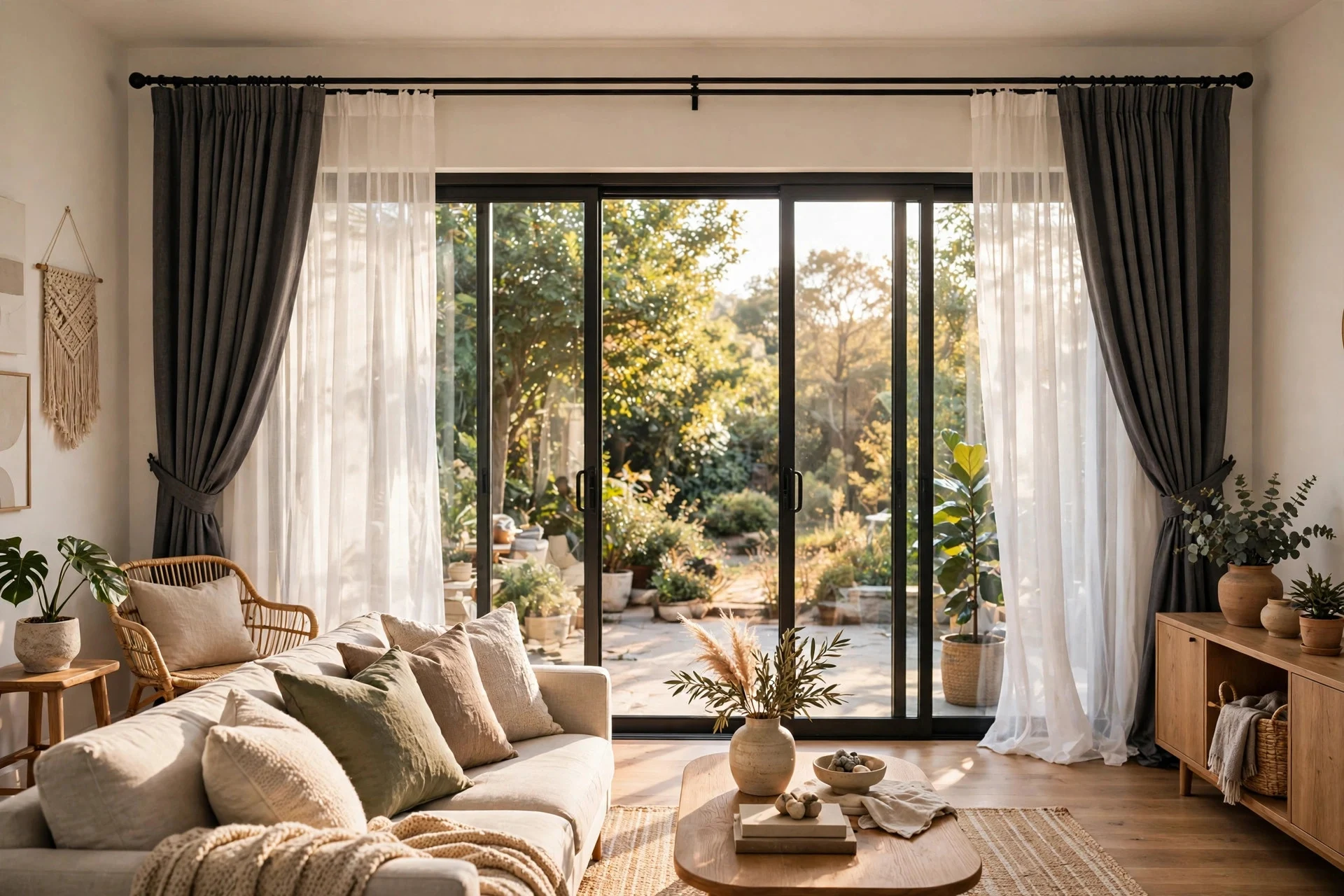
Can’t decide between light and privacy? Don’t. A double rod holds sheers on the back rod and heavier drapes on the front, and you get both looks in one window. Sheers closed during the day for soft light, drapes drawn at night for privacy — the most flexible setup you can put on a sliding door.
Layering also fixes the most common complaint about sliding-door curtains: that one flat pair of panels looks thin and unfinished. Two layers add the fullness that makes a wide glass wall feel dressed rather than just covered.
Cost: $120–$350 total (double rod $30–$80, sheers $50–$120, drapes $60–$180).
Difficulty: Moderate — measuring and levelling a double rod takes patience, about 1–2 hours.
Tip: Put the sheer layer on clip rings so it glides independently of the front drapes. You’ll adjust the sheers daily and the drapes only at night, so they shouldn’t share hardware.
Watch out: Four panels of fabric need room to stack. On a narrow wall with no space beside the doors, the stack eats into the glass. Measure your available wall space before committing to two layers.
4. Ripplefold Curtains: The Smoothest Glide
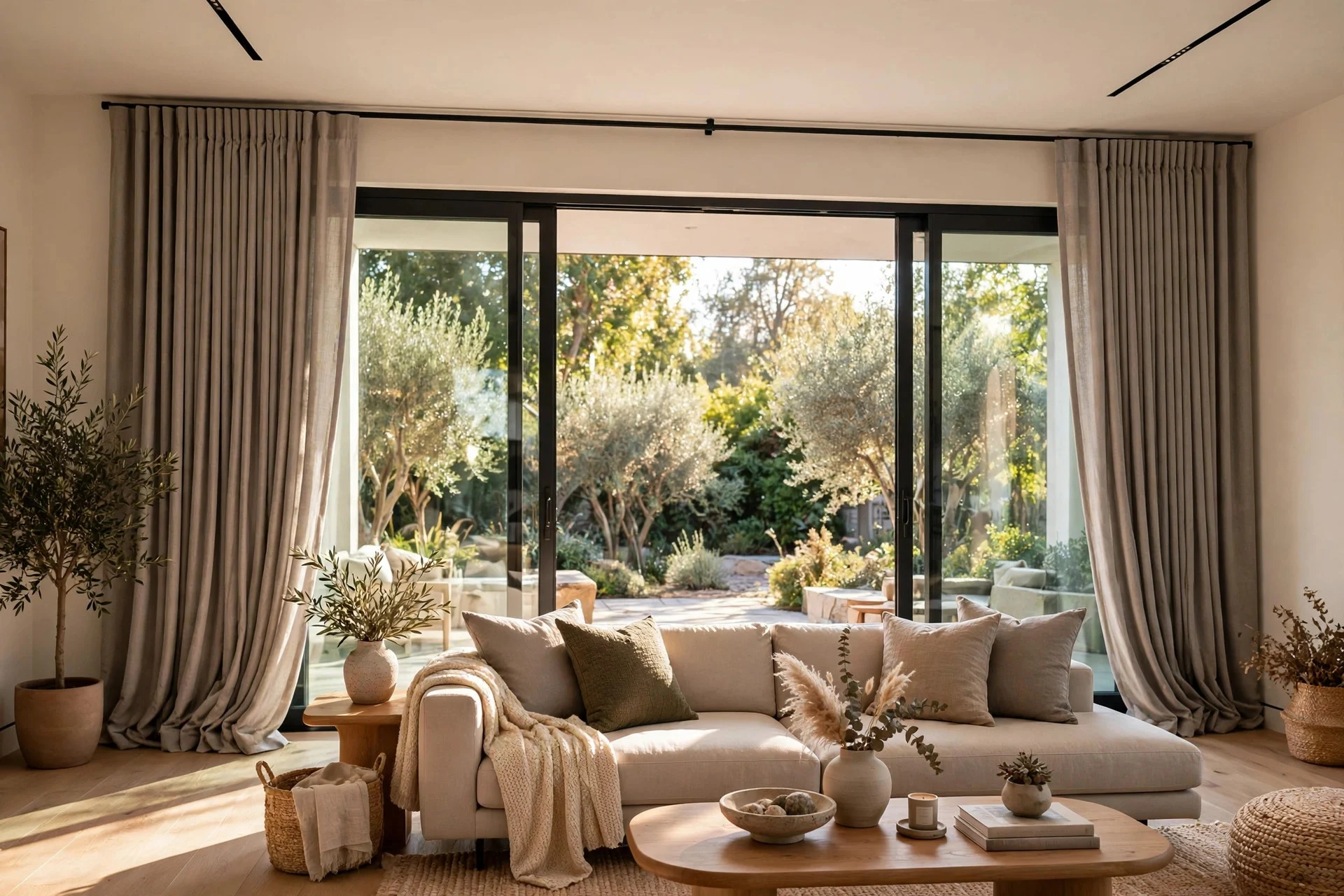
Ripplefold (sometimes sold as “wave heading”) is the curtain style hotels use on big glass walls. The fabric is sewn to snap tape that clips into carriers on a track, so the folds fall in perfect, even waves and the whole panel glides with one finger. No bunching, no snagging, no wrestling the fabric past the door handle.
This is the best heading for doors you open and close ten times a day — patio access, kids running in and out, dogs. Anything with rings or tabs will eventually catch or wear; a track just slides.
Cost: $90–$250 per panel ready-made; $200–$500 custom.
Difficulty: Moderate — the track must be level and firmly anchored; plan for a 2-hour install.
Tip: Ripplefold needs 2 to 2.5 times fullness to look right — far more fabric than you’d guess for a wide door. Run your measurements through a curtain fabric calculator before ordering; under-ordering is the number-one mistake with this style.
5. Outdoor-Rated Curtains for Indoor-Outdoor Living
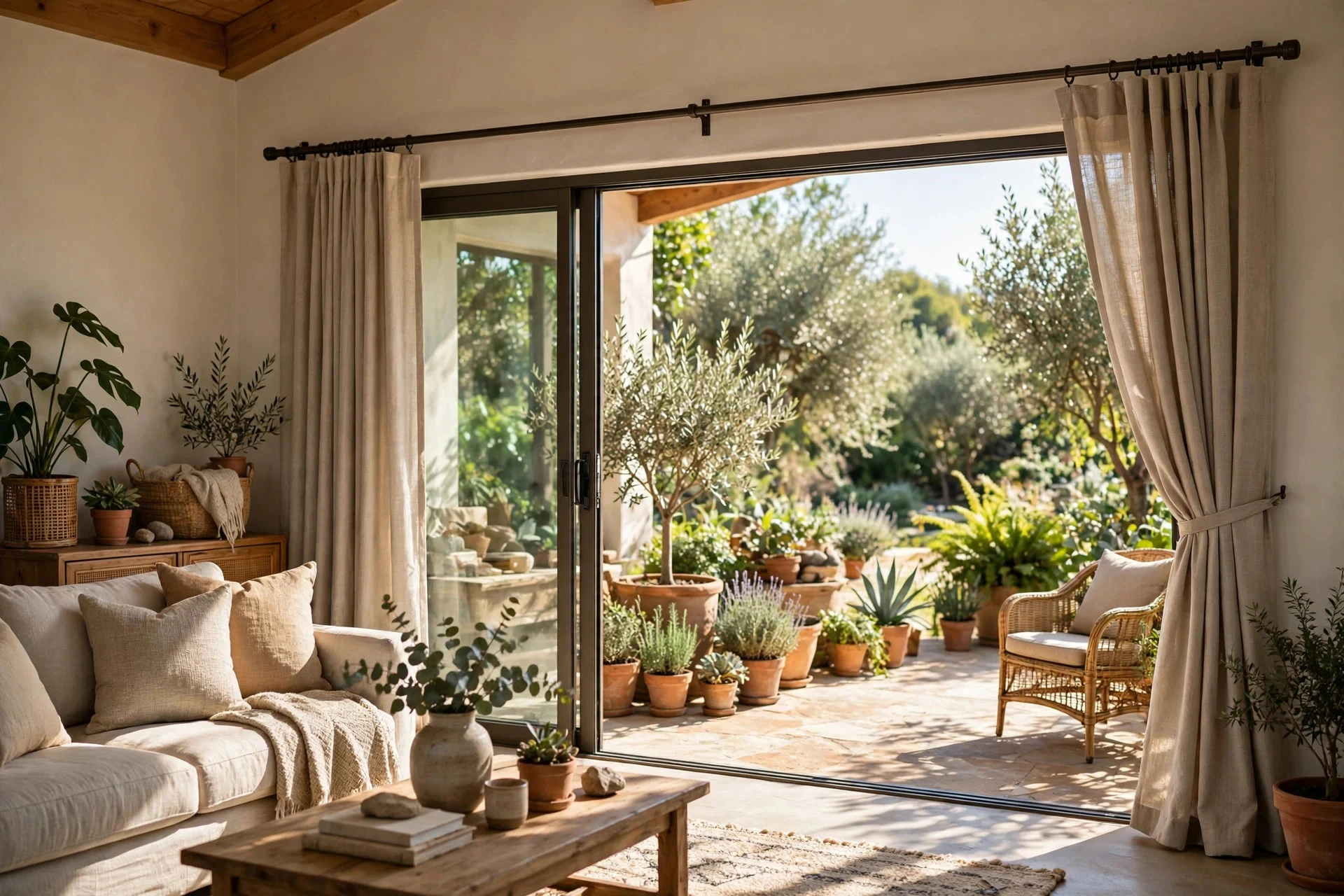
If your sliding doors open onto a patio or garden you actually use, consider dressing both sides in outdoor-rated fabric. These curtains are woven from solution-dyed acrylic or polyester that shrugs off sun, rain, and humidity, and they blur the line between inside and outside in a way regular curtains can’t.
Hang a matching pair just outside the doors and the same fabric inside, and the two spaces read as one big room when the doors are open — one of the cheapest ways to make a living room feel twice as large in summer.
Cost: $35–$90 per outdoor panel; a stainless or powder-coated rod adds $40–$100.
Difficulty: Easy — same hanging process as indoor curtains, 30–60 minutes.
Tip: Outdoor fabric feels stiffer than indoor drapery, so choose a relaxed heading like grommets or tabs that lets the fabric fall naturally.
Watch out: “Outdoor” doesn’t mean “leave them up through winter.” In harsh climates, take the exterior panels down in late autumn or they’ll fade and mildew despite the rating.
6. Patterned Panels That Do the Decorating
A wide glass wall is a big blank canvas, and patterned curtains turn it into the room’s main event. A botanical print, a bold stripe, or a subtle geometric on floor-length panels gives a neutral living room instant personality without repainting a single wall.
The trick is scale: small, fussy patterns turn to visual noise across 10 feet of fabric, while medium-to-large motifs hold together. Hold a fabric sample at arm’s length and squint — if you can still read the pattern, it’ll work on the doors. If you’re already in a seasonal mindset, these cozy fall living room ideas pair well with a warm-toned patterned panel.
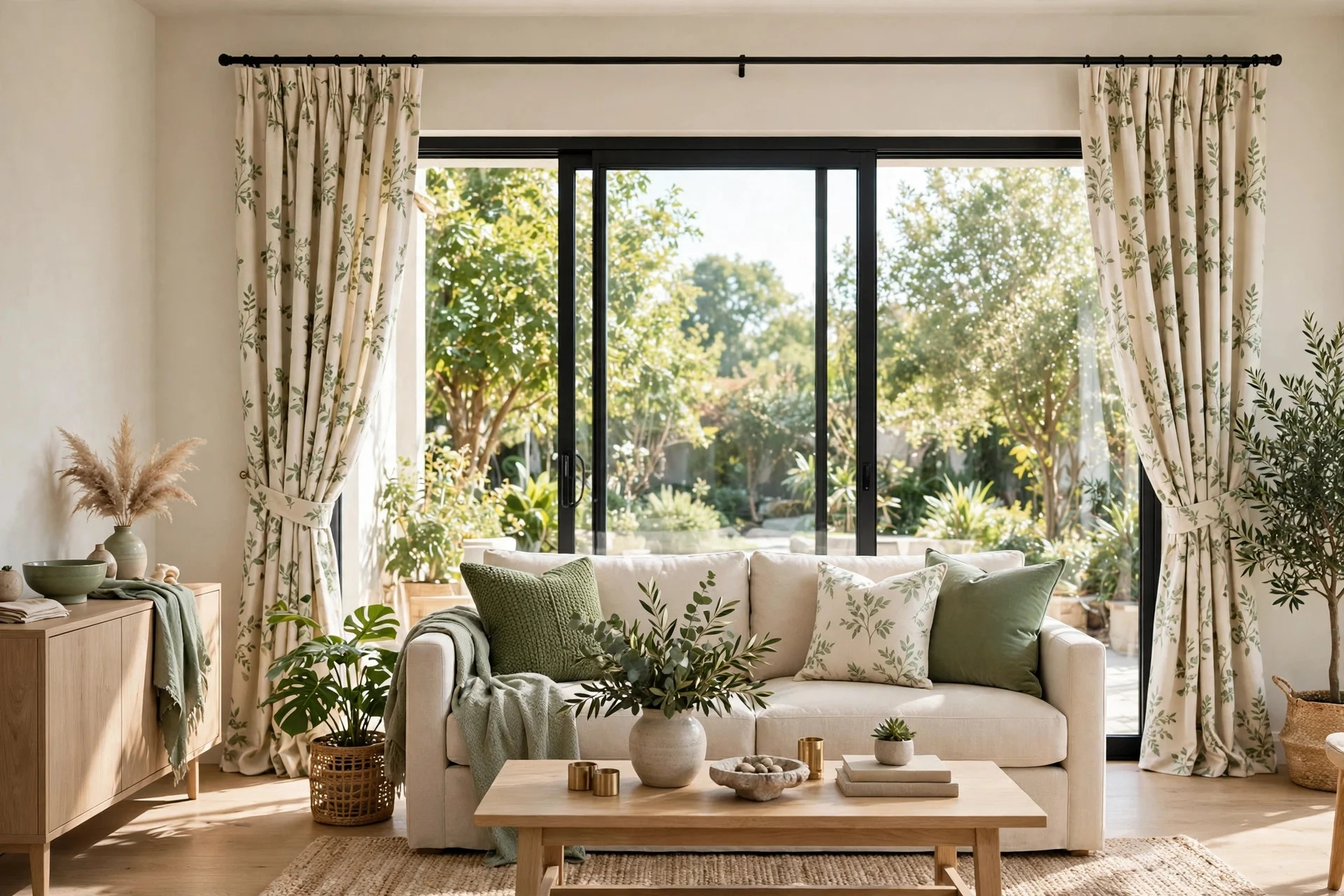
Cost: $50–$150 per panel; patterned fabric runs 20–30% more than solids.
Difficulty: Easy — standard hanging, 30–45 minutes.
Tip: Buy all panels from the same dye lot (check the packaging codes). Pattern and colour can shift slightly between batches, and on a 10-foot span the mismatch shows.
Watch out: Patterned curtains dictate the room’s palette. Pull one colour from the print for cushions or a rug and keep everything else neutral, or the room starts competing with itself.
7. Keep Your Verticals, Add Drapery Side Panels
Millions of sliding doors came with vertical blinds, and ripping them out feels wasteful when they still work. The fix: keep the verticals for light control and add stationary drapery panels on each side purely for looks. The blinds do the practical job; the curtains do the pretty job.
Vertical blinds are genuinely good at angled light control on a wide span — and genuinely bad at looking like anything other than an office. Side panels hide the plastic headrail ends, soften the hard vertical lines, and make the whole wall feel finished. One panel per side on a simple rod is enough, since they never need to close.
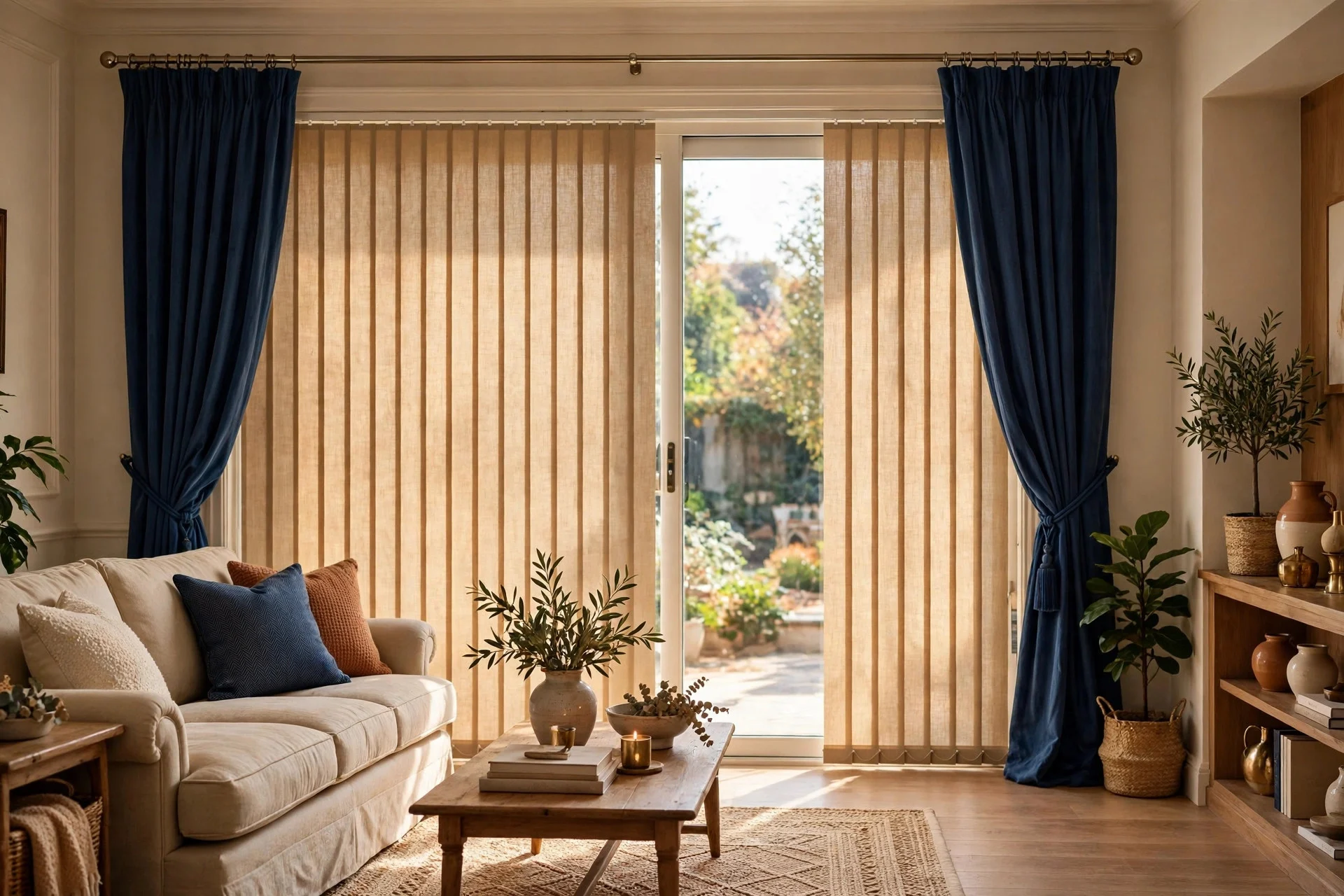
Cost: $60–$180 total — just two panels and a rod, since the blinds stay.
Difficulty: Easy — 30 minutes, and nothing gets removed.
Tip: Match the side panels to the blind colour’s undertone, not its exact shade. Warm beige blinds pair with warm-toned curtains (oatmeal, camel); cool grey blinds want cool-toned panels. Same temperature, different shade — that’s what looks intentional.
Watch out: Make sure the side panels hang outside the blinds’ travel path. If the panels sit where the verticals need to stack, you’ll be fighting your own curtains every time you open the blinds.
8. Rustic Back-Tab Linen on a Chunky Wood Rod
For farmhouse, cottage, or warm modern-rustic living rooms, nothing beats the casual softness of back-tab linen on a thick wooden rod. The tabs are hidden loops sewn on the back of the panel, so the front falls in relaxed folds, and the chunky rod gives the whole setup a handcrafted feel that thin metal rods can’t match.
This style suits sliding doors because it doesn’t try to be precise. The slightly rumpled linen and organic wood grain look better a little imperfect — which is exactly how curtains on a hardworking door end up anyway.
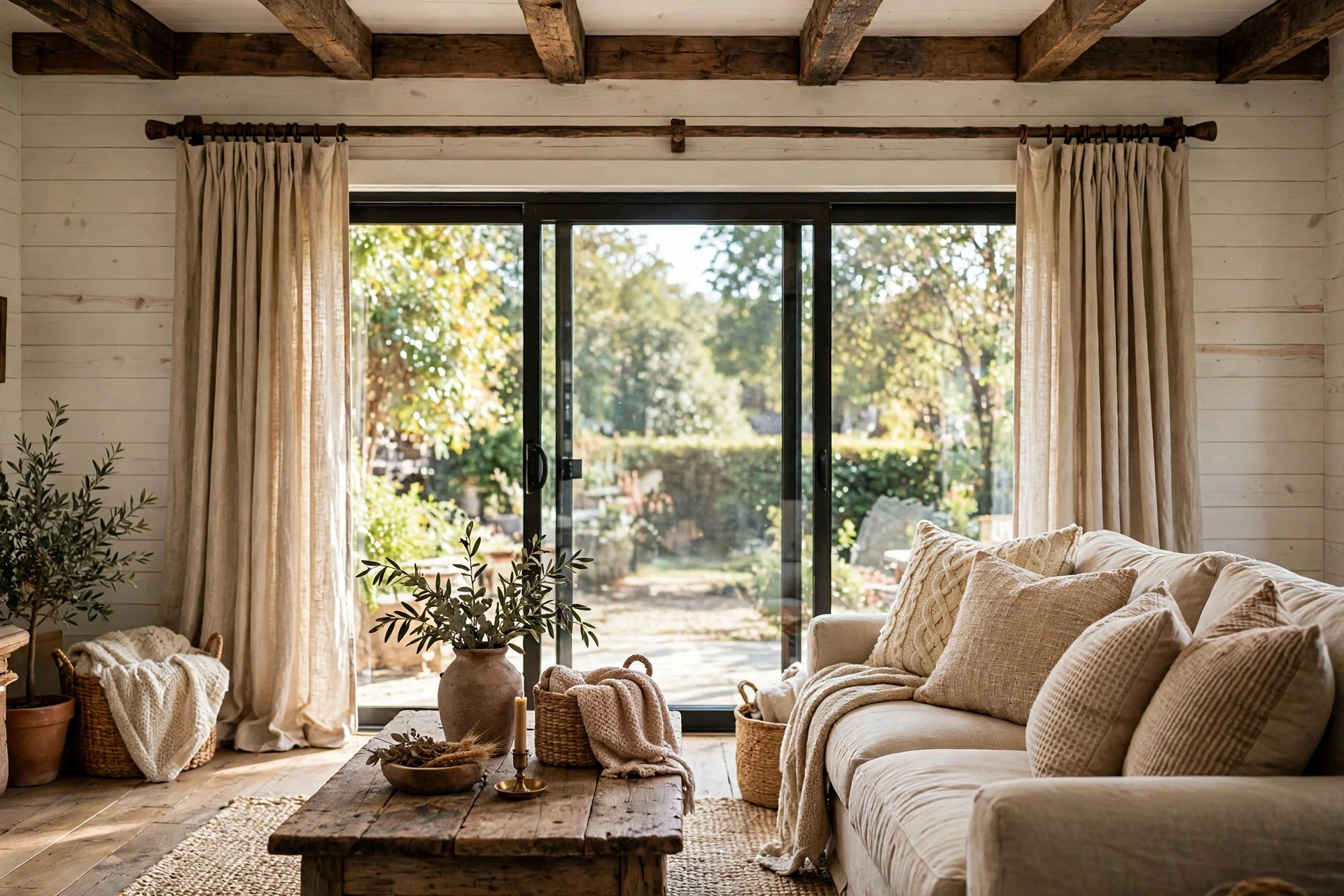
Cost: $45–$110 per linen panel; a chunky wood rod runs $50–$120.
Difficulty: Easy to moderate — wood rods are heavier; use proper wall anchors, about an hour.
Tip: Condition the tabs with a rub of plain candle wax where they meet the rod. It sounds odd, but it cuts friction dramatically, and back-tab panels are the one style most likely to stick when you yank them daily.
Watch out: Real linen shrinks if washed hot and stretches with humidity. Buy panels a touch long and wash cold, or choose a linen-look polyester if the doors get direct afternoon sun and daily use.
9. Grommet Tops for Wide, No-Fuss Spans
Grommet-top curtains — panels with metal rings punched along the top — are the workhorse choice for wide sliding doors. The large rings slide over the rod with almost no friction, the folds fall in deep, even waves, and the look is clean and contemporary without trying too hard.
Grommets also solve the fullness problem elegantly. About 1.5 times the door width is plenty, which keeps costs down on very wide doors where other styles demand twice the fabric. Getting the surrounding furniture scale right matters just as much as the curtains, so it’s worth reading up on choosing the right sofa size before you finalize the layout around the doors.

Cost: $35–$90 per panel; among the cheapest headings for wide spans.
Difficulty: Easy — the easiest panels to hang and adjust, 30 minutes.
Tip: Choose a rod diameter slightly smaller than the grommet’s inner opening — about a quarter inch of clearance is ideal. Too tight and the panels drag; too loose and they tilt and look sloppy.
Watch out: Metal grommets can scratch some rod finishes over time. A rod with a powder-coated or brushed finish hides the wear; a high-polish chrome rod will show every mark.
10. Ceiling-Mounted Track With Pinch-Pleat Drapes
For a formal or polished living room, mount the track directly to the ceiling and hang tailored pinch-pleat drapes. Taking the curtains all the way up makes the ceiling feel taller — the eye reads the full height as one continuous line instead of stopping at a rod.
Pinch pleats hold their shape well, which matters on a door that gets used: the pleats spring back instead of going limp like flat panels. A ceiling track also lets drapes stack tighter than a rod, so more glass stays visible when the curtains are open.
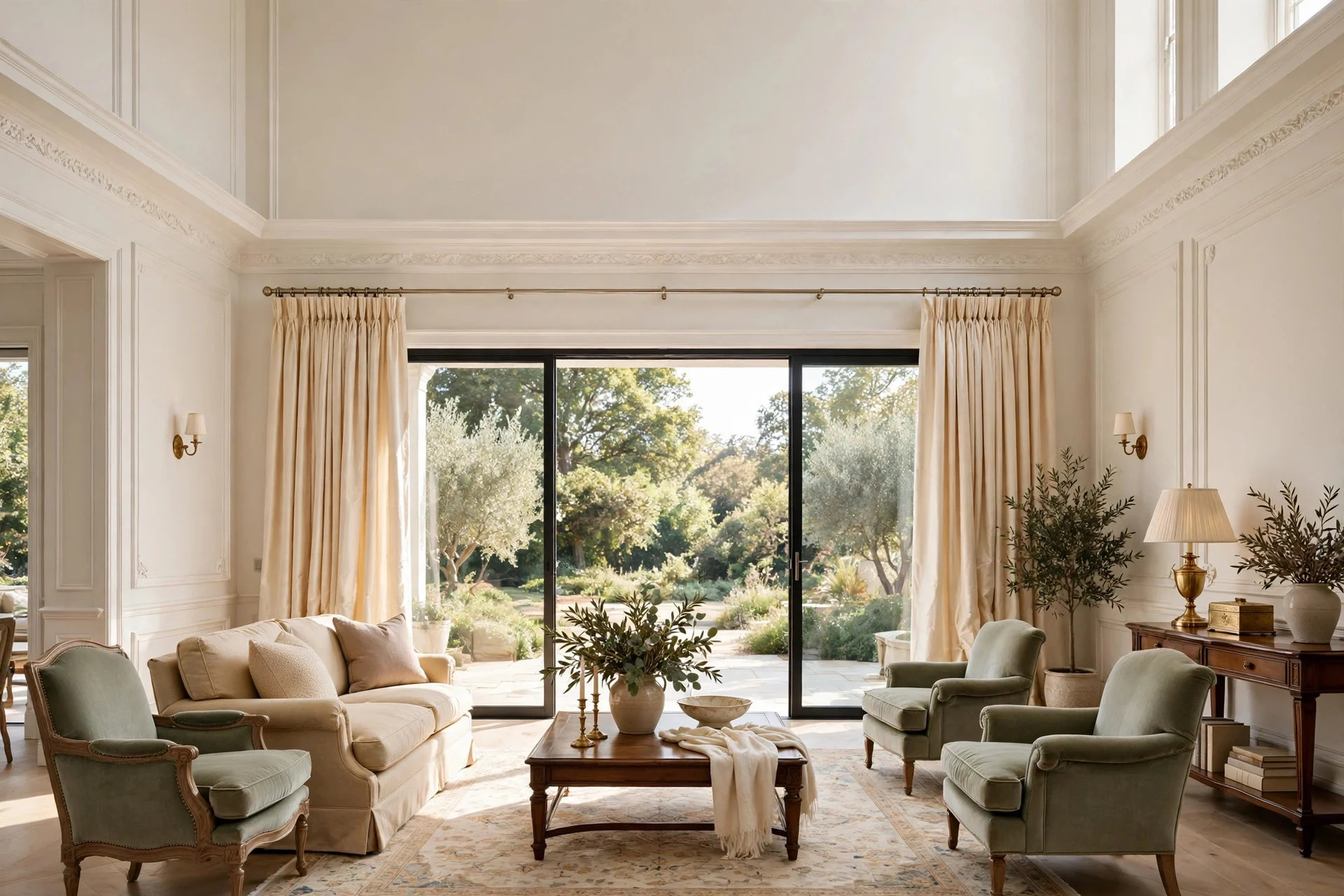
Cost: $150–$400 total (ceiling track $40–$100, pinch-pleat panels $60–$200 each).
Difficulty: Moderate to hard — ceiling mounting means finding joists or using toggle bolts; budget 2–3 hours or hire a handyman ($75–$150).
Tip: Mount the track 2–3 inches out from the wall so the pleats clear the door frame and handles when stacked. Too close and the fabric catches on the handle every single time — the most common regret with ceiling tracks.
How to Measure Sliding Doors for Curtains
Whatever style you pick, the measuring is the same, and it’s where most people go wrong. Measure the full width of the door frame, then add 8–12 inches on each side — that’s your rod or track width, and it guarantees the panels can stack off the glass. For length, measure from where the rod will sit (ideally 4–6 inches above the frame, or the ceiling) down to the hem: just kissing the floor is classic, while a 1-inch hover keeps high-traffic doors cleaner.
For width of fabric, multiply the rod width by your heading’s fullness factor — 1.5 for grommets, 2 for pleats and tabs, 2.5 for ripplefold — then divide by the panel width to get your panel count. When in doubt, round up; skimpy curtains are the one mistake you can’t style your way out of.
Questions People Ask About Sliding Door Curtains
Should curtains for sliding glass doors touch the floor?
Just barely touching — what designers call “kissing” the floor — looks best and stays put. For doors that open constantly, a half-inch hover is smarter: it avoids dust, pet hair, and the panels catching underfoot. Skip the puddled look here; extra fabric on the floor around a working door is a tripping hazard.
How wide should the curtain rod be for sliding doors?
Add 8–12 inches beyond the frame on each side, so 16–24 inches total. This lets the panels stack completely off the glass when open, keeping your light and your view. On walls with no spare space, a ceiling track that extends past the frame achieves the same thing.
Can you hang curtains over vertical blinds?
Yes — keep the blinds mounted and add stationary side panels on a separate rod (see idea #7). Make sure the curtain rod sits in front of the blind headrail and the panels hang outside the blinds’ stacking zone.
What is the best fabric for sliding door curtains?
It depends on the job: linen blends for airy daylight, triple-weave polyester for blackout, and solution-dyed acrylic for patio-side panels. For daily-use doors, prioritize fabrics that glide well and resist sun fading over delicate weaves like silk, which deteriorate fast near glass.
How do I stop curtains from blocking the door handle?
Three fixes: hang the rod or track wider so panels stack past the handle, choose a smooth-glide heading (ripplefold or grommets) that you can push fully clear with one hand, or use tie-backs on the handle side during the day. The wider rod is the permanent fix; the other two are habits.
Before You Buy: A Quick Checklist
Run through this before ordering anything. Measure the frame width and add 16–24 inches for the rod. Decide your priority — light, privacy, or both — and pick the fabric to match. Choose a heading that glides easily if the door gets daily use. Check that panels can stack fully off the glass without covering a light switch or thermostat.
Sliding glass doors ask more of curtains than any other window in the house. Pick the idea that fits how you live, measure twice, and hang them high and wide.