Introduction
A console table behind a sofa is one of those pieces of furniture most people own without ever quite knowing what to do with it. It collects remotes, charging cables, and a half-finished cup of coffee, and nobody feels inspired. But that narrow strip of tabletop is actually one of the most valuable styling surfaces in a living room. It sits at eye level when you’re standing, frames the back of the sofa, and shows up in nearly every photo of the room.
What I’ve seen work again and again is treating a sofa table like a small gallery rather than a dumping ground. Because it’s long and narrow, it rewards layering: tall things at the back, medium pieces in the middle, low objects at the front. A lamp, a stack of books, something living, something personal — that’s a whole room upgrade for the cost of a Saturday afternoon. The seventeen ideas below range from a few dollars to a few hundred, and every one of them is genuinely livable, not just photogenic.
The Ideas
1. The Classic Lamp-and-Books Anchor
A table lamp at one end of the console and a stack of coffee-table books at the other is the most reliable formula in the business, and it works because it solves two problems at once. The lamp adds warm, low light that makes the whole living room feel calmer after dark, and the books give you height and substance without spending much. I like lamps with a linen shade and a base that has some presence — ceramic, stone, or even aged brass — because a flimsy lamp on a narrow table looks apologetic.
My practical tip: put the lamp slightly off-center rather than jammed in the corner, and leave the cord tucked behind the table’s back leg or routed down with a small cord clip. Books should be things you’d actually open or at least proudly display, not filler. If you have a tall lamp and short books, prop one book upright on a small easel or lean a frame behind the stack to bridge the gap. Budget: $40–$150 (lamp is the main cost). Difficulty: Easy.
2. A Trailing Plant That Softens the Edge
Few things rescue a sofa table faster than something green spilling over its front edge. A pothos, philodendron, or string-of-pearls in a handsome pot on the tabletop instantly breaks the straight lines of the sofa and the table, and that softness reads as “styled” more than almost any object will. Behind-sofa tables get decent ambient light in most living rooms, which suits low-maintenance trailing plants perfectly.
Keep the pot elevated a few inches on a small riser or a stack of old books so the plant sits above the sofa’s back line — otherwise the trailing vines just collide with the cushions. Watering is the one discipline here: set a weekly reminder on your phone, because a crispy plant on the main table reads worse than no plant at all. If your thumb is truly not green, a good faux trailing plant in a real ceramic pot fools most people at this distance. Budget: $15–$45. Difficulty: Easy.
3. Leaned Artwork Instead of Hung Art
Propping a large framed print or canvas against the wall on top of the console, rather than hanging it, creates a relaxed gallery feeling that suits living rooms beautifully. The lean says “curated but not fussy,” and it has a practical advantage too: you can swap the art seasonally or whenever you find something new without touching a nail. Choose a piece that’s roughly two-thirds the width of the table so it reads intentional rather than accidental.
Behind the lean, layer a smaller frame or a tall vase so the composition has depth rather than one flat plane. Put a couple of felt pads on the back of the frame to protect your wall paint, and make sure the frame’s bottom edge sits at least an inch back from the table’s front edge so nobody knocks it while walking past. Thrifted frames with your own prints inside keep this nearly free. Budget: $20–$120. Difficulty: Easy.
4. The Sculptural Bowl Moment
One oversized, interesting bowl sitting alone on the console can carry the whole vignette. I’m talking about a hand-thrown ceramic bowl, a carved wooden dough bowl, a hammered metal piece — something with shape and material presence. This is the minimalist’s answer to the lamp-and-books formula: one strong object with breathing room around it, nothing else competing.
It works because a sofa table is often seen from across the room, and from a distance one clear silhouette reads better than six small trinkets. Fill the bowl seasonally if you like — citrus in winter, dried lavender in summer — or leave it empty and let the form speak. The only rule: the bowl needs to be big enough to matter. A small cereal bowl on a five-foot table looks lost. Go at least 12 inches across. Budget: $25–$100. Difficulty: Very easy.
5. Baskets Below for Real Storage
The shelf or floor space under a sofa table is storage gold if you treat it right. A pair of matching woven baskets tucked underneath turns that dead zone into a home for throws, dog toys, board games, or whatever the living room needs to swallow at a moment’s notice. From the front, all anyone sees is texture and order.
Match the baskets to each other but not necessarily to the table — seagrass under a wood table is classic, while black wire baskets under a light table add contrast. Keep one basket genuinely useful (blankets you actually use) so the system survives real life rather than existing only for photos. This is the rare decor idea that pays rent in daily function. Budget: $30–$80 for a pair. Difficulty: Easy.
6. Candlesticks at Three Heights
A cluster of candlesticks — three of them, at graduated heights — is one of the oldest styling tricks for a reason. The vertical rhythm draws the eye up from the sofa line, and the grouping feels deliberate even when the sticks themselves are thrifted finds. Brass, black metal, and white ceramic all work; what matters more than material is that the three heights step down noticeably, not gradually.
Place the tallest toward one end of the table and let the heights descend toward the center, or mirror the arrangement at both ends for symmetry. Battery-powered taper candles make this worry-free in a house with kids or pets — modern LED tapers with a warm flicker look surprisingly convincing from sofa distance. Light them for dinner parties and the whole room changes temperature. Budget: $15–$70. Difficulty: Easy.
7. A Small Home Bar Station
If your living room is where you entertain, the sofa table makes a natural bar cart alternative. A tray with a couple of decanters, two or three interesting bottles, and a small bowl for citrus or cocktail picks turns the back of the sofa into the spot guests gravitate toward. It’s social furniture disguised as decor.
Practicality matters here more than looks. Keep it to what you actually drink, use a tray with a lip so nothing slides off when someone bumps the table, and keep the bottles at the back of the tabletop away from the walkway side. A small cutting board leaning behind the tray adds height and warmth for almost nothing. During dry spells — hosting seasons come and go — the same tray can hold a carafe of water and glasses. Budget: $30–$90 (plus bottles). Difficulty: Easy.
8. Layered Textiles for Instant Warmth
A folded throw or a table runner draped along the length of the console adds the one thing most sofa tables lack: softness. Wood-on-wood-on-upholstery can read flat, and fabric breaks that up immediately. I like a runner with a subtle pattern laid lengthwise, with about six inches of overhang at each end, or a chunky knit throw folded in thirds and laid slightly off-center.
The color choice does real work here. Pull a tone from your rug or curtains and echo it in the textile to make the whole room feel pulled together. Then style on top of it — a lamp, a vase — so the fabric reads as a deliberate layer rather than a spill. Washable is wise; this surface collects dust. Budget: $15–$50. Difficulty: Very easy.
9. A Cluster of Ceramic Vases
Three to five vases in mixed heights, all in one material family but slightly different shapes, is a composition that almost cannot fail. Ceramic is the safest bet — matte white, speckled stoneware, or deep glazed colors all photograph and live beautifully. Group them tight at one end of the table, leaving the other end open for a lamp or a book stack.
Some of the vases can hold stems, some can sit empty; the emptiness is part of the point. Dried botanicals — pampas, eucalyptus, bunny tails — last months and suit this arrangement when you don’t want the upkeep of fresh flowers. One caution: on a narrow table in a high-traffic path, keep the cluster to the wall side and choose vases with a wide base so they’re tip-resistant. Budget: $30–$100. Difficulty: Easy.
10. The Reading Corner Setup
Turn half your sofa table into a proper reading station: a focused task lamp or a clip-on book light, a small stack of the books you’re actually reading now, and a ceramic mug or carafe for water. It gives the person sitting nearest that end of the sofa a little ritual spot, and it tells the story of a room that gets used.
The lamp choice is everything here. It needs to throw light down onto the pages, not glare sideways into eyes — a shade that directs light downward works best. Keep the current reads to two or three; a teetering tower of twelve books reads as a storage problem, not a reading corner. A tiny brass or wood bookmark tray catches keys and reading glasses too. Budget: $35–$110. Difficulty: Easy.
11. Vintage Finds With a Story
A couple of genuine vintage or antique objects on the console — an old camera, a brass telescope, a stack of leather-bound books, a weathered globe — give the room instant soul. Unlike new decor, these pieces come with texture and history built in, and they’re conversation starters when guests ask about them.
The trick is restraint: one or two vintage pieces maximum, surrounded by breathing room. Three antique stores’ worth of clutter on a console reads as a museum gift shop. Flea markets, estate sales, and grandmothers’ attics are the best sources, and half the joy is the hunt. Mix your vintage find with something modern — a sleek lamp next to a brass telescope — so the room feels collected rather than period-set. Budget: $10–$150 (thrifting dependent). Difficulty: Moderate — requires hunting.
12. A Framed Photo Gallery in Miniature
Three to five small framed photos — family, travel, friends — clustered or lined along the console turns the sofa table into the room’s memory shelf. Keep the frames consistent (all black, all brass, all natural wood) so a handful of different photos reads as one collection rather than a scattered bunch.
Vary the photo sizes slightly within the matching frames, and don’t be afraid to include one non-photo item — a small map, a concert ticket in a frame, a child’s drawing — to keep it feeling personal rather than staged. Behind the frames, a low trailing plant or a small lamp fills the back row so the gallery has depth. Rotate photos every few months; stale frames become invisible. Budget: $20–$60. Difficulty: Easy.
13. The Scent Station
A reed diffuser or a quality candle at the center of the console does invisible work: guests register the scent before they register any object. Place it where air circulates — near a doorway or a vent path — and choose one scent for the living room rather than competing fragrances. Fig, cedar, and warm amber tones suit most living rooms; citrus reads fresher in summer.
Style it like any other object: set the diffuser bottle on a small tray or a stack of coasters, and if you use candles, a lidded jar keeps the scent contained and the dust out between uses. Keep open flames away from the sofa’s fabric edge and never leave them burning unattended. This is a small investment with an outsized sensory payoff. Budget: $15–$50. Difficulty: Very easy.
14. The Decorative Tray Corral
When a console surface keeps collecting clutter no matter what you do, a tray is the answer — not as a punishment, but as a boundary. A large tray with a raised edge gathers remotes, coasters, and the odds and ends of daily life into one defined zone, and it looks deliberate doing it. Leather, wood, rattan, or stone — pick a material that contrasts slightly with the tabletop so the tray reads as its own layer.
Inside the tray, arrange three small things: a candle, a coaster stack, and one small object you like. Everything else that lands on the table goes inside the tray’s invisible rule: if it doesn’t fit, it lives elsewhere. When guests come over, you lift the whole tray off in one move and the table is instantly clean. Budget: $20–$60. Difficulty: Very easy.
15. A Seasonal Vignette That Rotates
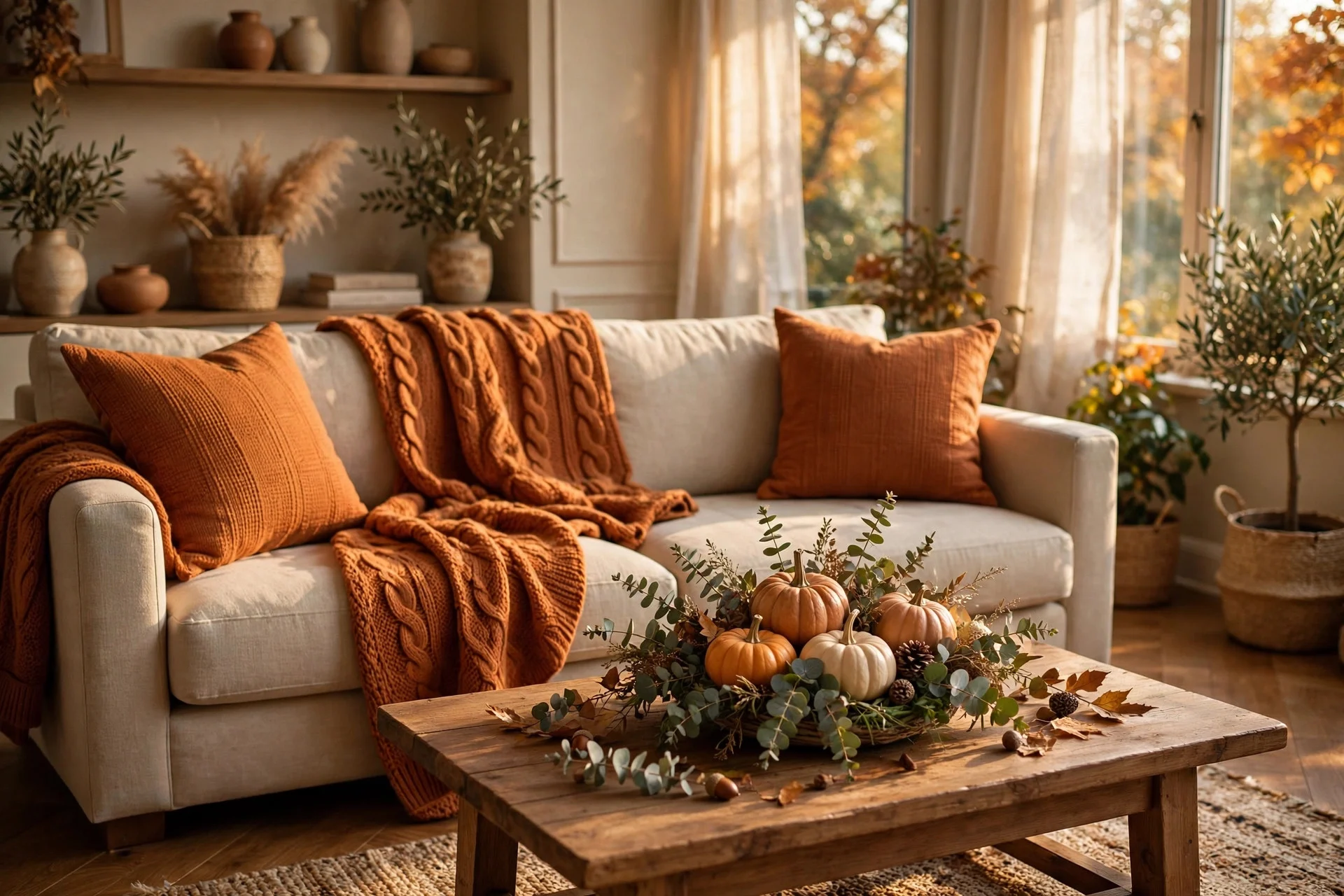
Dedicate one end of the console to a small arrangement you change four times a year, and the living room never goes stale. Autumn gets dried wheat and a pumpkin; winter, evergreen sprigs and a candle in glass; spring, fresh tulips and a pastel vase; summer, a bowl of shells or a blue-and-white pot. The rotation gives you a reason to notice the room again.
Keep the footprint small — a tray or a 12-inch zone — so the swap takes ten minutes, not an afternoon. Store the off-season pieces in one labeled box and the whole habit becomes nearly effortless. The rest of the console stays constant (lamp, books), so only the seasonal corner changes and the room keeps its familiar backbone. Budget: $10–$40 per season. Difficulty: Easy.
16. Stacked Vintage Suitcases
A tower of two or three vintage suitcases on or beside the console adds height, storage, and a travel-story vibe in one move. On the tabletop they work best on a longer console where they can anchor one end; beside the table, on the floor, they fill an awkward gap. Either way, the inside of the top case is hidden storage for out-of-season throws or photo albums.
Look for hard-sided cases with leather straps and intact corners — soft-sided luggage looks deflated stacked. The colors and stickers should harmonize with your room, not fight it. A small plant or a lamp on top of the stack finishes the composition and reclaims the surface. This one has strong opinions attached: people either love it or hate it, so commit fully or skip it. Budget: $20–$80 (thrifted). Difficulty: Easy.
17. A Mirror Behind the Table
Hanging or leaning a mirror on the wall directly behind the console doubles your styling for free — every object on the table gets reflected, and the mirror bounces light back into the room. In a small or dark living room, this single move can make the space feel noticeably larger. A round mirror softens all the rectangular lines; an arched one adds architectural interest; a large rectangle doubles as a window illusion.
Position the mirror so it reflects something pleasant — a window, a plant, artwork — not the ceiling fan or a blank wall. If the mirror is large, hang it securely into a stud; consoles get bumped, and a leaning large mirror in a house with kids is a risk. The mirror counts as decor and light fixture in one, which makes it the highest-impact idea on this list per dollar. Budget: $40–$150. Difficulty: Moderate (hanging hardware).
Quick Comparison
| # | Idea | Style Vibe | Budget | Difficulty |
|---|---|---|---|---|
| 1 | Lamp + books anchor | Classic, cozy | $40–$150 | Easy |
| 2 | Trailing plant | Organic, fresh | $15–$45 | Easy |
| 3 | Leaned artwork | Gallery, relaxed | $20–$120 | Easy |
| 4 | Sculptural bowl | Minimalist | $25–$100 | Very easy |
| 5 | Storage baskets below | Practical, warm | $30–$80 | Easy |
| 6 | Candlesticks trio | Traditional, moody | $15–$70 | Easy |
| 7 | Home bar station | Social, luxe | $30–$90 | Easy |
| 8 | Layered textiles | Soft, inviting | $15–$50 | Very easy |
| 9 | Ceramic vase cluster | Modern organic | $30–$100 | Easy |
| 10 | Reading corner | Personal, lived-in | $35–$110 | Easy |
| 11 | Vintage finds | Collected, storied | $10–$150 | Moderate |
| 12 | Photo gallery | Sentimental | $20–$60 | Easy |
| 13 | Scent station | Sensory, polished | $15–$50 | Very easy |
| 14 | Tray corral | Tidy, intentional | $20–$60 | Very easy |
| 15 | Seasonal vignette | Festive, fresh | $10–$40/season | Easy |
| 16 | Vintage suitcases | Eclectic, travel | $20–$80 | Easy |
| 17 | Mirror behind table | Bright, spacious | $40–$150 | Moderate |
How to Style a Sofa Table Without Getting It Wrong
The most common mistake I see is overcrowding. A console table is narrow — usually 10 to 14 inches deep — so it fills up fast. The rule that never fails me is the rule of three groups: divide the tabletop into left, center, and right, and give each zone one job. One zone gets height (a lamp or tall vase), one gets medium mass (books, a bowl), one gets something low or living (a plant, a candle). Leave air between the groups. That breathing room is what separates “styled” from “stuffed.”
Height comes second. Almost every weak console I’ve seen suffers from everything sitting at the same level — all the objects lined up like soldiers at six inches tall. Vary it deliberately: something at 20+ inches, something at 10–14 inches, something low. Use books and risers as elevators for short objects. And step back to the room’s entrance to check the whole composition; a sofa table is almost always viewed from across the room first, so it needs to read from eight feet away, not just from two.
Finally, respect the table’s job in real life. If your household drops keys and phones on it, build the tray corral into the plan instead of fighting it. If the sofa gets moved for cleaning, keep heavy objects minimal. The best-styled console is one that still looks good after a week of actual living — so build for maintenance, not just for the reveal photo.
Frequently Asked Questions
How tall should decor be on a behind-sofa table? Aim for a mix, but nothing should block sightlines across the room. The tallest object (a lamp or vase) can rise 20–30 inches above the tabletop; the sofa back itself is usually 30–36 inches from the floor. Keep everything visually below the top of any artwork hanging above, and make sure seated people can still see over the arrangement comfortably.
How far should a sofa table be from the sofa? Flush against the back of the sofa is ideal — no gap, or a gap of an inch or two at most. A table floating behind the sofa looks accidental and invites clutter to collect in the gap. If your table is deeper than the space allows, it’s the wrong table; consoles for this job are typically 10–14 inches deep.
Can I style a sofa table on a tiny budget? Absolutely — several ideas here cost under $25. Thrifted frames, a trailing pothos cutting in a jar of water, a stack of books you own, and a folded throw you already have will transform a console for nearly nothing. The skill is in the arrangement, not the price tag.
Should the decor match the coffee table decor? Coordinate, don’t match. Pull one repeated material or color through both surfaces — the same brass finish, the same wood tone — but let each surface have its own composition. Identical styling on both looks like a furniture showroom, not a home.
What do I put on a sofa table if I have kids or pets? Go sturdy and minimal: a heavy lamp with a cord tucked away, a large bowl with nothing breakable in it, storage baskets below for toys. Skip glass vases at the table’s edge, open flames, and anything top-heavy. A tray corral is your best friend — it contains the chaos in one movable unit.
How do I keep a sofa table from becoming a clutter magnet? Give every daily item a designated home (tray for remotes, basket for throws) and keep one zone of the table strictly decorative with nothing “useful” on it. The decorative zone sets the standard — once the whole surface is a drop zone, there’s no visual incentive to tidy it. Do a two-minute reset when you leave the room.
Is it okay to leave a sofa table empty? Yes, if the table itself is beautiful. A sculptural console in good wood or metal can hold a room on its own, especially with a mirror or art above it. Emptiness is a styling choice; dust and a lone charging cable are not. If it’s empty, keep it clean and intentional.
What’s the best lighting for a behind-sofa table? A table lamp with a warm bulb (2700K) is the classic answer — it adds ambient light at exactly the right height for evening reading and conversation. If there’s no outlet nearby, a battery-operated lamp or a cluster of LED candles gives you the glow without the cord problem.
Conclusion
A behind-sofa table is a small surface with an outsized role: it’s the backdrop to your living room’s main gathering spot. Whether you go with one sculptural bowl or a layered lamp-and-books composition, the principle is the same — give it height, give it life, and give it room to breathe. Start with one idea from this list this weekend, live with it for a week, and adjust. The best version of your console is the one that survives real life and still makes you smile when you walk into the room.