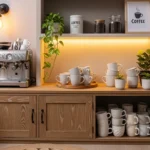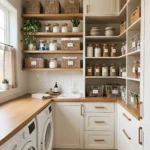
Every kitchen has one — that awkward corner that never seems to earn its keep. You walk past it a dozen times a day, shove a stray broom or a stack of grocery bags into it, and eventually stop noticing it altogether. Corners are the most commonly wasted real estate in any kitchen layout, and yet they’re often the easiest spot to turn into serious storage if you approach them the right way.
The problem isn’t that corners are useless. It’s that standard cabinetry and shelving were never designed with corners in mind. Straight shelves leave deep, unreachable gaps. Standard cabinets create blind spots you need to crawl into. So the corner becomes a dumping ground instead of a working part of the kitchen.
A well-planned corner pantry changes that completely. With the right shelving style, door type, or built-in system, that dead zone can hold a surprising amount of food, cookware, and small appliances — often more than a full wall of standard cabinets, because you’re finally using depth and height that used to go to waste.
This list walks through 22 practical corner pantry ideas, ranging from budget-friendly DIY fixes to full custom builds. Some work for renters who can’t renovate. Others are suited to homeowners planning a bigger kitchen overhaul. By the end, you’ll have a clear sense of which approach fits your space, your budget, and how much storage you actually need.
1. Diagonal Corner Pantry Cabinet
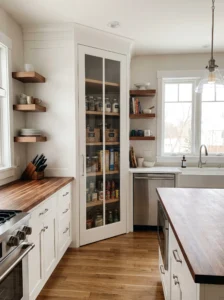
A diagonal corner cabinet sits at a 45-degree angle across the corner, creating a single door and a triangular interior that’s far more usable than it looks. This works because it eliminates the deep, unreachable dead space you get when two straight cabinet runs simply meet at a right angle.
It’s best suited for kitchens undergoing a full renovation, since it requires custom or semi-custom cabinetry rather than stock units. Inside, adjustable shelving lets you stack canned goods toward the front and taller items like cereal boxes or oil bottles toward the back. Stick to a finish that matches your existing cabinet line — white shaker or a matching wood tone keeps it from looking like an afterthought.
The biggest mistake people make here is skipping soft-close hinges. A heavy diagonal door swinging freely can bang into an island or walkway. In real kitchens, this style quietly becomes the most-used cabinet in the room simply because everything inside is visible at a glance instead of buried in a blind corner.
2. Lazy Susan Corner Pantry
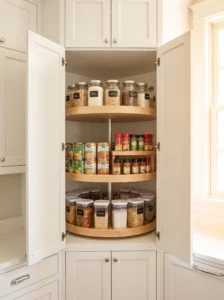
The rotating lazy Susan remains one of the most reliable fixes for corner storage, and there’s a reason it hasn’t gone out of style. A full circular or kidney-shaped tray spins 360 degrees, so nothing gets pushed to the back and forgotten.
This works especially well in smaller kitchens where you need every inch of a base cabinet corner to count. Two-tier lazy Susans are worth the extra cost — they roughly double your storage without needing more floor space. Choose a durable polymer or coated wire tray rather than thin plastic, since these get spun and loaded daily.
Lighting isn’t usually necessary here since the rotation brings items to you, but a light-colored interior finish helps you spot labels faster. The common mistake is overloading one side, which throws off the spin and strains the center pole over time. Balance heavier jars and cans across both tiers instead of stacking them all on one shelf.
3. Pull-Out Corner Drawer System
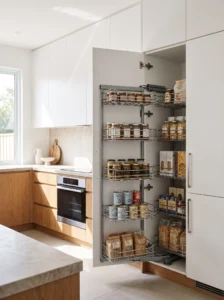
Pull-out drawer systems designed specifically for corners — sometimes called “magic corner” units — extend outward on a two-stage track when you open the door, bringing the entire contents of the cabinet within reach.
These work best in kitchens where accessibility matters, since there’s no reaching or crouching involved. They’re pricier than a basic lazy Susan, but the payoff is real: nothing sits in a blind spot, and the mechanism handles weight well when installed correctly. Go with steel-frame baskets over wire-only designs for longevity, and make sure the cabinet box is reinforced to handle the extended weight when fully pulled out.
Sizing matters more here than in most other corner solutions — measure your cabinet opening carefully before ordering, since these systems are far less forgiving of a poor fit than a simple shelf. Once installed, most homeowners say they forget the corner was ever a problem at all.
4. Open Corner Shelving Unit
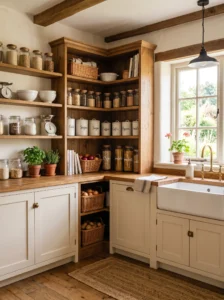
Skipping doors altogether and going with open shelving in the corner creates a display-and-storage hybrid that works particularly well in farmhouse, cottage, or Scandinavian-style kitchens.
This approach shines in kitchens with good natural light, since open shelves photograph and look best when they’re not competing with shadows. Use matching glass jars, labeled canisters, or woven baskets to keep the look intentional rather than cluttered. Wood shelving with visible brackets adds warmth; floating shelves with hidden supports feel more modern and minimal.
The tradeoff is exposure to dust and grease, especially if the corner sits near your stove. Keep everyday dry goods here and store anything greasy-prone in closed containers. Done well, an open corner pantry becomes something you actually want to look at rather than hide — though it does require more regular tidying than a closed cabinet.
5. Floor-to-Ceiling Corner Pantry Tower
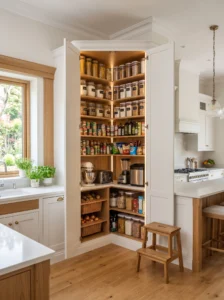
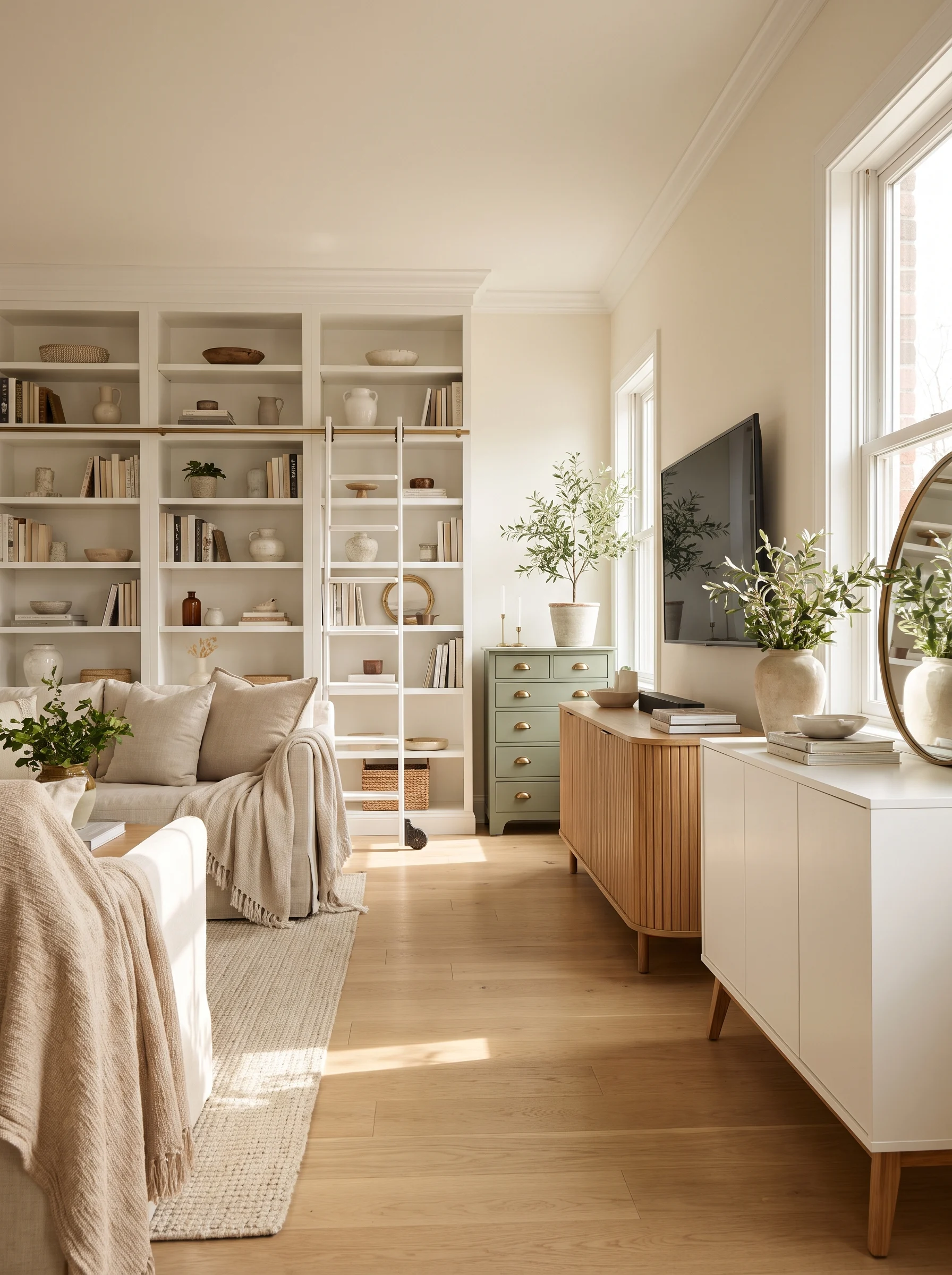
For kitchens with taller ceilings, a floor-to-ceiling corner tower turns unused vertical space into a genuine walk-in-pantry alternative without needing a separate room.
This works best when there’s at least eight feet of ceiling height to play with, since the upper shelves need a step stool anyway and shouldn’t feel like an afterthought. Use pull-out or rolling ladder access for the top shelves, and reserve those higher spots for bulk items and small appliances you use only occasionally — holiday baking dishes, the stand mixer, seasonal serveware.
Lighting is worth the investment here. A single interior LED strip along one side makes the whole tower usable even in a dim corner. The mistake most people make is filling top shelves with everyday items, which defeats the purpose. Keep daily-use goods at eye level and let the height do the heavy lifting for storage you only need occasionally.
6. Corner Pantry with Glass-Front Doors
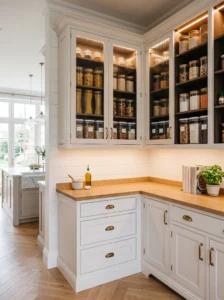
Swapping solid doors for glass-front ones on a corner pantry cabinet gives you the organization of a closed unit with the visual openness of open shelving — a nice middle ground for kitchens that want both function and style.
This works particularly well in kitchens with a cohesive color scheme, since glass fronts put your pantry contents on subtle display. Frosted or reeded glass softens the look if you’d rather not show every can and box; clear glass works better if your pantry staples are already stored in matching containers.
Interior lighting makes a real difference with glass doors — a warm LED puck light turns the corner into a soft focal point rather than a dark gap behind glass. Avoid mixing too many packaging styles inside, since glass doors reveal clutter just as easily as they reveal order. This style rewards a little extra effort in decanting and labeling.
7. Blind Corner Cabinet with Wire Baskets
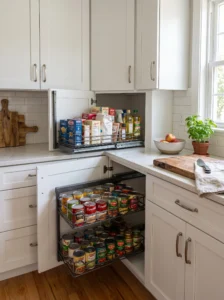
If a full pull-out system isn’t in the budget, wire basket inserts designed for blind corner cabinets offer a middle-ground upgrade. These slide in and out on simple tracks, giving you partial access without the cost of a rotating or extending mechanism.
This suits kitchens doing a lighter refresh rather than a full remodel, since the baskets often install into existing cabinet boxes with minimal modification. Chrome or coated wire holds up better than uncoated metal, which can rust from kitchen humidity over time. Keep heavier canned goods on the lower basket and lighter boxed items up top to keep the whole unit stable when sliding.
The main limitation is that the very back corner still isn’t fully reachable, so it’s best reserved for backstock items you don’t need often — extra paper towels, backup spices, bulk pasta. It’s a practical, lower-cost step up from a standard blind cabinet without a full renovation.
8. Corner Pantry Cupboard with Adjustable Shelves
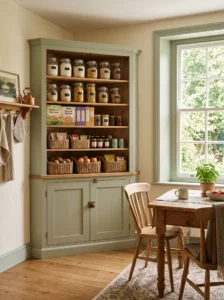
A simple, freestanding or built-in corner cupboard with adjustable shelving is one of the most budget-friendly ways to claim a wasted corner, especially in older kitchens where custom cabinetry isn’t practical.
This works well in kitchens with a bit of open corner space rather than an enclosed cabinet gap — think dining nooks or breakfast corners near the kitchen proper. Adjustable pegs or shelf pins let you customize spacing as your storage needs change, which matters more than people expect; cereal boxes and small spice jars need very different shelf heights.
Choose solid wood or a sturdy engineered wood over particleboard if the cupboard will hold anything heavy, since sagging shelves are a common complaint with cheaper builds. A coat of paint matching your trim helps a freestanding piece look built-in rather than added on. This is a solid entry point if you’re testing whether a corner pantry setup works for your routine before committing to something permanent.
9. Under-Stairs Corner Pantry Conversion
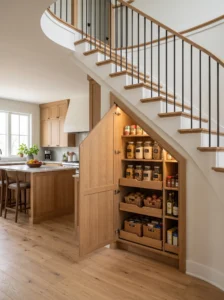
If your kitchen backs onto a staircase, the triangular space underneath is often one of the most overlooked storage opportunities in the entire home. Converting it into a corner pantry can add a genuinely substantial amount of storage.
This works best in homes with open-concept layouts where the kitchen and stairwell share a wall, making access straightforward. Because the space narrows toward the back, shallow pull-out drawers work far better than fixed shelving — you lose less usable depth to awkward reaching. Matching the door or facade to your kitchen cabinetry keeps the conversion looking intentional rather than like a leftover closet.
Ventilation is worth checking before you commit, since enclosed under-stair spaces can trap humidity. A small vent or gap at the base helps prevent musty smells from building up around packaged goods. Done well, this is one of the highest-storage-per-dollar ideas on this list, since you’re not adding square footage — just finally using what’s already there.
10. Corner Pull-Out Pantry Cabinet (Slim Vertical)
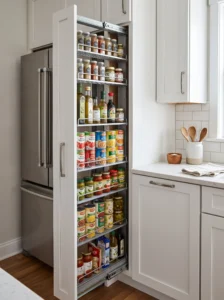
A narrow, vertical pull-out pantry designed to fit into a tight corner gap — often just 6 to 12 inches wide — is ideal for kitchens where a full cabinet isn’t possible but a sliver of unused wall space sits idle.
This works especially well next to a refrigerator or at the end of a cabinet run, tucking neatly into a corner that would otherwise collect dust behind an appliance. Choose a unit with adjustable door racks on both the front and back panels to maximize the slim footprint — spices, oils, and canned goods fit naturally into these narrow shelves.
Soft-close glides are worth prioritizing here, since these units get opened frequently and cheap hardware wears out fast under daily use. The one drawback is weight capacity; avoid loading the top shelves with anything too heavy, as slim units can tip forward if unbalanced. For tight kitchens, this is often the single most efficient use of a leftover corner gap.
11. Corner Pantry with Sliding Barn Door
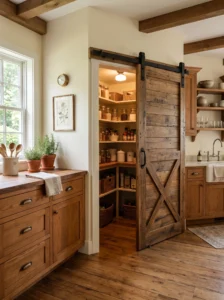
Replacing a swinging cabinet door with a small sliding barn door adds character to a corner pantry while solving a real functional problem — swinging doors in corners often collide with islands, walkways, or adjacent cabinetry.
This style fits especially well in farmhouse, industrial, or rustic kitchen designs, though a slim-profile sliding track works in more modern spaces too if you choose a flat, unadorned door panel. Because the door doesn’t need clearance to swing open, you can position the corner pantry closer to a walkway without worrying about blocked traffic flow.
Hardware quality matters more than people expect — a cheap track will stick or rattle within a year of daily use. Go with a soft-close sliding mechanism rated for the door’s actual weight. The main styling mistake is choosing a door finish that doesn’t relate to anything else in the kitchen; tie it to your flooring or an accent beam if you have one for a look that feels planned rather than bolted on.
12. Corner Pantry Nook with Open Cubbies
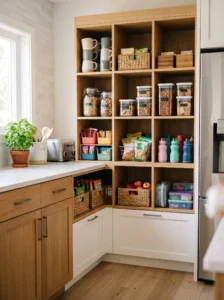
Small open cubbies built into a corner — think a honeycomb-style grid or simple square compartments — work well for kitchens that want quick-grab storage for everyday items rather than deep bulk storage.
This suits busy households where kids or multiple people are grabbing snacks, mugs, or lunch supplies throughout the day, since open cubbies don’t require opening a door first. Keep cubby depth shallow, around 10 to 12 inches, so items don’t get lost or stacked three deep where you can’t see what’s behind the front row.
Painting the interior of each cubby a slightly different shade from the surrounding cabinetry can help define the space visually without needing extra trim work. The tradeoff, as with any open storage, is that it needs more frequent tidying to avoid looking cluttered. For households that already struggle to keep closed pantries organized, though, the visibility here can actually improve habits rather than hurt them.
13. Corner Pantry with Built-In Spice Rack
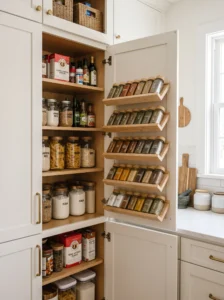
Dedicating one section of a corner pantry specifically to a built-in, angled spice rack solves two problems at once — it uses a shallow section of the corner that’s too narrow for bulky items, and it keeps spices visible instead of buried in a drawer.
This works particularly well in the upper portion of a corner unit, near eye level, since spices are used constantly and shouldn’t require digging. Angled shelving, tilted slightly forward, lets you read labels without pulling every jar out. Keep the rack no more than four to five inches deep per tier — anything deeper wastes space and hides jars behind each other.
Consistent jar sizing makes a bigger visual difference here than in almost any other part of the pantry, since spice racks are one of the most visible storage zones in daily use. It’s a small addition, but it’s the kind of detail that makes a corner pantry feel considered rather than purely functional.
14. Two-Toned Corner Pantry Cabinetry
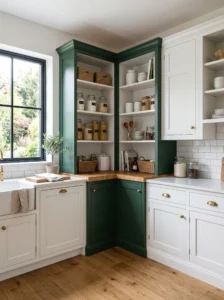
Painting or finishing a corner pantry in a different tone from the surrounding cabinets turns a functional storage fix into a genuine design feature — a small but effective way to add visual interest to an otherwise plain kitchen layout.
This works best when the rest of your cabinetry is a fairly neutral tone, giving the corner pantry room to stand out without clashing. A deep green, navy, or warm terracotta against white or light wood cabinetry tends to read as intentional rather than mismatched. Keep hardware consistent across both tones so the kitchen still feels like one cohesive design rather than two separate projects.
This idea works whether you’re building a new corner pantry or simply repainting an existing one, which makes it one of the more affordable ways on this list to add real personality to the kitchen. The only real risk is going too bold without testing a sample first — corners catch light differently than flat walls, so a color that looks right on a swatch can shift noticeably once it’s on cabinetry.
15. Corner Pantry with Built-In Wine and Bottle Storage
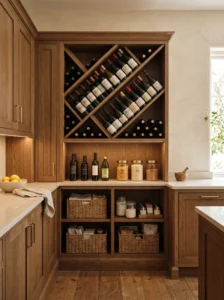
For kitchens where entertaining is part of the routine, dedicating a section of the corner pantry to angled bottle storage keeps wine, oil, and vinegar bottles both organized and easy to reach.
This works well in the lower or mid-section of a corner unit, where bottles can be stored horizontally without taking up prime shelf space needed for boxed and canned goods. Diagonal wooden or metal bottle racks use the corner’s natural angle more efficiently than straight horizontal slots would in a standard cabinet run.
Keep this section away from any nearby heat source, like the stove or oven wall, since consistent temperature matters more for wine than for most other pantry items. It’s a detail that turns a purely practical storage corner into something that also supports how the kitchen actually gets used for gatherings, without requiring a separate bar cart or wine fridge.
16. Corner Pantry Cabinet with Pull-Down Shelving
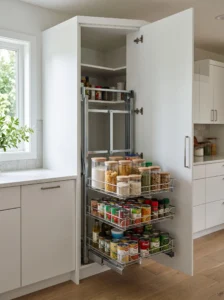
Pull-down shelf mechanisms, more commonly seen in upper cabinets, can be adapted for taller corner pantry units to bring high shelves within easy reach without a step stool.
This is especially useful for kitchens where accessibility is a priority, or simply for households where the primary cook is shorter than average. The mechanism lowers the shelf toward you at the pull of a handle, then returns it to its stored position — practical for corner units where the depth would otherwise make reaching the back of a high shelf genuinely difficult.
These systems cost more than fixed shelving, so they’re best reserved for the section of the pantry you access most, rather than every shelf in the unit. Weight limits are worth checking carefully, since the mechanism itself has a maximum load. For anyone who’s ever kept a step stool permanently parked in the kitchen, this single upgrade can eliminate the need for one entirely.
17. Compact Corner Pantry for Small Kitchens
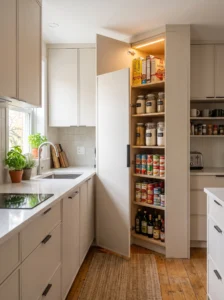
Not every kitchen has room for a full corner tower or wide diagonal cabinet, and a compact version — often just 18 to 24 inches per side — proves that a corner pantry doesn’t need to be large to be useful.
This works especially well in studio kitchens, galley layouts, or older homes where corners are naturally tighter. Prioritize vertical shelving over depth here, since a compact footprint needs to work hard on height rather than width. Slim door pulls and a flush-mounted design keep the unit from feeling bulky in an already tight space.
Because every shelf counts more in a smaller unit, resist the urge to store bulky, infrequently used items here — reserve compact corner pantries for daily staples only. It’s proof that even a small, awkward corner in a tiny kitchen can hold a genuinely useful amount of food and supplies with the right planning.
18. Corner Pantry with Chalkboard or Labeled Doors
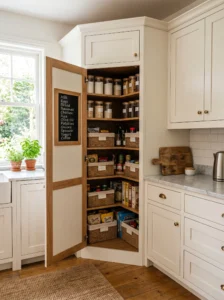
Adding a chalkboard panel or printed labels to a corner pantry door is a low-cost way to add both function and personality — you get a running grocery list or inventory tracker built right into the storage itself.
This works particularly well in family kitchens where meal planning or grocery lists are a shared task. A chalkboard-painted door panel, framed with simple trim, lets anyone jot down what’s running low without needing a separate notepad stuck to the fridge. Alternatively, printed labels on baskets or shelves inside the pantry cut down on the “where does this go” confusion in busy households.
Keep the chalkboard area small and framed rather than covering the entire door, since a full chalkboard surface can start to look messy fast. This is one of the lowest-cost ideas on the list, but it adds genuine daily usefulness that a purely decorative update wouldn’t.
19. Corner Pantry with Appliance Garage Combo
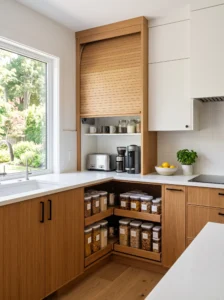
Combining a corner pantry with a small appliance garage — a hidden compartment for the toaster, coffee maker, or blender — solves two counter-clutter problems in a single build.
This works best when the corner pantry sits adjacent to counter space, since the appliance garage typically opens at counter height with a tambour or lift-up door, letting you roll appliances out only when needed. Below or beside it, the pantry section handles food storage, keeping the whole zone dedicated to daily kitchen tools rather than spread across the counter.
Ventilation is the detail people miss most often — appliances that generate heat, like toasters, need airflow even when tucked away. A small vented panel at the back prevents heat buildup. This combo idea tends to make the biggest visible difference in a kitchen, since clearing counters has an outsized effect on how organized the whole room feels.
20. Corner Pantry with Under-Cabinet Lighting
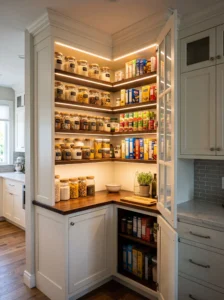
Adding under-cabinet or under-shelf LED lighting to a corner pantry addresses one of the most common complaints about corner storage — that the deepest parts are always dim, even during the day.
This works in nearly any corner pantry style, from open shelving to fully enclosed cabinets, and it’s one of the more affordable upgrades on this list since battery-powered or plug-in LED strips don’t require an electrician in most cases. Warm white lighting, rather than cool or blue-toned LEDs, tends to suit kitchen pantries better and makes labels easier to read at a glance.
Position the strip along the front edge of each shelf rather than the back, so light spills forward onto the shelf below instead of shining into your eyes when you open the door. It’s a small addition, but it’s often the difference between a corner pantry you actually enjoy using and one you avoid because you can never quite see what’s in it.
21. Corner Pantry Repurposed from an Unused Closet
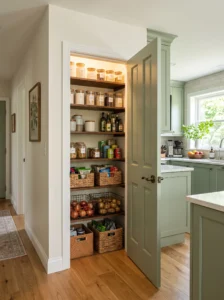
If your kitchen sits near a hallway or entry closet that’s rarely used for its original purpose, converting it into a corner pantry can be one of the most storage-efficient projects on this entire list, since you’re working with existing wall space and, often, existing shelving.
This works particularly well in older homes with coat closets or linen closets positioned near the kitchen. Removing the closet door in favor of a pantry-style door, or adding shelving units suited to food storage rather than linens, is usually enough to make the conversion functional. Depth matters here — closets are often deeper than standard pantry shelving needs, so adding a second row of shallow shelving toward the front prevents items from disappearing into the back.
This is a bigger project than most others on this list, since it may involve flooring transitions or minor drywall work where a closet meets the kitchen. But for the right layout, it can add more usable storage than any cabinet-based solution, corner-specific or otherwise.
22. Multi-Functional Corner Pantry with Fold-Out Table or Desk
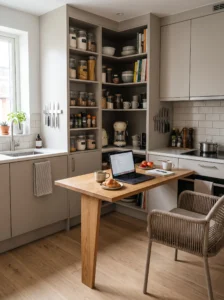
For kitchens that double as a workspace or breakfast nook, a corner pantry built with a small fold-out table or desk attachment makes the corner work harder than storage alone ever could.
This suits smaller homes or apartments where a dedicated home office or breakfast table isn’t practical. The fold-down surface, typically hinged to the side of the pantry cabinet, tucks away flush against the unit when not in use and folds out for quick meals, homework, or a laptop workstation. Keep the surface shallow, around 16 to 20 inches deep, so it doesn’t crowd the kitchen when extended.
Reinforced hinges and a sturdy support leg or bracket are worth the extra cost here, since a wobbly fold-out surface gets old fast. This idea works best paired with a simpler pantry storage style above or beside it — the goal is function, not visual complexity, so let the fold-out feature do the standout work.
Comparison Table: Corner Pantry Styles at a Glance
| Type | Best Use | Material | Style/Vibe | Difficulty Level |
|---|---|---|---|---|
| Lazy Susan Corner Pantry | Small kitchens needing max base-cabinet access | Coated wire, polymer | Practical, traditional | Easy |
| Diagonal Corner Cabinet | Full renovations, custom kitchens | Wood, shaker-style panels | Classic, built-in | Moderate |
| Pull-Out Drawer System | Accessibility-focused kitchens | Steel-frame baskets | Modern, functional | Moderate–High |
| Open Corner Shelving | Farmhouse or cottage-style kitchens | Wood, floating brackets | Rustic, airy | Easy |
| Under-Stairs Conversion | Open-concept homes with adjacent stairwell | Wood, drywall | Custom, seamless | High |
| Compact Corner Pantry | Small kitchens, apartments, galley layouts | Engineered wood, laminate | Minimal, space-saving | Easy–Moderate |
How to Choose the Right Corner Pantry for Your Kitchen
Picking the right style comes down to four things: available space, budget, how your household actually cooks, and how much of a project you’re willing to take on.
Start with sizing and scale. Measure the actual corner depth and width before falling in love with a particular style — a diagonal cabinet needs more floor clearance than a slim vertical pull-out, and a lazy Susan needs enough door swing radius to open fully. A beautiful design on paper that doesn’t physically fit your kitchen isn’t worth pursuing.
Materials matter more than they seem to at first glance. Solid wood and coated wire hold up to daily use far better than particleboard or uncoated metal, which can warp or rust with kitchen humidity over time. If you’re on a tighter budget, spend more on the shelving mechanism itself — the moving parts — and less on decorative trim, since function is what determines whether you’ll actually use the pantry daily.
Durability and maintenance go hand in hand. Open shelving looks great in photos but needs regular dusting and tidying, while closed cabinets require less upkeep but hide clutter until you open the door. Be honest about which habit fits your household before committing.
On budget, the biggest mistake people make is underestimating hardware costs. A basic cabinet box is often the cheapest part of a corner pantry project — soft-close hinges, rotating mechanisms, and pull-out tracks add up fast. It’s worth pricing hardware separately before finalizing a design, since a beautiful cabinet with cheap hardware will feel disappointing within a year.
Finally, avoid buying a system that’s more complex than your household actually needs. A rotating pull-out system sounds impressive, but if you mostly need basic dry-goods storage, a well-organized set of adjustable shelves will serve you just as well for a fraction of the cost.
Final Thoughts
A wasted kitchen corner is really just an unsolved storage problem, and as this list shows, there’s rarely a single right answer — the best solution depends on your kitchen’s layout, your budget, and how your household actually uses the space day to day. A lazy Susan or a simple set of adjustable shelves might solve the problem just as well as a full custom build, especially if your kitchen doesn’t need the extra storage a floor-to-ceiling tower provides.
What matters most is starting with an honest look at the corner itself — its depth, its height, how much light reaches it, and how often you’ll realistically want to open it. From there, the ideas in this list scale from weekend-friendly, low-cost fixes to full renovation projects, so there’s a starting point regardless of where your kitchen and budget currently stand.
The corners that used to collect clutter and dust can become some of the most functional parts of the kitchen once you give them the right setup. It doesn’t require a full remodel to get there — sometimes it just takes rethinking a space you’d stopped noticing altogether.
Frequently Asked Questions
How much does a corner pantry cabinet typically cost to install?
Costs vary widely depending on style. A basic lazy Susan retrofit might run a few hundred dollars, while a full custom diagonal cabinet or pull-out drawer system can run well into the thousands once installation and hardware are included. Freestanding cupboards and open shelving tend to be the most budget-friendly options.
Is a lazy Susan or a pull-out drawer system better for a corner pantry?
It depends on your priorities. A lazy Susan is generally cheaper and simpler to maintain, while a pull-out drawer system gives fuller access to every inch of the corner. If accessibility or mobility is a concern in your household, the pull-out system is usually worth the added cost.
Can I add a corner pantry without a full kitchen renovation?
Yes. Freestanding cupboards, wire basket inserts, and slim vertical pull-out units can all be added without touching your existing cabinetry or walls. These are good options if you want more storage without committing to a larger remodel.
How deep should corner pantry shelves be?
Most corner pantry shelves work best between 12 and 16 inches deep. Shallower shelves, especially for spice racks, prevent items from getting lost behind one another, while deeper shelves suit bulkier canned or boxed goods.
What’s the most durable material for corner pantry shelving?
Solid wood and coated wire hold up best over time, particularly in kitchens with higher humidity near the stove or sink. Particleboard and uncoated metal are more prone to warping, sagging, or rusting with regular use.
Do open corner shelves need more maintenance than closed cabinets?
Yes, generally. Open shelving is exposed to dust, grease, and general kitchen air, so it needs more frequent wiping down. Closed cabinets protect contents better but can hide clutter and expired items longer if you’re not checking regularly.
Will a corner pantry actually add significant storage compared to standard cabinets?
In most cases, yes. Corners are typically the least-used storage space in a kitchen, so converting one into a functional pantry — even a modest one — often adds more usable storage than expanding a straight run of cabinets would in the same footprint.
What’s the biggest mistake people make when planning a corner pantry?
Choosing a mechanism that’s more complex or expensive than the household actually needs. Not every kitchen needs a rotating or pull-out system — sometimes well-placed adjustable shelving solves the same problem for a fraction of the cost and with far less maintenance.