How to Decorate a Living Room With Dark Wood Floors
Can a living room with dark wood floors actually feel bright and welcoming instead of like a cave? Yes — the floors aren’t the problem, it’s the layers around them. Dark wood is dramatic and rich; it only turns heavy when everything else in the room competes in the same deep register. This guide walks you through 12 steps, in the order you should actually do them, so each decision builds on the last instead of fighting it. Budget-wise, most of these steps are low-cost; I’ll give you real price ranges as we go.
Step 1: Study Your Light Before Buying Anything
The single biggest mistake people make with dark floors is shopping before looking. Stand in the room at 10 a.m., 2 p.m., and 6 p.m. on a normal day and notice where sunlight lands and where it doesn’t. A north-facing room with dark walnut floors behaves completely differently from a south-facing one — the first needs every trick for brightness, the second can handle deeper furniture tones. This step costs nothing and takes about an afternoon of casual attention, but it decides everything that follows: wall color, rug size, even how many lamps you’ll need.
Materials/cost note: Free. Your tools: a notebook or your phone, three time checks across the day.
Watch out: Don’t judge a room by one visit on a sunny Saturday. Cloudy-day light is your real baseline — if it works on gray days, it works every day.
Step 2: Brighten the Walls (the Right Warm White)
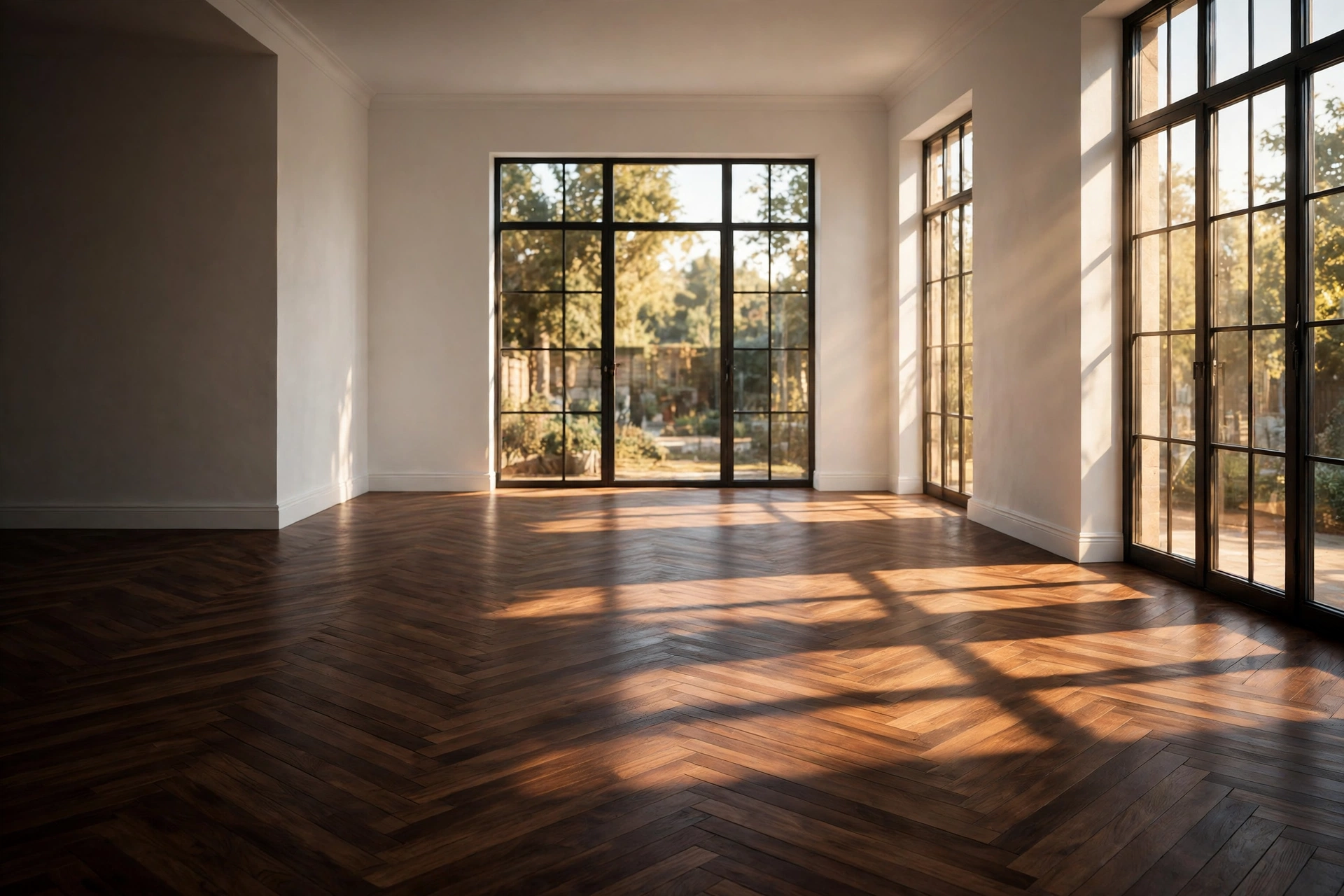
Once you know your light, pick the wall color — because walls are the largest surface fighting the floors’ darkness. A warm white, soft cream, or very pale greige bounces light around the room and lets the dark floors read as “rich” instead of “oppressive.” The keyword is warm: stark, cool whites make dark floors look harsh and industrial. Think shades like warm ivory, oat milk, or pale mushroom. Paint a large swatch — at least 2 feet square — and check it morning and evening before committing.
Materials/cost note: One gallon of good paint ($40–$70) covers a living room accent wall; a whole room usually needs 2–3 gallons, so plan $80–$180 plus a $30 roller kit.
Watch out: Limewash finishes look gorgeous over dark floors but go darker than the sample when dry, so test accordingly. For more on that finish, see limewash walls in a living room.
Step 3: Anchor the Room With a Light Area Rug
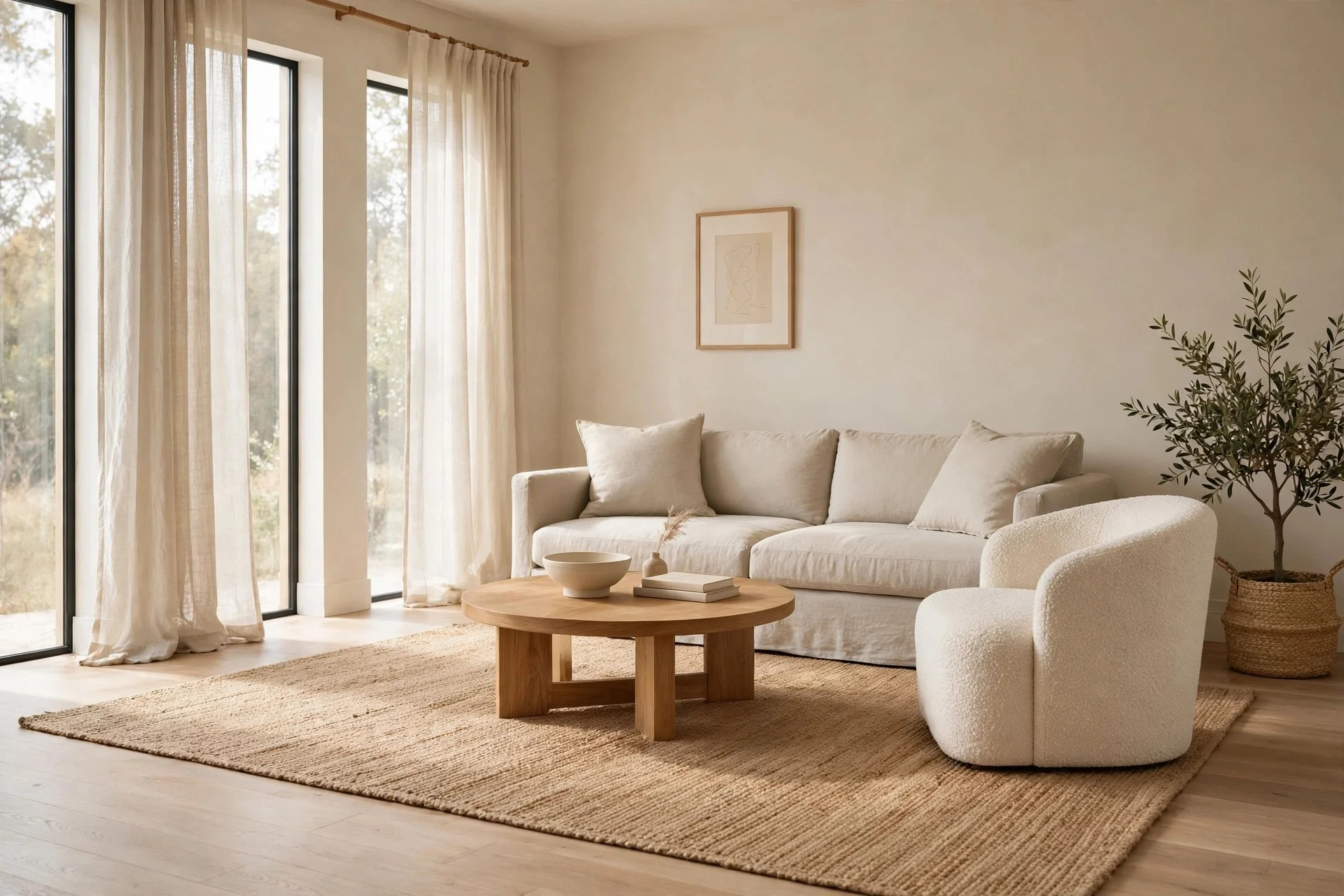
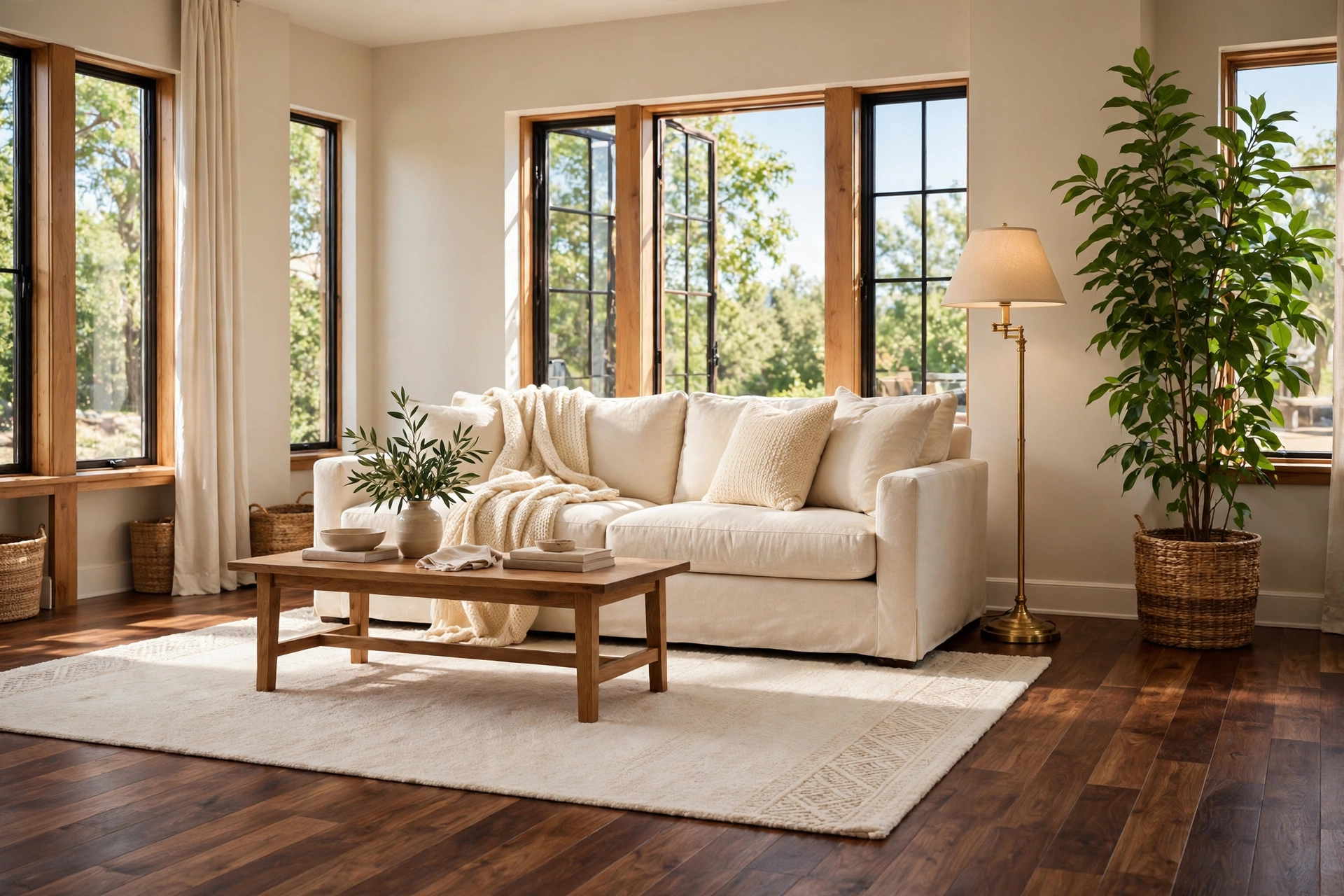
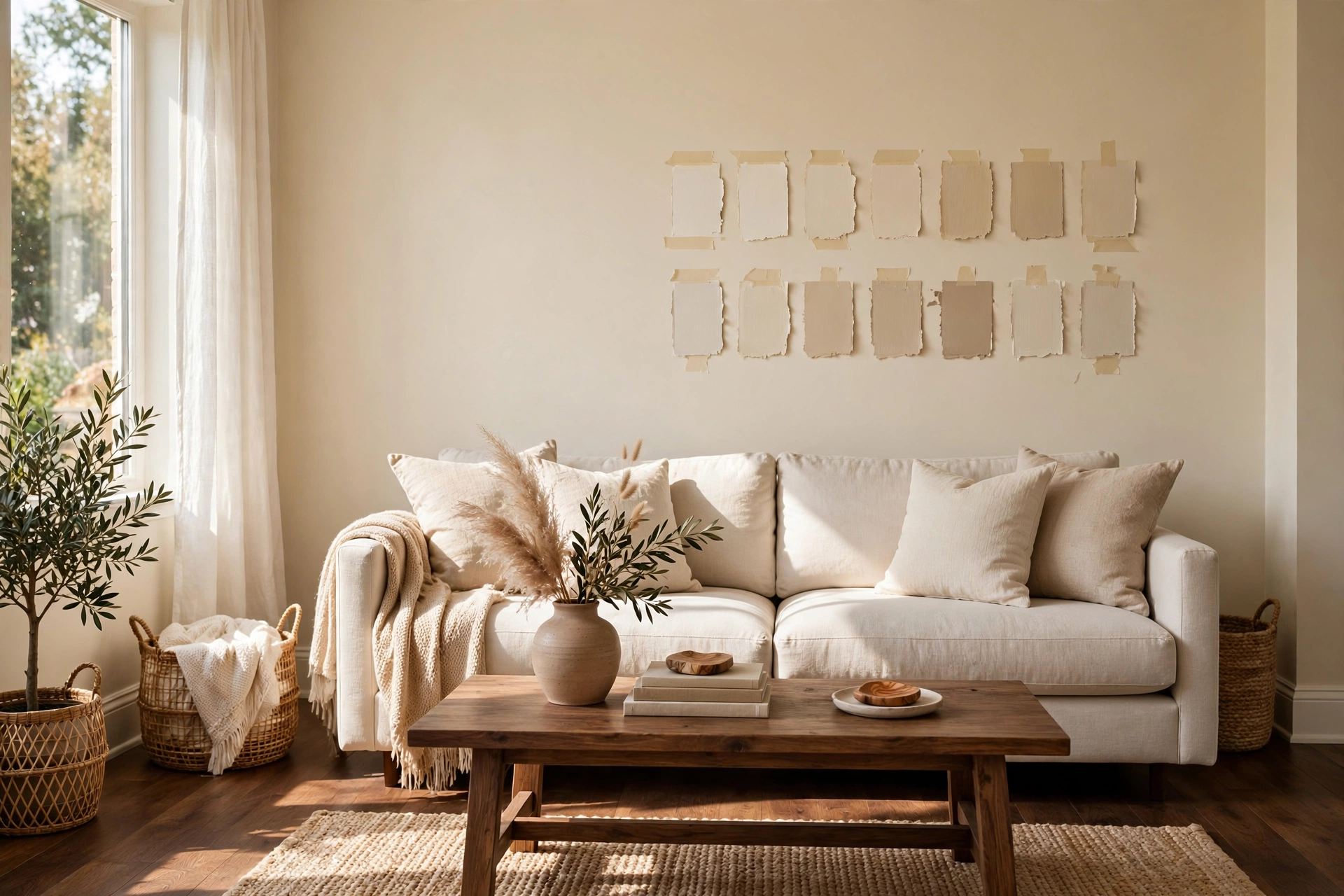
This is the single most powerful move on the list. A large, light-toned rug covers 60–70% of the visible floor and instantly cuts the visual weight of dark wood. Size matters more than anything: the front legs of your sofa and chairs should sit on the rug, which usually means 8×10 or 9×12 feet in a standard living room. Flat-weave jute or low-pile wool in natural, ivory, or pale gray reads calm and stays family-friendly.
Materials/cost note: A good 8×10 rug runs $150–$400 (polyester/jute blends at the low end, wool higher). Add a felt rug pad ($40–$80) — it protects the finish from furniture dents.
Watch out: Rugs smaller than the seating arrangement make the room look choppy and emphasize the dark floor’s borders. When in doubt, size up.

Step 4: Balance the Wood Tones in Your Furniture
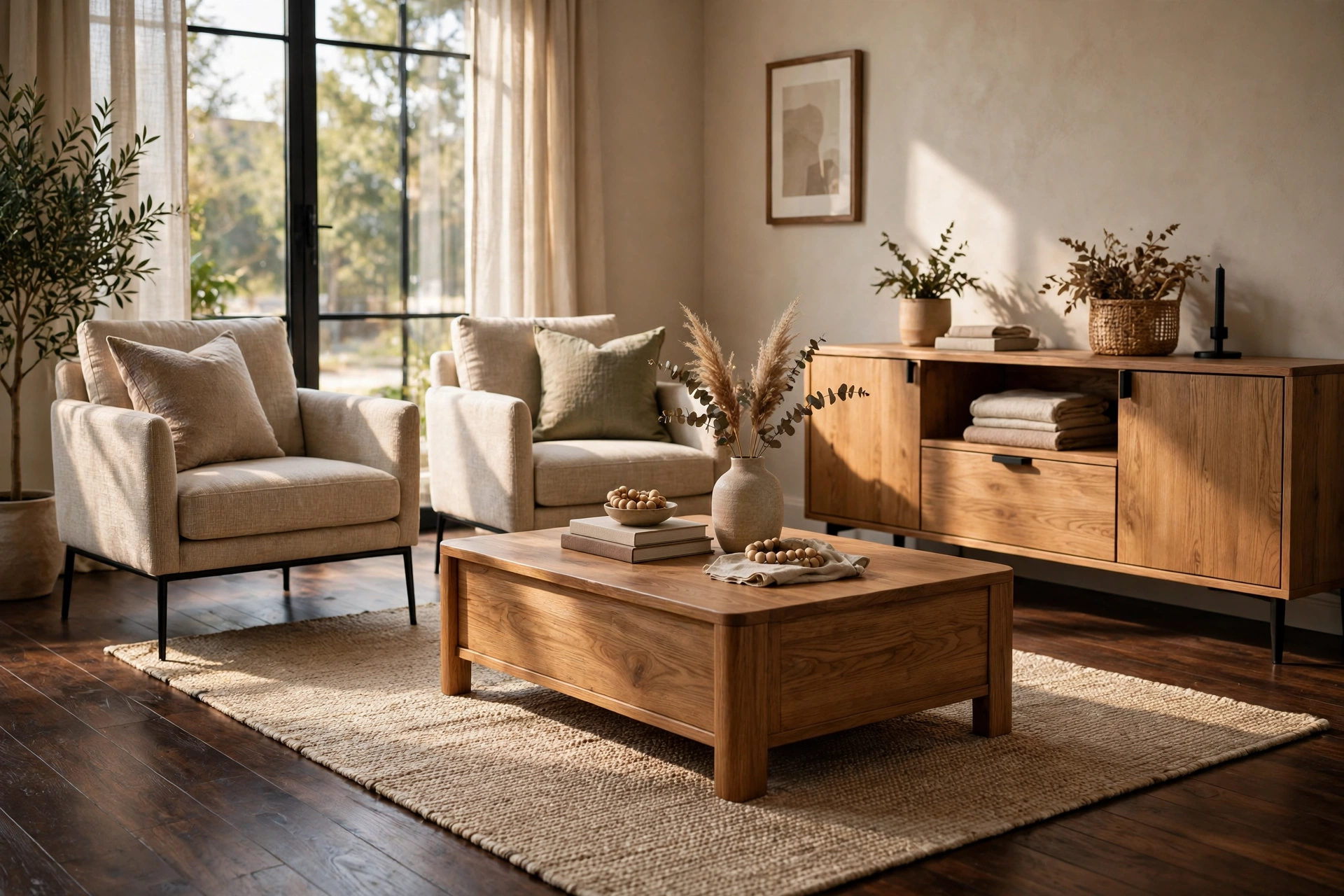
Here’s the rule designers often repeat for a reason: don’t match your furniture wood to your floor wood. Dark floors plus dark wood furniture equals visual mud. Mix in medium-tone pieces (oak, walnut with a lighter stain), painted wood, or furniture with slender metal legs that lift the piece off the floor and let light flow under it. One dark statement piece — a leather club chair, a media console — is plenty; the rest should sit in the middle of the tone scale.
Materials/cost note: Swapping heavy pieces costs nothing to plan; if buying, a mid-tone wood coffee table runs $120–$350, metal-leg accent chairs $90–$250 each.
Watch out: Skip the “matching living room set” — uniform dark pieces against dark floors flatten the whole room.
Step 5: Choose Upholstery in Light to Mid Tones
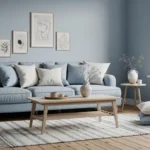
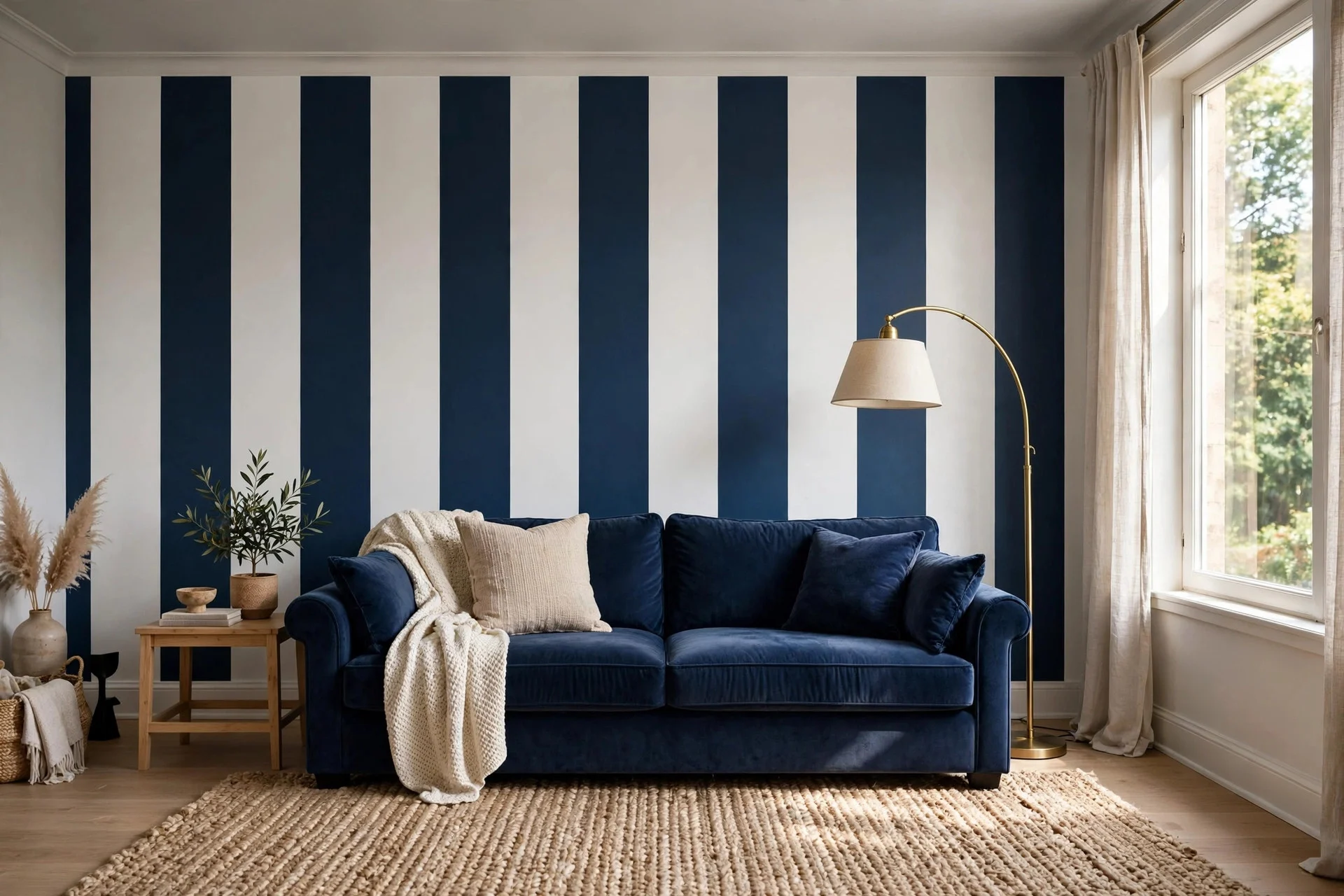
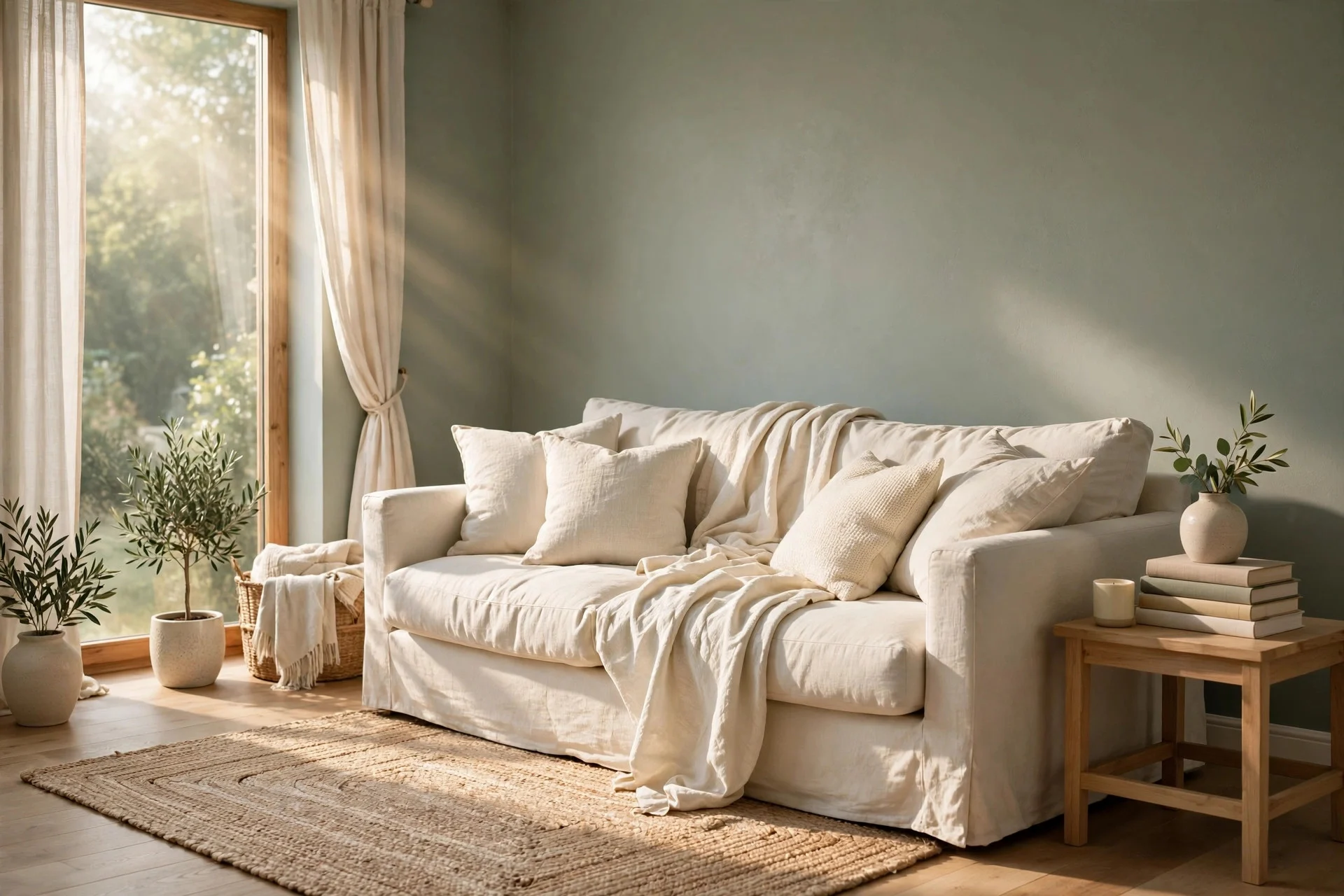
Your sofa is the second-largest visual mass after the rug, so its color sets the room’s temperature. Cream, oatmeal, warm beige, sage, or dusty blue upholstery sits beautifully against dark floors — it creates the contrast that lets both elements shine. If your sofa is already dark, don’t panic: throw light-colored cushions and a draped throw over it and you’re 80% there. Performance fabrics (the stain-resistant weaves) are worth the upcharge in homes with kids or dogs — they clean with a damp cloth and look like regular linen.
Materials/cost note: A quality light-colored sofa: $800–$2,000. Budget route: washable slipcover in cream or natural linen, $60–$150, which refreshes an existing sofa in an afternoon.
Watch out: Pure white sofas photograph beautifully and stress most owners daily. Stick to warm off-whites — they forgive real life.

Step 6: Layer Three Levels of Lighting
Dark floors absorb light — that’s physics, not opinion. So one overhead fixture will never cut it; you need ambient light (ceiling or floor lamps that fill the room), task light (reading lamps, table lamps), and accent light (picture lights, a candle cluster on the coffee table). Aim for a warm bulb temperature around 2700K — it flatters dark wood instead of turning it cold. If you’re not sure how much light your room needs, run your numbers through a lighting calculator before buying fixtures, so you get the lumens right the first time.
Materials/cost note: A floor lamp $60–$180, table lamps $30–$90 each, picture light $40–$120. Plan on 2–4 new light points beyond the ceiling fixture — most rooms land at $150–$400 total.
Watch out: Cool-white “daylight” bulbs (5000K) make dark wood look gray and dingy. Warm it up.

Step 7: Bounce Light With Mirrors, Glass, and Metallics
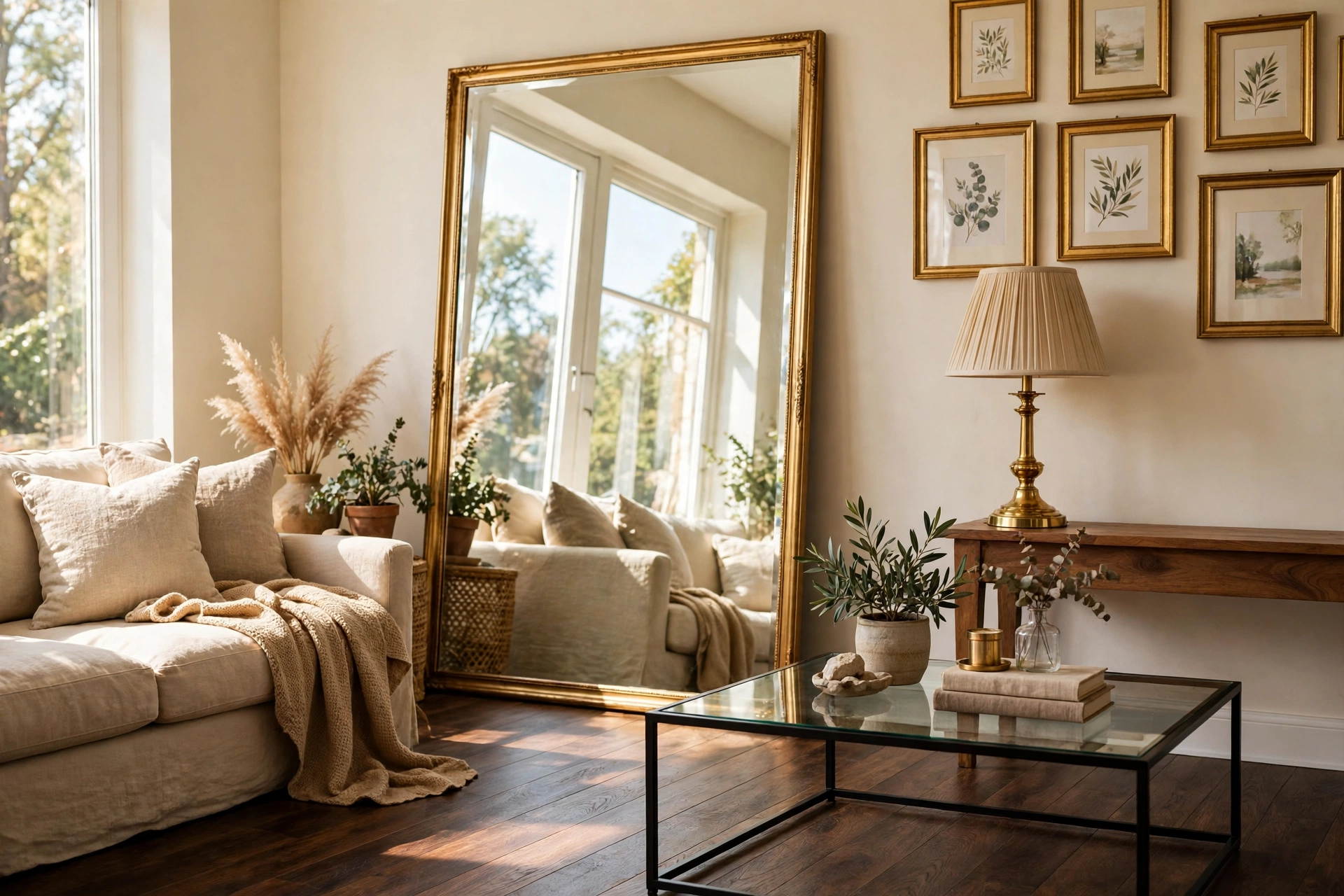
Every reflective surface in the room is doing double duty over dark floors — it throws light back where the wood swallows it. A large mirror opposite or beside a window multiplies natural light for the price of one frame. Brass or gold-toned accents (lamp bases, picture frames, a side table) read warm against dark wood in a way chrome doesn’t. A glass or acrylic coffee table practically disappears, keeping sight lines open instead of adding another dark mass.
Materials/cost note: A big leaner mirror $80–$250, glass-top coffee table $130–$350, brass lamp bases $40–$100 each. Even three gold frames at $15–$30 apiece make a visible difference.
Watch out: Keep metallics to one finish family per room — brass plus chrome plus copper reads cluttered, not curated.
Step 8: Add Greenery and Natural Texture
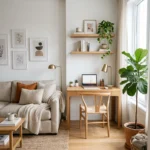
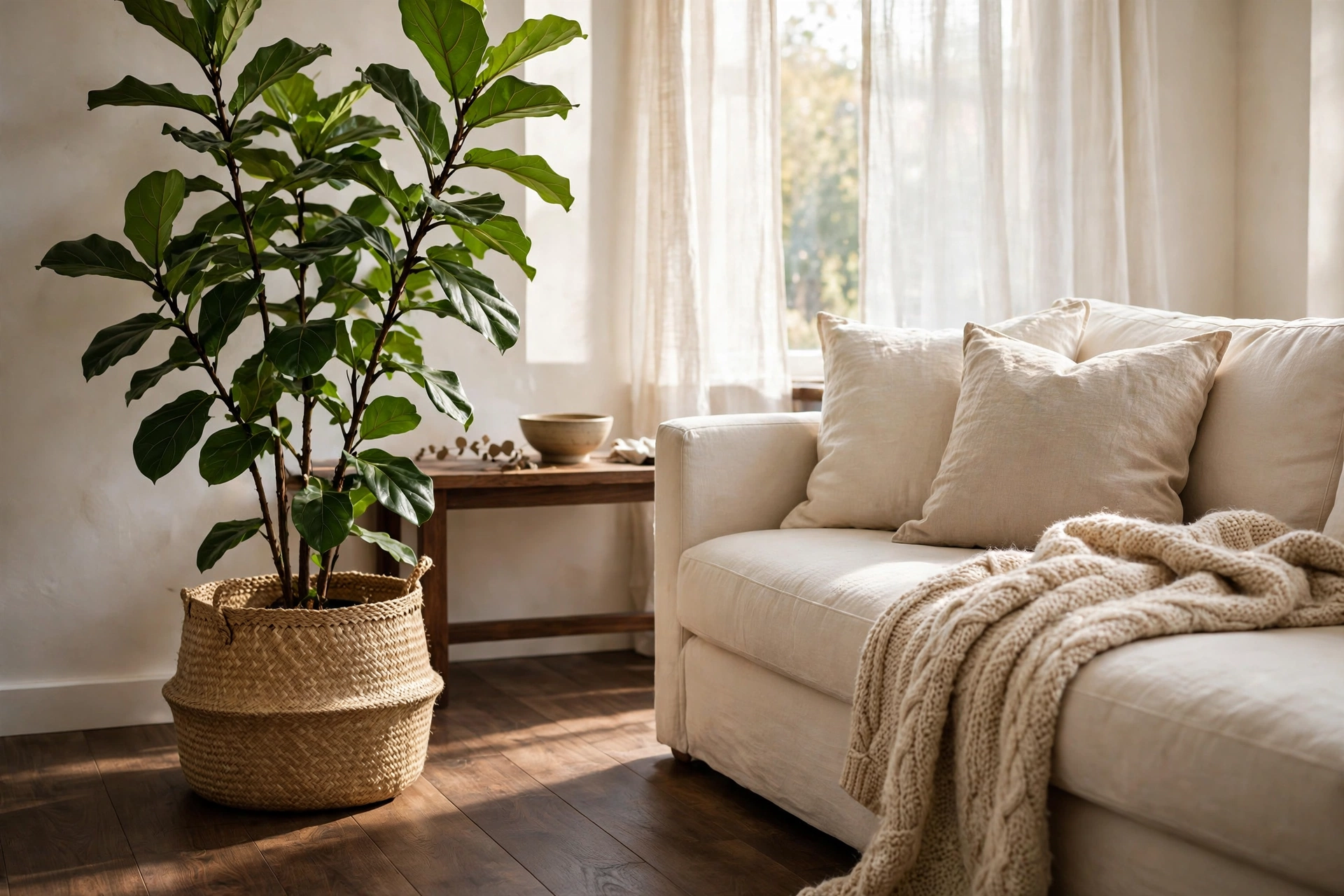
Plants do something no fixture can: they introduce life and vertical softness that breaks up all the flat, hard surfaces. One large plant (a fiddle-leaf fig, a snake plant, an olive tree) in a woven basket does more than five small pots scattered around. Natural textures — jute baskets, a wool throw, linen cushions — keep the room from feeling sleek and cold. The green-and-gold of a healthy plant against dark wood is one of the prettiest color combinations in interiors, and it’s practically free to maintain.
Materials/cost note: A large houseplant $40–$120, woven basket $20–$50, textured throws and cushions $25–$60 each.
Watch out: Dark floors hide spilled potting soil brilliantly — which means you’ll notice it less and track it more. Use a saucer under every pot.
Step 9: Let the Windows Do Their Job
Heavy, dark curtains over dark floors double down on the heaviness — and they block the daylight your room needs most. Swap them for sheer linen panels that filter light in, or at least go for curtain rods mounted wider and higher than the frame so panels stack off the glass. If privacy matters, layer sheers behind light-colored drapes and close only what you need. Light curtain fabric in a pale tone costs less than most people expect and changes the room’s mood immediately.
Materials/cost note: Sheer linen-look panels run $25–$60 per panel (most windows need two), a wider curtain rod $30–$80. A full window refresh usually lands under $200.
Watch out: Curtains hung at frame width make windows look smaller and rooms darker. Mount rods 6–10 inches beyond each side and close to the ceiling.

Step 10: Hang Art That Speaks Up
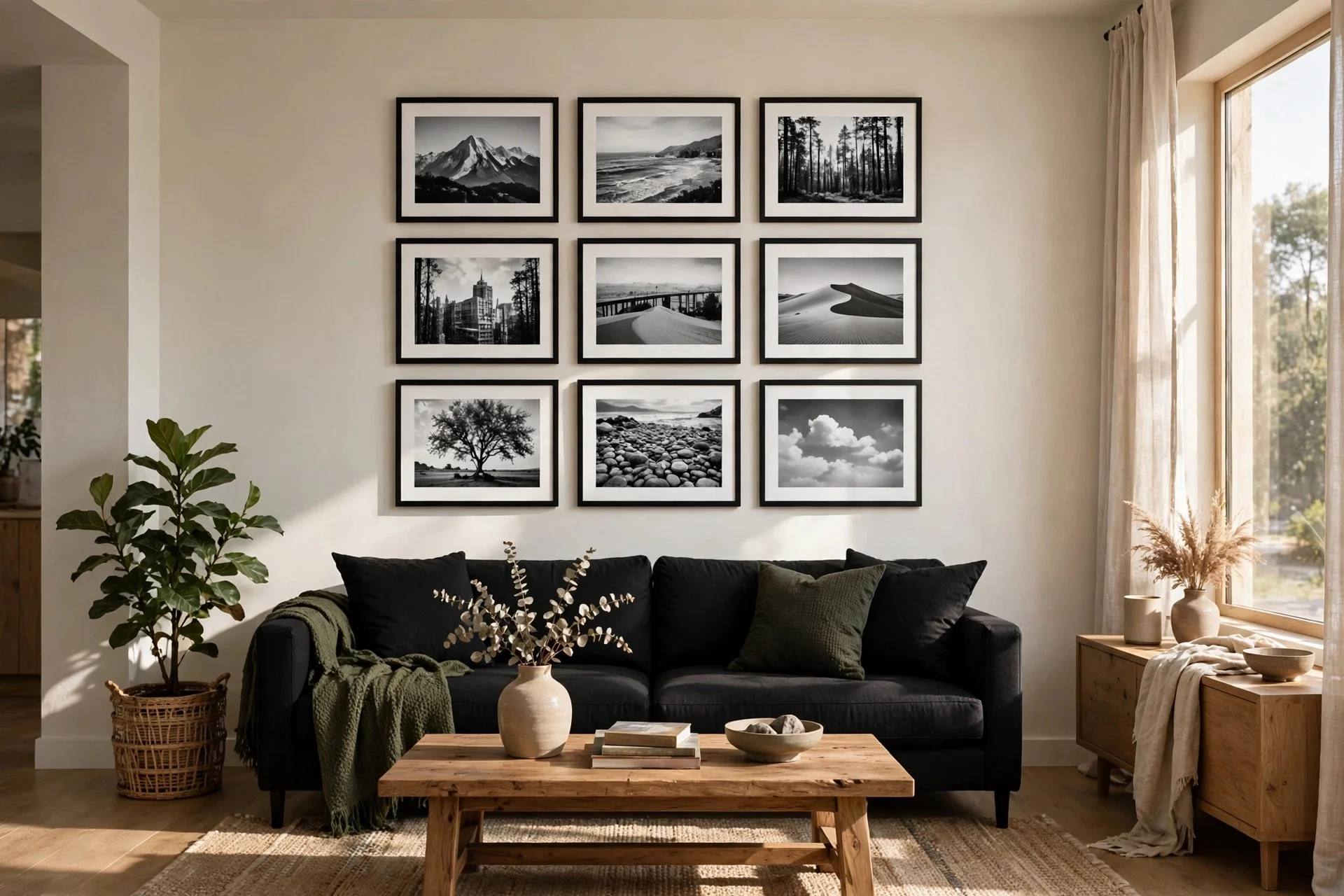
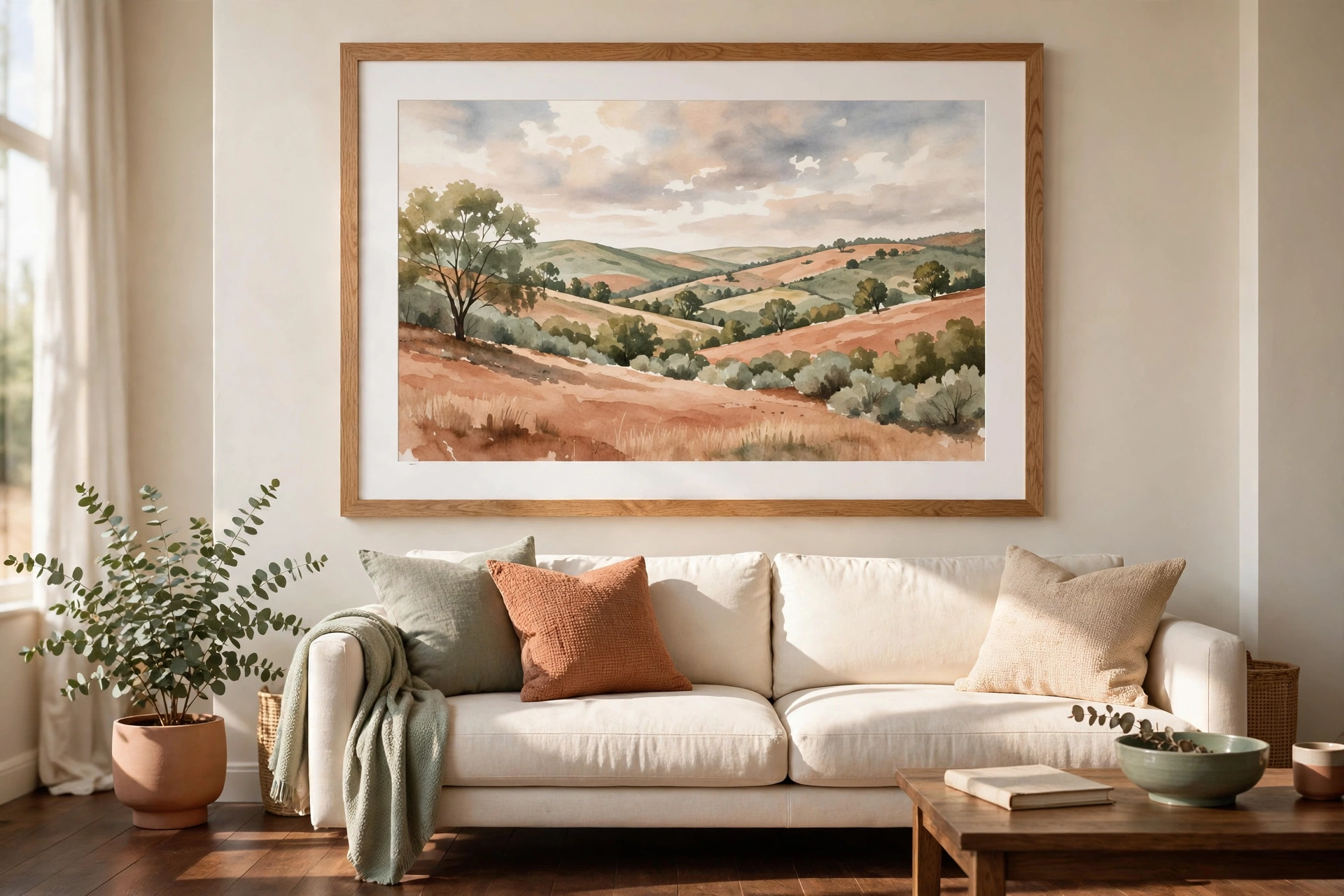
Small, dark-framed art disappears against walls when the floor is the loudest thing in the room. Go larger than you think — one big piece over the sofa anchors better than a scatter of small frames — and choose art with light or colorful mats and frames that contrast. Gallery walls work too, but keep the overall tone light: pale mats, oak or gold frames, breathing space between pieces. Art is also where you can repeat your accent color (sage, terracotta, dusty blue) and tie the whole room together.
Materials/cost note: A large framed print $80–$250, gallery-wall frames $10–$25 each. Printing your own photos or free printable art and framing it runs under $60 for a full wall.
Watch out: Hanging art too high is the classic error. Center the piece at about 57 inches — average eye level — so it connects with the furniture, not the ceiling.
Step 11: Keep Ceilings and Trim Bright
Ceilings and trim are the room’s reflectors — leave them dingy and the whole space sinks. A fresh coat of clean white on the ceiling lifts everything, and bright white baseboards, door frames, and window trim create a crisp line where the dark floor meets the wall. This contrast is what makes dark wood look intentional and high-end rather than heavy. It also matters enormously in rooms with lower ceilings: for more on that, see low-ceiling living room decor ideas.
Materials/cost note: Ceiling paint (one gallon, ~$35–$60) plus trim paint (a quart, ~$15–$30). A weekend of painting — roughly 6–8 hours for a living room — is the cheapest transformation on this list.
Watch out: Use flat or matte paint on ceilings (it hides flaws) and satin or semi-gloss on trim (it wipes clean). Don’t mix them up.

Step 12: Protect the Finish You’re Decorating Around
All this decorating is pointless if the floors get scratched and dull. Dark wood shows dust, footprints, and scratches far more than light floors — that’s the trade-off for the richness. Felt pads under every chair and table leg ($8–$15 for a multi-pack) are non-negotiable. Runner rugs in hallways and high-traffic paths catch grit before it grinds into the finish. And clean with a damp microfiber mop, never a soaking-wet one — standing water is dark wood’s worst enemy.
Materials/cost note: Felt pads $8–$15, runner rugs $40–$120 each, a good microfiber mop kit $25–$45. Annual professional deep-clean: $150–$300 for a living room.
Watch out: Steam mops force moisture into seams and can void finish warranties. Stick to damp mopping and dry quickly.

Questions Readers Ask About Dark Wood Floors
What color walls go best with dark wood floors?
Warm whites, soft creams, pale greige, and light warm grays are the safest winners — they reflect light and let the floors be the rich accent. If you want color, pale sage, dusty blue, or warm beige all sit comfortably beside dark wood. Avoid deep, saturated wall colors unless the room gets excellent natural light; they can make the space feel closed in.
Do dark wood floors make a room look smaller?
They can, but only when everything else is dark too. The floor itself is just one surface — pair it with light walls, a large light rug, and bright ceilings, and the room reads just as spacious as with light floors. What actually shrinks a room is low contrast between floor and everything else.
Should I stain my floors lighter instead?
Only if you dislike the dark look itself. Refinishing runs $3–$8 per square foot (a 300-square-foot living room: $900–$2,400) and takes 3–5 days of disruption. For most people, the decorating steps in this guide get 90% of the brightness they want for a fraction of the cost — try them first.
What rug colors work over dark wood floors?
Ivory, natural jute, pale gray, and soft beige are the workhorses — they create the contrast that makes dark floors look deliberate. If you want pattern, mixing patterns in living room decor shows how to layer a patterned rug with solid textiles without chaos. Avoid very dark rugs; they erase the contrast that makes the look work.
Your Dark-Floor Game Plan
Don’t try to do all twelve steps this weekend. Start with light (Step 1 and 2), then the rug (Step 3) — those three change the room more than everything else combined. Add lighting and textiles next, then art and accents as you find pieces you love. Dark wood floors are a gift: they give your living room depth, warmth, and a designer look that light floors can’t fake. Work with them, not against them, and the room takes care of itself.