
If your pantry is basically one narrow shelf wedged between the fridge and a wall, you already know the daily frustration: cans falling out when you reach for the pasta, spice jars you can never find, and that weird dead corner nobody has ever properly used. Small kitchens don’t come with small grocery lists, and that mismatch is where most storage stress actually starts.
Here’s the thing most people get wrong — they assume a tiny pantry problem needs a bigger room. In reality, it almost always needs better geometry. A cramped closet with smart vertical storage will outperform a large, poorly organized pantry every single time. The difference isn’t square footage; it’s how intentionally every inch gets used.
This list walks through 27 tiny pantry designs, ranging from simple weekend fixes to slightly more involved builds, that make small spaces feel open, organized, and genuinely functional. Some rely on clever hardware, some lean on visual tricks like open shelving and glass containers, and a few rethink awkward spots — under stairs, inside closets, beside a fridge — that most kitchens waste completely.
By the end, you’ll have a clear sense of which approach fits your layout, your budget, and how much time you’re willing to spend on a Saturday afternoon.
1. Slide-Out Wire Basket Shelving

Wire baskets on telescoping rails turn a flat, hard-to-reach shelf into something you can pull all the way toward you. This works especially well in pantries deeper than 16 inches, where anything stored at the back usually gets forgotten. The open wire design keeps the space feeling light instead of boxed in, and it lets air circulate around produce or bread.
Install them at staggered heights — taller items on lower baskets, shorter ones up top — and stick to a 3 to 5 inch gap between baskets so nothing feels stacked on top of itself. Chrome or matte black both work, though black tends to disappear visually against darker cabinetry, which helps a narrow space feel less cluttered.
One mistake people make is loading the baskets too heavy, which strains the rails over time. Keep canned goods on the lower baskets where the slide mechanism can handle the weight. Anyone who’s dealt with a jammed drawer knows how quickly convenience turns into annoyance when hardware is undersized for the load.
2. Door-Mounted Vertical Racks

The back of a pantry door is dead space in most homes, and that’s exactly why it’s worth claiming first. Shallow wire or acrylic racks mounted to the door add several inches of usable depth without touching the room itself.
This design works best for smaller, lighter items — spice jars, snack packets, foil and wrap boxes, small sauce bottles. Keep the racks within reach so the door can still close without hitting shelving on the opposite wall, and measure your pantry’s total depth before buying, since a rack that’s too deep will jam the door.
A practical touch: group items by category rather than size. It sounds obvious, but a lot of people organize by what fits where, and end up hunting for the same three items every week. Once things are grouped — baking, snacks, condiments — the whole system becomes faster to use, not just tidier to look at.
3. Open Shelving With Labeled Glass Jars

Swapping closed cabinets for open shelves, then decanting dry goods into uniform glass jars, is one of the most reliable ways to make a small pantry look larger. Uniform containers remove visual noise, and glass lets light pass through instead of stopping at a solid door.
This suits kitchens with good natural light or a strong overhead fixture, since open shelves show everything, including dust and mismatched packaging if you skip the jars. Stick to a consistent jar shape and size where possible, and label with a simple handwritten or printed tag rather than anything overly decorative.
The real payoff shows up in daily use — you can see at a glance when the rice is running low, instead of finding out mid-recipe. It’s a small shift, but it removes a surprising amount of friction from weekly meal planning.
4. Corner Lazy Susan

Corner cabinets are notorious for wasting space, and a rotating lazy Susan solves that by turning an awkward blind spot into fully accessible storage. This works particularly well in L-shaped kitchens where a pantry cabinet meets a countertop at 90 degrees.
Two-tier rotating trays handle the most volume; go with a full circle if the cabinet is a true corner unit, or a kidney-shaped tray if the opening is narrower. Light wood or white plastic trays keep the interior looking clean, and a soft-close mechanism prevents the tray from spinning too freely when loaded unevenly.
Avoid overloading one side, which throws off the rotation and makes items tip. Distribute weight evenly around the tray. Once it’s set up, reaching the back of a corner cabinet stops being a two-handed excavation project and becomes a simple spin-and-grab.
5. Under-Stair Pantry Nook

If there’s a staircase anywhere near the kitchen, the triangular space underneath is almost always sitting empty. Converting it into a narrow pantry nook adds real storage without expanding the kitchen’s footprint at all.
This design suits homes with open-plan stairs adjacent to the kitchen, particularly older houses where under-stair space was originally left as a closet or ignored entirely. Custom shelving that follows the slope of the stairs makes the most of the height, with deeper shelves at the bottom and shallow ones as the ceiling drops.
Paint the interior a shade lighter than the surrounding walls so the nook doesn’t read as a dark cavity. A small picture light or battery-operated puck light solves the visibility problem most under-stair spaces have. It’s one of the more labor-intensive builds on this list, but it often adds more storage than any single kitchen cabinet could.
6. Roll-Out Drawers Under the Counter

Base cabinets are frequently just one deep shelf with a door, which means half the storage is invisible unless you get on your knees. Retrofitting them with roll-out drawers turns that same footprint into something you can see and reach fully.
This is a strong option for kitchens where cabinet space is limited to the counter perimeter, with no separate pantry room at all. Drawers with a low front lip work well for cans and jars, while a taller-sided drawer suits boxed goods and bags. Solid wood or plywood drawers hold up better than thin particleboard kits under repeated use.
The common misstep is installing drawers without measuring the swing clearance of nearby cabinet doors, which leads to two things bumping into each other daily. Once it’s installed correctly, there’s a noticeable difference in how much less bending and reaching a simple task like grabbing canned tomatoes requires.
7. Ladder-Style Shelving Unit

A freestanding ladder shelf leaned against a blank wall works as a pantry substitute in kitchens with zero built-in storage to spare. The angled frame takes up less floor space than a straight bookshelf while still offering four or five usable tiers.
This suits studio apartments, rentals, or any kitchen where drilling into walls isn’t an option. Choose a narrower ladder shelf — under 20 inches wide — for tight galley kitchens, and use the top shelf for display items like a cutting board or a few jars, saving the lower, deeper shelves for actual bulk storage.
Because it’s freestanding, stability matters more than usual. Anchor it to the wall with a simple safety strap if there are kids or pets in the house. People who’ve used these in small rentals often mention how much the room “opens up” visually compared to a boxy cabinet, simply because you can see the wall behind it.
8. Pegboard Wall Organizer

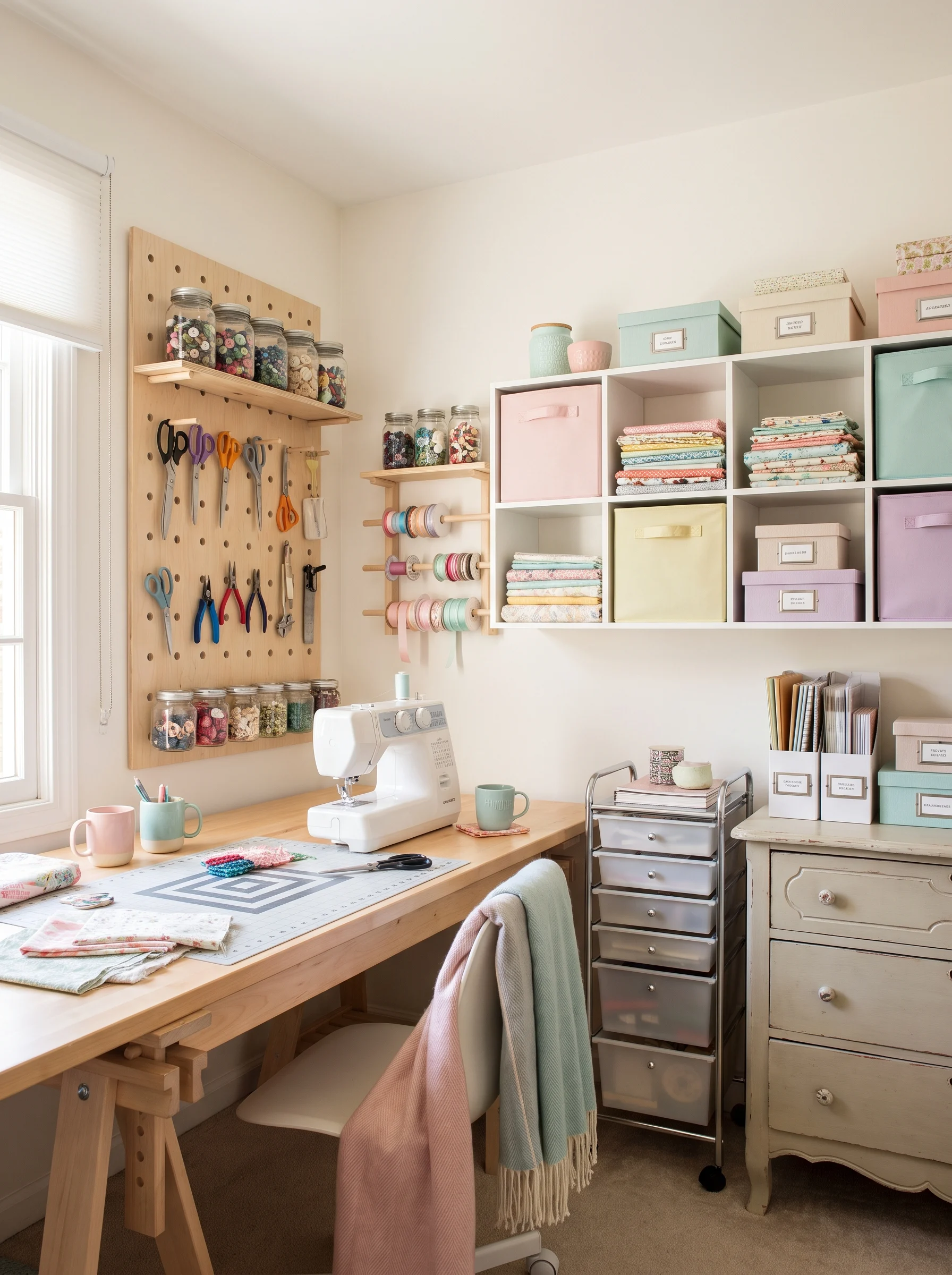
Pegboard isn’t just for garages. Mounted inside a pantry or on an adjacent wall, it turns flat vertical space into a fully customizable storage grid using hooks, small shelves, and bins.
This works particularly well for pantries with awkward proportions — very tall, very narrow, or oddly shaped — where fixed shelving would waste space. Paint the pegboard to match the wall so it blends in rather than standing out, and mix hook heights so tall items like brooms or aprons don’t compete with smaller hanging baskets.
A quiet advantage here is flexibility: when your storage needs change, so can the layout, without any new holes or hardware. Anyone who’s rearranged a kitchen after a move knows how rare that kind of adaptability is with fixed shelving.
9. Magnetic Spice Strips

Spice jars are small individually but chaotic in bulk, especially crammed into a cabinet where only the front row is visible. Magnetic strips mounted to the inside of a pantry door or a side wall hold metal-lidded spice tins upright and fully visible.
This design fits pantries that are more tall than wide, where every flat surface needs to pull double duty. Mount the strip at eye level or slightly below, and leave enough clearance between the strip and any shelf edge so the door swings freely.
Refillable tins keep things consistent, since mismatched spice jar brands rarely line up neatly. It’s a small change, but it removes the familiar scene of digging through a drawer for cumin while dinner’s already on the stove.
10. Tiered Can Organizers

Cans rolling around a flat shelf are one of the most common small-pantry headaches. A stepped, tiered rack tilts cans forward so every label is visible and every can rolls to the front automatically as you use them.
This suits any pantry with at least one deep shelf, and works especially well for households that buy canned goods in bulk. Choose a rack width that matches your most common can size — a rack built for soup cans will leave gaps with wider tomato cans.
Rotate stock front to back occasionally so older cans don’t sit untouched at the rear. It sounds like a minor system, but once it’s in place, expired cans stop turning up during spring cleaning, because everything naturally cycles through in order.
11. Woven Baskets on Open Shelves

Open shelving looks clean until it’s full of mismatched bags and boxes. Woven baskets solve that by grouping loose items — chip bags, packets, produce — into a single tidy unit per shelf, while still keeping the open, airy feel of exposed shelving.
This works well in farmhouse or coastal-style kitchens, though it adapts to most aesthetics with the right basket material. Natural rattan softens a small space visually, while black wire baskets suit a more modern kitchen. Label the front of each basket so contents don’t become a guessing game.
Avoid baskets so deep that items get lost at the bottom — shallow, wide baskets are easier to scan than tall, narrow ones. Households with kids often find this setup useful because little hands can grab a whole basket of snacks without pulling everything else off the shelf in the process.
12. Glass Jar Wall Display

A dedicated wall section fitted with small shelves or brackets to hold glass jars turns dry goods into part of the room’s decor rather than something hidden away. This suits kitchens where the pantry is really just a section of open wall near the stove or counter.
Match jar sizes to a grid layout — same height rows, staggered widths — so the wall reads as organized rather than cluttered. Keep heavier items like flour and sugar on lower shelves, both for stability and easier scooping.
The tradeoff is exposure to light, which can affect certain dry goods over time, so this suits pantry staples used quickly rather than long-term bulk storage. Done well, it turns a purely functional wall into something that actually looks intentional.
13. Fold-Down Prep Table

In pantries barely wide enough to stand in, a small fold-down table mounted to a side wall adds a temporary work surface for measuring, decanting, or prepping without needing to carry everything to the main kitchen counter.
This works best in walk-in style pantries at least 30 inches wide, giving enough clearance to stand at the table when it’s unfolded. A simple piano hinge and a folding support bracket keep it sturdy when in use and flat against the wall when it’s not needed.
Choose a surface that can handle spills — laminate or sealed wood — since this spot often doubles as a landing zone for opened bags and jars. It’s a small addition, but having a dedicated surface inside the pantry itself cuts down on the back-and-forth trips to the main counter during meal prep.
14. Repurposed Over-the-Door Organizer

A shoe organizer with clear pockets, mounted on the inside of a pantry door, works surprisingly well for small packaged goods — spice packets, snack bars, seasoning mixes — that otherwise get lost in a drawer.
This suits renters or anyone who wants a no-drilling storage boost, since most versions hang directly over the door with no hardware required. Choose a version with reinforced pockets, since flimsy fabric sags once it’s loaded with anything heavier than paper packets.
Sort pockets by category, left to right, so muscle memory takes over after the first week of use. It’s a low-cost fix, but it adds a surprising number of storage slots to a door that would otherwise sit completely unused.
15. Stackable Clear Bins

Clear plastic bins with lids let you stack items vertically without losing sight of what’s inside — a real advantage over cardboard boxes or opaque containers that all start to look the same after a while.
This design fits pantries with taller shelves that go underused because loose bags don’t stack well on their own. Group by category — baking, breakfast, snacks — and keep the most-used bins at eye level, saving the step stool for occasional-use items on top.
Choose bins with a consistent footprint so they stack securely rather than teetering. A common mistake is buying whatever size is on sale, which results in a mismatched, wobbly stack instead of clean, even rows. Once bins are uniform, the whole shelf reads as organized at a glance.
16. Floating Shelves Above the Counter

When there’s no room for a separate pantry, floating shelves above a stretch of counter can absorb a good portion of the overflow. Because they have no visible brackets or bulky frame, they read as lighter than traditional cabinetry.
This suits narrow kitchens where wall cabinets would feel heavy or closed-in. Keep the shelves shallow — 8 to 10 inches — so they don’t crowd the counter below, and stagger heights slightly to create visual rhythm instead of one flat row.
Reserve the shelves for items used often, since anything stored here is fully exposed to kitchen humidity and grease. A lot of people find that limiting these shelves to daily-use staples, rather than bulk storage, keeps them from turning cluttered within the first month.
17. Pantry Hidden Behind Cabinet-Style Doors

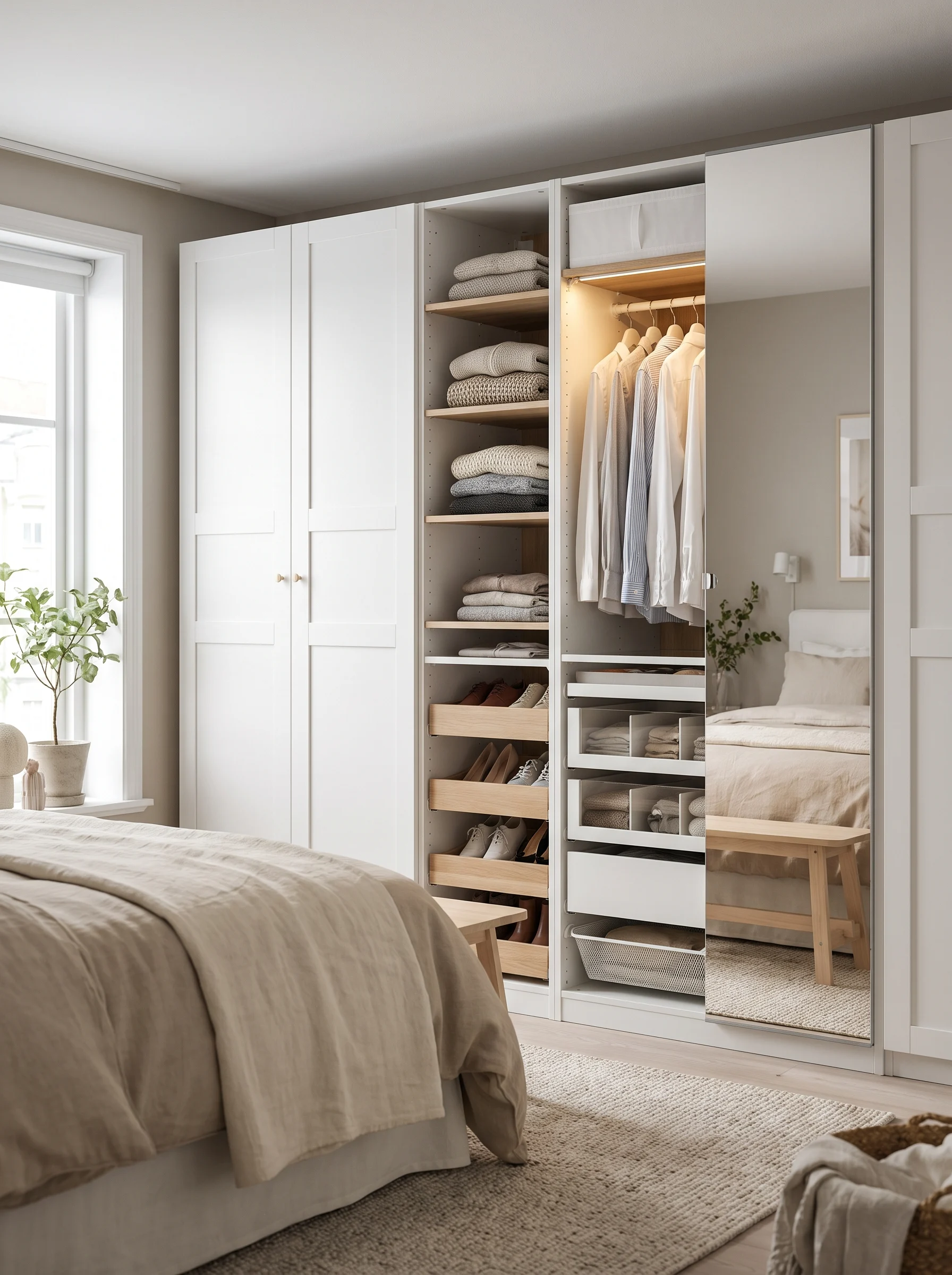
Sometimes the goal isn’t visual openness — it’s the opposite. Full-height cabinet doors that conceal a narrow pantry column keep the kitchen looking streamlined while hiding whatever chaos exists behind them.
This works well in modern or minimalist kitchens where visible clutter, even organized clutter, disrupts the overall look. Use doors that match the surrounding cabinetry exactly, with no visible seam or contrasting hardware, so the pantry disappears into the wall of cabinets rather than standing out as a separate unit.
Add interior lighting on a door-activated switch, since a hidden pantry is only convenient if you’re not fumbling in the dark every time you open it. This approach takes more planning upfront, but it solves the storage problem without adding any visual bulk to the room.
18. Mini Butler’s Pantry

A butler’s pantry is traditionally a full room between the kitchen and dining area, but a scaled-down version — a few feet of counter, shelving, and maybe a small sink — can work in even modest homes with an awkward transitional space.
This suits homes with a narrow hallway or unused nook connecting the kitchen to a dining room. Even a two-foot-deep counter with shelves above and a cabinet below functions as overflow storage and a staging area for serving dishes or coffee supplies.
Match the finish to the main kitchen so it reads as an extension rather than an afterthought. It’s a bigger undertaking than most entries on this list, but for homes with the right layout, it solves both storage and workflow problems at once — especially during holidays or entertaining.
19. Tall, Narrow Pull-Out Pantry Cabinet

A cabinet just 6 to 10 inches wide, fitted with pull-out shelves, fits into gaps most people assume are unusable — the sliver of space beside a fridge, for example. Because the shelves slide out fully, you’re not reaching into a dark, narrow slot.
This is one of the most efficient designs for kitchens with literally no spare wall or floor space, since it works in gaps as small as 6 inches. Choose a unit with shelves on both sides for maximum capacity, and keep the heaviest items on the lower shelves to prevent the whole unit from feeling top-heavy when extended.
Measure twice before ordering, since these units are typically custom or semi-custom sized. A gap that seems unusable at first glance often turns out to hold more canned goods and spice jars than an entire standard cabinet.
20. Chalkboard-Labeled Storage Bins

Labeling isn’t just about tidiness — it changes how quickly you can find things. Bins with a chalkboard-painted label area let you rewrite contents as needed, which matters in a small pantry where what’s stored where tends to shift often.
This suits households that reorganize seasonally or buy in bulk depending on sales, since permanent labels become outdated fast. Use a paint pen instead of traditional chalk for a cleaner, smudge-free finish that still allows updates when needed.
Keep the label style consistent across all bins — same font size, same placement — so the shelf reads as a system rather than a random collection of handwriting. It’s a small detail, but consistency here does a lot of the visual heavy lifting in a compact space.
21. Wicker Basket Drawer Inserts

Fitting woven wicker baskets into open cabinet cubbies, rather than using solid drawers, softens the look of a small pantry while still keeping items contained and easy to pull out. The gaps in the weave also help with air circulation for bread and produce.
This works particularly well in kitchens with a farmhouse, cottage, or transitional style, where an all-hard-surface pantry can feel a little cold or clinical. Measure cubby openings carefully, since wicker baskets vary slightly in size between manufacturers and a loose fit looks sloppy over time.
Use a felt or fabric liner if you’re storing loose items like flour bags, since wicker isn’t fully sealed. It’s a design choice as much as a functional one, and it tends to make a small pantry feel warmer rather than purely utilitarian.
22. Combined Wall-Mounted Wine and Storage Rack

For kitchens tight on space, a single wall unit that handles both wine bottles and a shelf or two of pantry goods makes more sense than two separate pieces of furniture competing for the same wall.
This suits smaller households that don’t need extensive wine storage but want a dedicated spot rather than bottles rolling around a cabinet. Mount at a height where bottles are easy to slide in and out without lifting the whole rack off the wall, and keep the pantry shelf portion for lighter items only, since the combined unit isn’t built for heavy loads.
A practical note: check the wall’s stud placement before mounting, since a loaded wine rack is heavier than it looks once every slot is filled. Done right, this setup consolidates two storage needs into one compact footprint.
23. Pantry Extension Under the Sink

The area under the kitchen sink is often half-empty once cleaning supplies are accounted for. Adding a slim pull-out shelf or a stackable bin system on the unused side extends pantry storage into a spot most people overlook entirely.
This works for smaller kitchens where every cabinet needs to do more than one job. Keep dry goods away from the direct plumbing area to avoid moisture exposure, and use sealed containers rather than open bags for anything stored here.
A common oversight is forgetting to check for condensation on pipes before adding food storage nearby — a quick look during a rainy week will tell you if the area stays dry enough. When it works, this spot quietly adds extra capacity without touching a single square inch of visible kitchen space.
24. Closet-to-Pantry Conversion

A hallway or linen closet near the kitchen can become a full pantry with shelving, without any structural changes beyond removing the existing rod or fixed shelves and replacing them with adjustable ones.
This suits older homes with generous closet space in odd locations, a layout choice more common in houses built before open-concept kitchens became standard. Adjustable shelving lets you customize shelf height for tall cereal boxes on one side and shorter canned goods on the other, rather than committing to fixed spacing that wastes vertical inches.
Add a light fixture if the closet doesn’t already have one, since most closets were never wired with kitchen-level visibility in mind. This conversion tends to surprise people with how much capacity a “wasted” closet actually holds once it’s properly shelved.
25. Rolling Cart Pantry

A slim rolling cart with two or three tiers works as a mobile pantry substitute in kitchens too small for any fixed storage addition. Because it’s on wheels, it can be tucked beside the fridge and pulled out fully when needed.
This suits apartments and rentals where drilling or built-ins aren’t an option at all. Choose a cart with a raised lip on each tier to keep jars from sliding off during moves, and pick a width that clears doorways and tight corners without needing to be lifted.
The main tradeoff is capacity — a cart won’t match built-in shelving for volume — but for single-person households or smaller kitchens, it often covers everything needed without demanding permanent space. It also solves a problem fixed shelving can’t: the ability to move the entire pantry out of the way when hosting.
26. Curtained Open Nook

An open shelving nook with a simple curtain on a tension rod gives you the flexibility of open storage with the option to hide clutter when needed, without the cost or weight of solid cabinet doors.
This works well in kitchens with a cottage, bohemian, or vintage aesthetic, where a fabric curtain fits the overall look better than hardware-heavy doors. Choose a lightweight linen or cotton fabric so it doesn’t feel heavy against a small space, and mount the rod slightly wider than the nook opening so the curtain can pull fully clear when you need full access.
This setup also handles seasonal changes well — swapping the curtain fabric is a quick, low-cost way to refresh the kitchen’s look without touching the actual storage system underneath.
27. Two-Tier Corner Cabinet With Deep Lazy Susan

For kitchens with a genuinely awkward blind corner cabinet, a deep two-tier lazy Susan reaching close to the back wall reclaims nearly all of that typically wasted space, which standard shelving simply can’t reach.
This suits larger corner cabinets, often 33 inches or wider, where a standard single tray leaves a significant gap at the back. Choose a full-circle tray design over a kidney shape if the cabinet allows it, since full circles rotate more smoothly and hold more overall.
Keep bulkier, less frequently used items on the bottom tier, since bending down is easier than reaching deep into a blind corner. Once installed, a corner that used to swallow items whole becomes one of the most efficient spots in the entire kitchen.
Comparison Table: Quick Reference
| Type | Best Use | Material | Style/Vibe | Difficulty Level |
|---|---|---|---|---|
| Slide-Out Wire Baskets | Deep pantry shelves | Metal wire | Modern, functional | Moderate |
| Open Shelving + Glass Jars | Visible dry goods storage | Wood + glass | Farmhouse, minimalist | Easy |
| Corner Lazy Susan | Blind corner cabinets | Plastic or wood | Practical, modern | Moderate |
| Under-Stair Nook | Homes with adjacent staircases | Wood, custom-built | Traditional, cozy | Advanced |
| Pull-Out Narrow Cabinet | Slim gaps beside appliances | Wood or laminate | Streamlined, modern | Advanced |
| Rolling Cart | Rentals, apartments | Metal or wood | Casual, flexible | Easy |
Buying Guide: How to Choose the Right Tiny Pantry Design
Start with actual measurements, not guesses. Pull out a tape measure and record the height, width, and depth of the space you’re working with, along with any obstructions like outlets, vents, or door swings. A design that looks great in a photo can fail completely if it doesn’t account for a nearby door or a low ceiling.
Material choice affects both looks and lifespan. Solid wood and plywood hold weight better than particleboard or thin MDF, especially for pull-out drawers or heavily loaded shelves. Wire and metal racks resist sagging over time better than plastic, though plastic remains a reasonable, budget-friendly choice for lighter loads like snacks or spice jars.
Durability often comes down to hardware, not just the visible material. Cheap drawer slides or hinges wear out fast under daily use, so it’s worth spending slightly more on the moving parts even if you save elsewhere. Maintenance is usually minimal — wipe-downs and occasional hardware checks — but open shelving needs more regular dusting than closed cabinetry, which is worth factoring in if you’re short on cleaning time.
Budget-wise, it helps to separate what actually improves function from what’s purely decorative. Baskets and matching jars look good, but slide-out shelving or a rebuilt corner cabinet solves the underlying space problem more directly. If funds are limited, prioritize the structural fix first and add the cosmetic layer later.
The most expensive regrets usually come from buying a fixed-size unit — a cart, a rack, a set of bins — before confirming it fits the space with clearance for doors and drawers nearby. Always double-check swing radius and walking clearance before finalizing a purchase, especially for anything mounted or freestanding in a narrow walkway.
Final Thoughts
A tiny pantry doesn’t need a renovation to function well — it needs a layout that matches how you actually cook and shop. Some of the ideas here, like magnetic spice strips or stackable bins, take an afternoon and a modest budget. Others, like converting a closet or building into the space under a staircase, take more planning but pay off with real, lasting storage.
The common thread across all 27 designs is that they treat every inch as usable, from the back of a door to the depth of a blind corner. Once storage stops being random and starts being organized around actual habits — what you reach for daily versus what sits untouched for months — a small pantry starts to feel considerably less small.
Pick one or two ideas that fit your current layout and budget rather than trying to overhaul everything at once. A single well-executed change, like adding slide-out baskets or converting a corner cabinet, often makes a bigger difference than a handful of half-finished projects. Small spaces reward precision more than ambition, and that’s really the core idea behind every design on this list.
Frequently Asked Questions
How much does it cost to redesign a small pantry?
Costs vary widely depending on the approach. Simple fixes like baskets, bins, or a magnetic spice strip can cost under $50 total. Built-in solutions like pull-out drawers or a custom nook typically run several hundred dollars once materials and labor are factored in.
Do open shelves make a small pantry look bigger?
Generally, yes. Open shelving removes the visual bulk of cabinet doors and lets the eye see further into the space. Pairing it with uniform containers keeps the look tidy rather than cluttered, which matters more in open designs than closed ones.
What’s the most budget-friendly tiny pantry upgrade?
Door-mounted racks, magnetic spice strips, and repurposed over-the-door organizers are usually the cheapest options, often under $30, and require no permanent installation or major tools.
How do I stop cans and jars from rolling around?
Tiered can organizers solve this directly by tilting cans forward in rows. For jars, a shallow lip on the shelf edge or dividers inside a drawer keeps things from shifting every time the door opens.
Are pull-out drawers worth the extra cost over fixed shelves?
For deep cabinets, yes. Fixed shelves waste the back few inches almost entirely, since most people won’t reach that far regularly. Pull-out drawers make that same depth fully usable, which often justifies the added cost.
How often should a small pantry be reorganized?
A light check every few months is usually enough, with a fuller reorganization once or twice a year, especially after holidays or bulk shopping trips when stock levels shift the most.
Can renters make these changes without permanent modifications?
Many of these ideas work well for renters, including rolling carts, over-the-door organizers, magnetic strips, and freestanding shelving units, none of which require drilling or altering the existing structure.
What’s the biggest mistake people make with small pantry storage?
Buying storage products before measuring the space properly. A basket, cart, or shelf that doesn’t account for door clearance or depth often ends up unused or returned, which wastes both money and time.