Closets don’t fail because they’re too small. They fail because everything inside is treated the same. Shirts, shoes, scarves, and that one box of winter sweaters all fight for the same bar and the same shelf, and within a month the whole thing has settled into a pile on the floor. Most of us blame ourselves for being messy, when the real problem is a closet that was never built around how we dress.
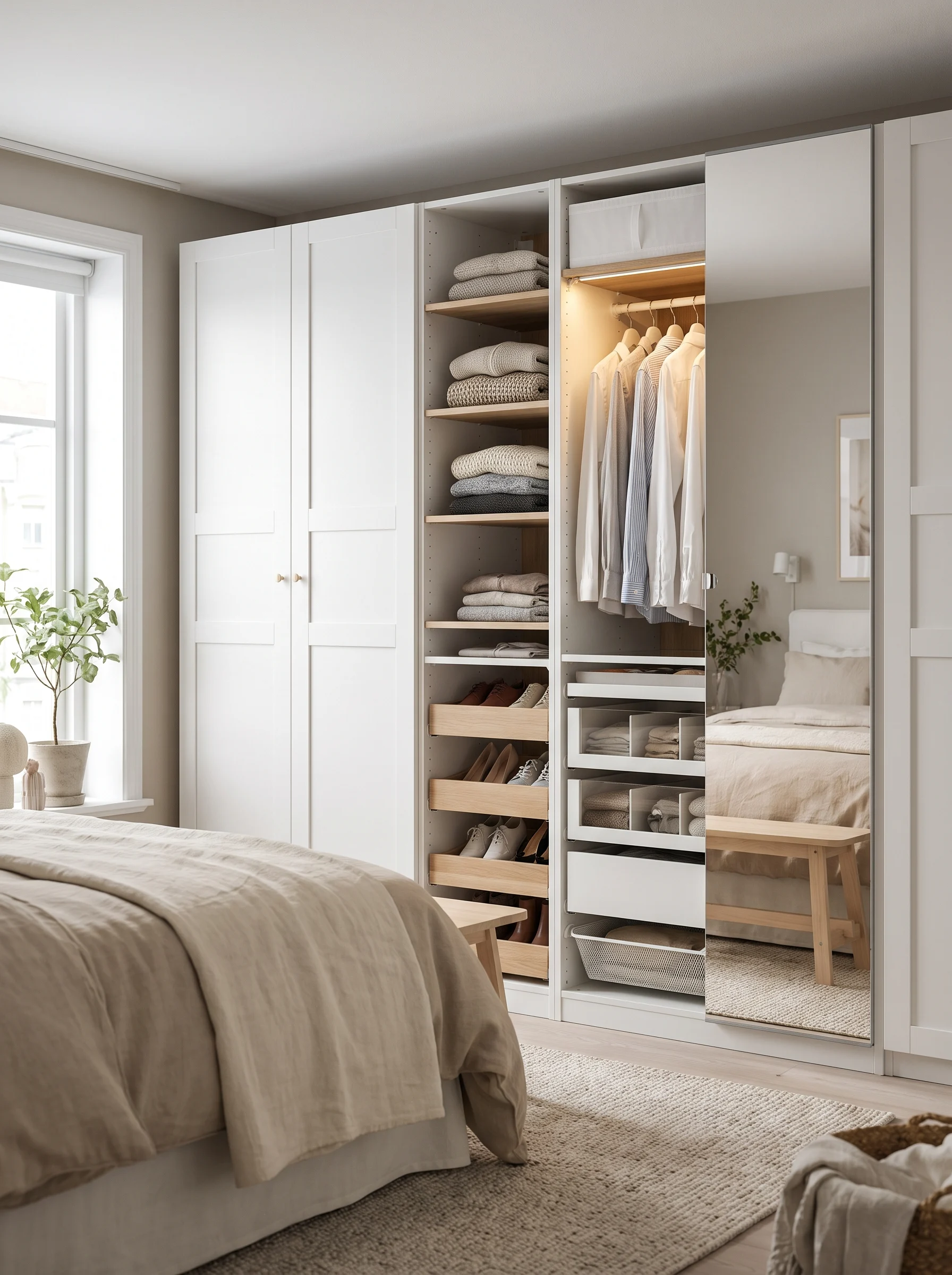
That’s where the PAX system earns its reputation. It’s a modular frame you size, fit, and fill yourself. The frames come in two depths, about 13 3/4 inches and 22 7/8 inches, and two heights, roughly 79 1/4 and 93 1/8 inches, so you can match them to a shallow hallway or a deep bedroom wall. Inside, the KOMPLEMENT organizers handle the details: drawers, pull-out shelves, rails, and trays. The system is flexible enough to give you a layout that fits your wardrobe rather than a generic rod and a shelf.
This list covers 17 PAX ideas, some about layout, some about the small interior upgrades that make daily mornings easier, and a few about making the finished piece look built in rather than bought flat-packed. Pick the ones that solve your actual frustrations. A closet with fifteen clever features you never use is no better than the one you started with.
1. Pick the Depth Before Anything Else
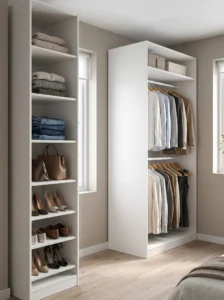
Most PAX regrets start here. People fall for a photo of a deep wardrobe, then discover it eats half their bedroom, or they choose the shallow version and can’t hang a coat without it pressing against the doors.
The deeper frame, around 22 7/8 inches, is the one for hanging clothes on a standard hanger sideways to the door. The shallow 13 3/4 inch frame suits folded clothes, shoes, bags, and shelving in hallways or narrow rooms where every inch of floor counts. Hanging bars can’t turn inside a shallow frame, so plan on shelves and drawers there instead.
Tape the footprint on the floor with painter’s tape and walk around it for a day. Open an imaginary door, step into the space, sit on the bed. You’ll learn more from that than from any product page. If the room is tight, a shallow frame holding folded items often beats a deep one holding less than you hoped. Measure the swing of the doors too, since they need clearance that the frame depth alone doesn’t show.
2. Double-Hang Rails for Shirts and Skirts

If you own mostly short items, a single long rail wastes the lower half of the closet. Stacking two rails, one above the other, nearly doubles hanging space without adding a single inch to the footprint.
This suits anyone with shirts, blouses, folded-over trousers, skirts, and jackets, which is most people’s actual wardrobe. Set the upper rail at a comfortable reach height and the lower one roughly 40 inches below it, so a shirt hangs fully without brushing the one underneath.
Keep long dresses and coats in a separate full-height section on the other side. Mixing them into the double-hung section is how people end up with pants dragging on the floor. Group by type, then by color within each type, and the closet becomes quick to scan.
A small observation: the lower rail ends up being the one you use most, because it sits at hip height. Put your everyday pieces there and save the top rail for dressier clothes you reach for less often.
3. Pull-Out Shoe Shelves
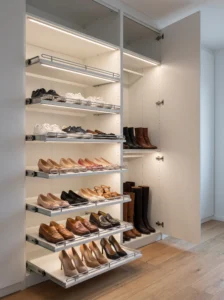
Shoes pile up at the bottom of a closet faster than anything else, and a pull-out shoe shelf fixes that without taking up extra room. The shelf slides out so you can see every pair at once instead of crouching to dig through the back.
Install them in the lower portion of a frame, where they’re easiest to reach, and angle them if the option is available so the shoes sit tilted and visible. A standard width holds around three or four pairs per shelf depending on shoe size, so count what you own before ordering.
Flats, sneakers, and sandals fit comfortably. Tall boots are the exception. Give them a section of open floor space or a taller area with removable shelves, since they’ll flop and crease on a shelf built for low shoes. A mistake worth avoiding is stacking shelves too close together, which leaves no room for the heel of a pump to clear the shelf above.
Once everything is visible, you stop wearing the same three pairs.
4. Internal Drawers for Folded Clothes
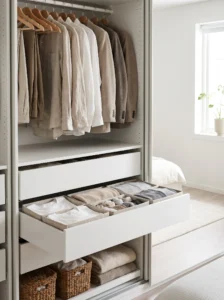
A dresser inside the wardrobe sounds redundant until you realize it frees up an entire piece of bedroom furniture. Internal drawers handle knits, T-shirts, underwear, and gym clothes, so you can often skip the standalone dresser completely.
Place drawers in the middle third of the frame, at roughly waist to chest height, where you can see into them when pulled out. Lower drawers force you to bend, and top ones require a step stool.
Divide the contents with small trays or fabric organizers so socks don’t migrate into the sweater drawer. Fold knits vertically, like files, so you can see every item at once instead of lifting a stack to find the one at the bottom.
The practical payoff is a bedroom with more floor space. Losing a dresser can make a small room feel noticeably roomier, and the clothes live behind closed doors where they stay tidy even when the drawers aren’t perfect.
5. Pull-Out Trouser Hangers and Accessory Racks
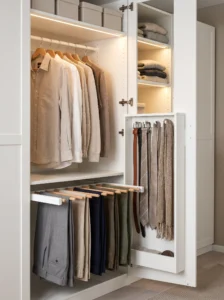
Belts, ties, scarves, and trousers tend to slide off hangers or end up in a drawer jumble. Pull-out racks give each of these a place where you can see everything at once.
A pull-out trouser hanger fits best at the end of a hanging section, within easy reach. Each pair hangs by the hem, so nothing wrinkles from being folded over a bar. Belts and ties do well on a slim rack that slides out like a drawer.
These work in nearly any room, but they matter most in a shared closet where one person owns far more small accessories than the other. Keep the rack on the side of the person who uses it, rather than splitting it down the middle.
A tip worth trying: put the things you wear to work together in this zone. When belts, ties, and trousers live side by side, a weekday morning stops requiring four separate searches.
6. A Jewelry and Valuables Tray

A shallow drawer insert lined with soft compartments keeps rings, watches, earrings, and small valuables out of loose dishes and bathroom counters. It’s a small addition that changes how often you lose a single earring.
Position it at the top of a drawer unit or in a dedicated shallow drawer near eye level. You want to look straight down into it, not reach blindly into a deeper drawer.
Choose dividers sized to the jewelry you actually own. Large compartments suit watches and bracelets, while small grids hold earrings and studs. A common mistake is buying more compartments than needed, then watching them fill with random hair ties and receipts.
If you share the closet, assigning one drawer per person prevents the usual confusion about whose earring is whose. The tray also makes getting ready faster. When everything lives in the same place every day, you stop spending five minutes hunting for the one piece you wanted.
7. Trim and Panels for a Built-In Look
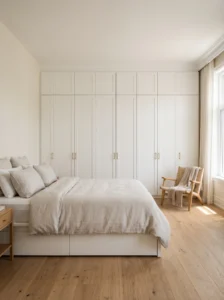
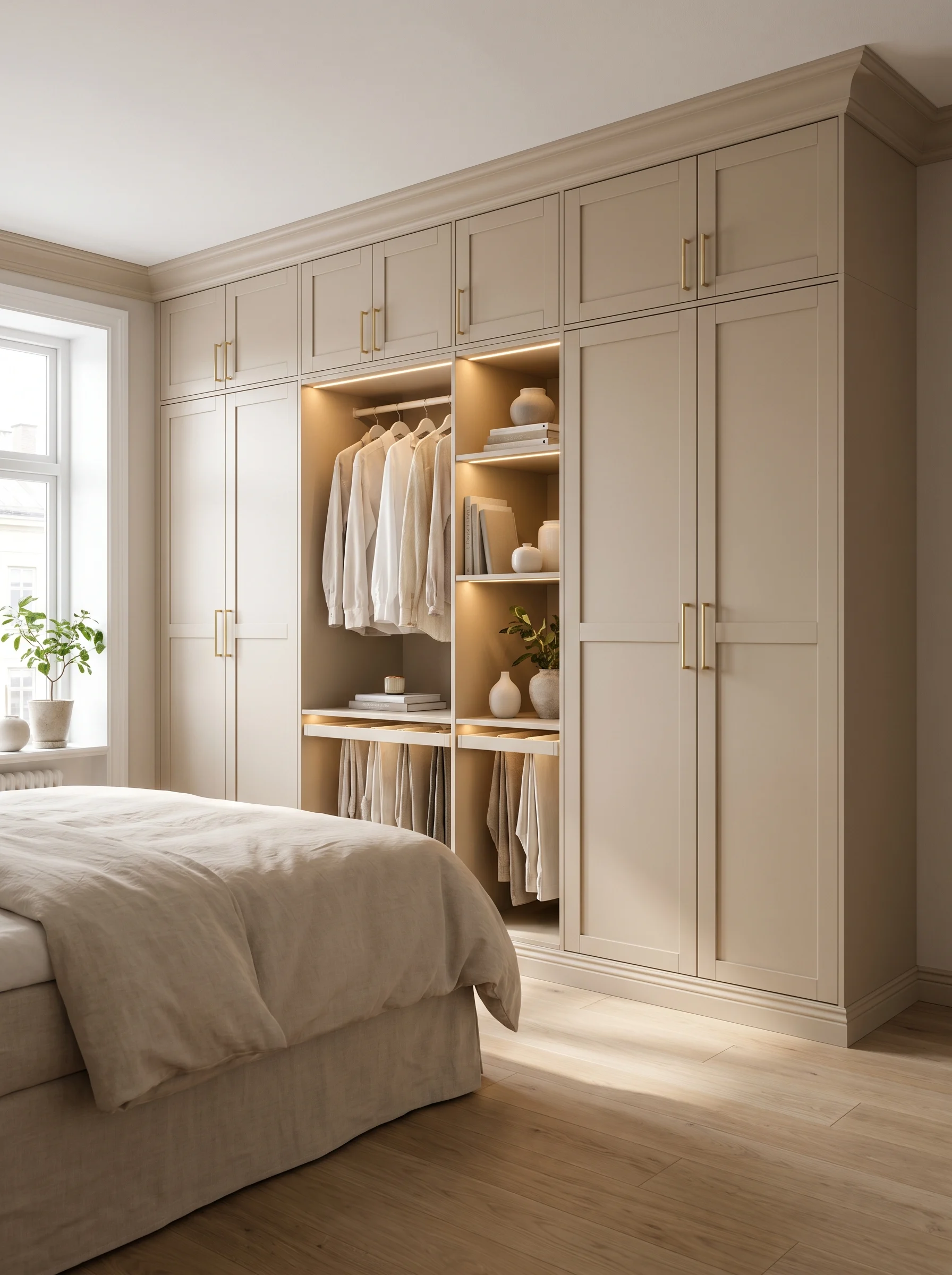
A bare PAX unit pushed against a wall reads as furniture. Add filler panels and trim, and it starts to look like part of the architecture.
This works best along a full wall, where the wardrobe can span from corner to corner. Choose the 93 1/8 inch frame height in a standard 8-foot room and you’ll leave only about three inches at the top, which crown molding or a simple trim strip can close completely.
Paint the trim to match the wall rather than the wardrobe if you want the unit to blend in, or match it to the doors for a more furniture-like feel. Caulk the seams where the trim meets the wall, because a gap that looks fine up close shows as a shadow line from across the room.
Measure the room at several heights, since walls and ceilings are rarely perfectly square. The adjustable feet on the frames help level out an uneven floor, which makes the finished wall look intentional instead of slightly crooked.
8. Lighting Inside the Frame
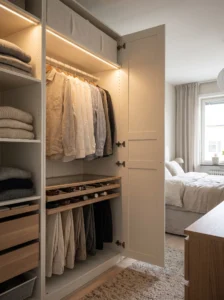
Dark closet interiors are one of the most common complaints about wardrobes, and adding light inside fixes it better than any organizing trick. When you can see the back of a shelf, you use the whole shelf.
The PAX and KOMPLEMENT system includes lighting options designed to fit inside the frames, so there’s no need to improvise with adhesive strips and loose cords. Mount a light along the top inside edge to wash down across the clothes, or choose a motion-activated type that switches on when the door opens.
Pick a warm white tone rather than a cool one. Cool light makes colors look flat, and you’ll find yourself carrying clothes to a window to check whether that navy is actually black. Plan for the power cable before assembly, since routing it afterward is far more awkward.
The difference shows up every morning. A closet you can see into is a closet you can keep tidy, and it takes the guesswork out of dressing before sunrise.
9. Mirror Doors That Do Double Duty
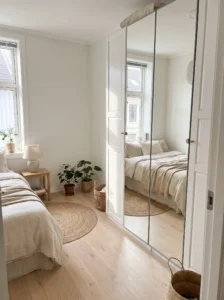
Full-length mirror doors turn the wardrobe into the dressing mirror you’d otherwise have to find wall space for. In a small bedroom, that’s one less piece of furniture and one more reason the room feels bigger.
Mirrors suit rooms with limited wall space and rooms that don’t get much light, since the reflective surface bounces daylight around. Place the mirrored section where you naturally stand to get dressed, not tucked in a corner you’ll never use.
Think about what the mirror faces. A mirror opposite a cluttered desk doubles the clutter. A mirror that catches a window or a calm wall makes the room feel more open. Also consider the weight: mirror doors are heavy, so make sure the frame is anchored to the wall according to the instructions.
Fingerprints show easily on mirrored doors, so expect to wipe them down now and then. For most people, that’s an easy trade for never needing a separate floor mirror again.
10. Sliding Doors for Tight Rooms
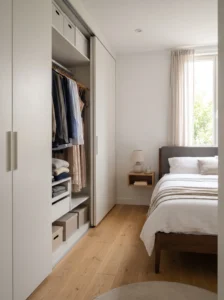
Hinged doors need clearance to swing open, and in a narrow bedroom that clearance often collides with the bed or a dresser. Sliding doors solve it by moving sideways along a track, so the floor in front of the wardrobe stays clear.
This works best in rooms where the wardrobe sits within a few feet of the bed, or in hallways where an open door would block traffic. The tradeoff is access. Sliding doors only let you open part of the wardrobe at a time, so the unit works best when what you reach for daily sits in the center, not hidden behind the overlap.
Keep the track clean. Dust and small debris build up in the groove and make the doors stick, a quick wipe every few weeks prevents most problems. Choose a lighter door finish in smaller rooms, since large sliding panels dominate a wall.
It’s a good choice when floor space matters more than seeing the whole interior at once.
11. Corner Wardrobe Configuration
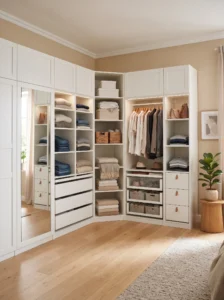
Corners are usually dead space, and PAX has corner units designed to turn that wasted angle into storage. An L-shaped arrangement wraps around two walls, giving you far more hanging and shelf space than a straight run in the same room.
It suits bedrooms where one corner is otherwise empty, or where you need maximum capacity and have no spare wall length. The corner unit itself holds shelves that rotate around the angle, which looks neat but needs planning, because stuff pushed deep into the corner is hard to reach.
Use the awkward deep section for items you rarely touch, like off-season bedding, and keep daily clothes on the straight sections. Plan door swings carefully. Doors on adjoining walls can collide with each other, so sketch the layout and check how each opens before ordering.
The payoff is capacity. For a couple sharing one room, a corner setup often holds what two straight wardrobes would, in less overall wall length.
12. Wardrobes Flanking the Bed
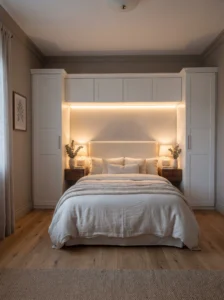
Placing a PAX unit on each side of the bed, with a shelf or cabinet bridging the space above, creates a bed alcove with enormous storage. It also makes the bed look built in, which gives the whole room a finished feel.
This layout suits a wall that has lots of length but nowhere obvious to put furniture. Leave enough space between the bed and each wardrobe to open doors and walk past. About 24 inches is a comfortable minimum, more if you can spare it.
Choose the shallow frame depth if the room is narrow, since two deep units can overwhelm the bed. Add a bridge shelf above the headboard for books or a small lamp, and run a light underneath for a soft glow at night.
The honest benefit is storage you’d otherwise lose to nightstands and a separate dresser. Clothes live at arm’s reach on both sides, and the room reads as one calm, symmetrical feature.
13. A Walk-In Closet From a Spare Room
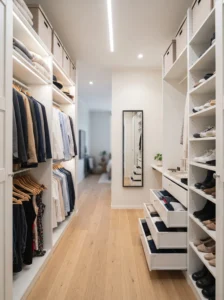
Two PAX walls facing each other, with a clear aisle between them, give you something close to a custom walk-in. This works in a small spare room, a corner of a large bedroom, or even a wide closet space.
Aim for an aisle at least 30 to 36 inches wide, so you can open drawers fully and still stand comfortably between them. Deep frames on both sides will narrow the walkway fast, so consider a deep frame on one wall and a shallow one on the other.
Use the facing walls differently. Put hanging space on one side and drawers, shelves, and shoes on the other. Add a light overhead, since a walk-in without good lighting just feels like a hallway of clothes.
Leave a small clear area at the end, even a few square feet, for a stool or a mirror. That little spot makes the closet usable as a dressing room, not just a storage space.
14. A Kid-Friendly Closet That Grows
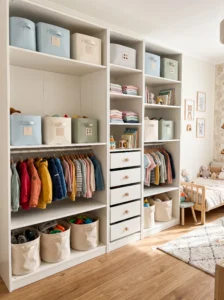
Kids outgrow their clothes constantly, and a wardrobe that can’t adapt becomes useless after a couple of years. PAX works well here because shelves, rails, and drawers can all be moved as needs change.
Start with low rails so small children can hang things themselves, and shelves at a reachable height for toys or folded clothes. As they grow, raise the rail and swap in taller sections for longer garments. Use the shallow frame depth if the room is small, since children’s clothes don’t need deep hanging space.
Choose simple door handles that small hands can grip, and avoid mirror doors in a young child’s room, since a ball or a toy can crack them. Keep heavier items low, and anchor the frame to the wall for stability.
The great advantage is that you’re not replacing furniture every few years. The same frame, reconfigured, serves a toddler and a teenager.
15. Built-In Laundry Baskets
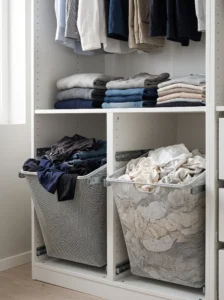
A hamper inside the wardrobe keeps dirty clothes out of sight and off the floor. Pull-out baskets or sliding frames fit into the lower section, and they’re one of the more practical ways to cut down on bedroom clutter.
Place the basket at the very bottom, where it’s out of the way but easy to pull out. If you sort laundry, choose two smaller baskets, one for lights and one for darks, so the sorting happens as you undress instead of at the washing machine.
Use baskets with breathable sides or mesh so damp towels and gym clothes don’t make the whole wardrobe smell. A closed solid bin traps odor, and the scent will reach your clean clothes.
It’s a small change that saves a daily irritation. Without a hamper corner, clothes land on a chair, and that chair becomes a permanent pile.
16. Curtains Instead of Doors
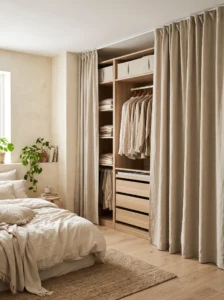
Skipping doors altogether and hanging a curtain across the front gives a softer, more relaxed look. It also saves the clearance that swinging or sliding doors need, which helps in very small spaces.
This suits bedrooms with a casual or bohemian feel, and it’s a budget-friendly choice, since fabric costs far less than doors. Mount the curtain rod on the ceiling or high on the wall so the fabric hangs full length, which makes the whole wall look taller.
Choose a heavier fabric that hides the contents, like linen or a thick cotton. Thin curtains show every shape behind them. Keep the interior reasonably tidy, because a gap in the curtain reveals more than you want.
One thing to note is that curtains don’t block dust the way doors do, so clothes will need washing a little more often. If you’re willing to accept that, this is among the cheapest and quickest ways to finish a PAX wall.
17. Top-Shelf Boxes for Seasonal Storage
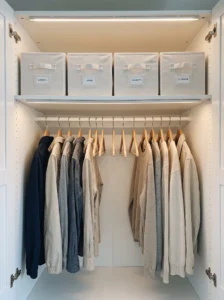
The shelf above the hanging rail is prime real estate for things you only need twice a year. Labeled boxes up there keep winter scarves, summer linens, and spare bedding out of your daily way.
Use matching boxes so the top of the wardrobe looks tidy rather than random. Label each one on the front, since you won’t remember which box holds what six months later. Choose lighter boxes for the highest shelf, because lifting a heavy box overhead is both awkward and a recipe for dropped contents.
Keep a small step stool nearby so you’re not tempted to climb on a chair. Put things you need every few weeks on a middle shelf, and save the very top for true deep storage.
This idea works for almost any wardrobe, and it quietly frees up the rest of the space. With seasonal items stored away, the main sections stay focused on what you wear now.
Comparison Table: PAX Configuration Types at a Glance
| Type | Best Use | Material | Style/Vibe | Difficulty Level |
|---|---|---|---|---|
| Standard hinged doors | Bedrooms with clearance in front | Laminate or wood-effect panels | Classic, versatile | Easy |
| Sliding doors | Narrow rooms, hallways | Panels on a track | Sleek, space-saving | Moderate |
| Mirror doors | Small or dark bedrooms | Glass-faced panels | Bright, practical | Moderate |
| Curtain front | Budget makeovers, casual rooms | Fabric on a ceiling rod | Soft, relaxed | Easy |
| Corner configuration | Rooms with an unused corner | Corner and straight frames | Maximum storage | Difficult |
| Built-in with trim | Full-wall installations | Frames, filler panels, molding | Custom, finished | Difficult |
How to Choose the Right PAX Setup
Start with measurements, not with a favorite photo. Measure the width of the wall, the ceiling height at several points, and the clearance in front for door swings. The frames come in set widths, so plan the combination that fills your space with the fewest awkward gaps. If the numbers leave a small gap, filler panels close it neatly.
Think about depth first. A deep frame holds hanging clothes, but a shallow one saves a lot of floor space, so choose according to what you actually store. Count your clothes by type, long, short, folded, and shoes, then assign space in proportion. A wardrobe built for an imaginary wardrobe will disappoint you.
Durability is solid for the price. The frames carry a 10-year limited warranty, but they’re particleboard-based, so keep them away from moisture, and anchor them to the wall as directed. Interior drawers and shelves hold up well to daily use, though overloading them is the usual cause of sagging.
Maintenance is minimal. Wipe doors with a damp cloth, keep sliding tracks clear, and avoid harsh cleaners on mirror edges.
On budget, the frames themselves are inexpensive, and cost climbs with doors, interior organizers, and lighting. Spend on the interior pieces you’ll touch every day, like drawers and pull-outs, and save on doors if you must. Prices change by size and configuration, so check current figures before you plan.
The expensive mistakes are buying everything at once and skipping the anchor. Assemble the frames, live with the layout for a few weeks, then add organizers where you feel the gaps. Always secure the frame to the wall, especially around children.
Final Thoughts
An organized closet is mostly a matter of giving each type of item its own sensible home. The PAX system makes that easy because every piece can be adjusted, added, or rearranged as your wardrobe changes. Some of these ideas are structural, like corner layouts and trim. Others, like a jewelry tray or a hamper, are small upgrades that quietly improve every morning.
You don’t need all 17. Start with the two or three that solve your loudest frustration. If shoes are the problem, begin with pull-out shelves. If the room feels cramped, consider sliding doors or a shallow frame. If the wardrobe looks like a box against the wall, trim and paint will do more than any accessory.
Measure carefully, assemble the frames before buying everything else, and give the layout a couple of weeks of real use. Adjusting a shelf height costs nothing, while replacing a poorly chosen set of doors does. Build the closet around how you actually dress, and it will stay organized long after the initial effort.
Frequently Asked Questions
How much clearance do I need in front of a PAX wardrobe?
For hinged doors, leave enough space for the doors to open fully plus room to stand, usually at least 30 inches. Sliding doors need far less clearance, which makes them useful in tight rooms.
Can PAX frames be anchored to the wall?
Yes, and they should be. The frames come with hardware for wall anchoring, and it’s especially important in homes with children or pets. Follow the instructions for your wall type.
What’s the difference between the two frame depths?
The shallower frame, about 13 3/4 inches deep, suits folded clothes, shoes, and narrow rooms. The deeper one, about 22 7/8 inches, is meant for hanging clothes on a standard hanger.
Will a PAX wardrobe fit under my ceiling?
The frames come in two heights, about 79 1/4 and 93 1/8 inches. The shorter one can be assembled upright with a ceiling of at least 79 1/2 inches, so measure before you order.
How long does a PAX wardrobe last?
With careful use, many last for years. The frames carry a 10-year limited warranty, and the interior pieces hold up well unless they’re overloaded or exposed to moisture.
Is it cheaper to build a PAX closet than hire a carpenter?
Usually, yes, especially for standard layouts. Costs rise with doors, lighting, and trim, so compare a full parts list against a quote before deciding.
What’s the most common mistake people make with PAX?
Ordering everything before measuring, or skipping the planning stage entirely. Measure the room, tape out the footprint, and plan the interior around what you own.
Can I change the layout later?
Yes. Shelves, rails, and drawers can be moved or added as your needs shift, which is one of the system’s biggest strengths.