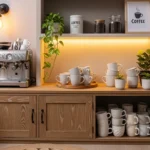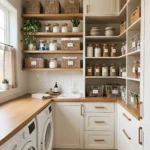
There’s a particular kind of pantry that shows up in every farmhouse-style home tour, and it’s rarely the biggest or the most expensive one in the house. What makes it memorable isn’t square footage — it’s texture. Weathered wood, a little bit of imperfection, hardware that looks like it’s been used for decades even if it was bought last month. That’s the whole appeal of farmhouse design: it doesn’t chase polish, it chases character.
The tricky part is that “farmhouse” gets used so loosely these days that it’s started to mean almost nothing — slap on a barn door and call it done. Real rustic character comes from layering a handful of specific, intentional choices rather than one obvious signal. A shiplap wall alone doesn’t make a pantry feel farmhouse. Paired with open shelving, warm wood tones, and a few well-chosen vintage touches, though, it starts to feel like a room with a history, even in a brand-new build.
This list pulls together thirty ways to bring that character into a pantry, whether you’re starting from a blank closet or reworking an existing one. Some ideas are simple styling swaps you can do this weekend. Others involve real carpentry or a bit of demolition. By the end, you’ll have a solid sense of which combination of these elements actually fits your space and your patience for a project.
1. A Sliding Barn Door Entrance
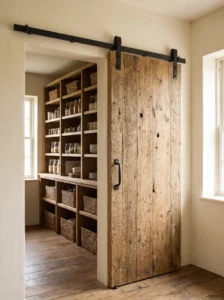
A barn door is probably the single most recognizable farmhouse signal, and there’s a reason it’s stuck around — it solves a real problem while looking the part. Sliding on an exposed track instead of swinging on hinges, it saves floor space that a hinged door would eat into, which matters in a tight pantry nook.
This works best on a solid wall with at least a foot of clearance beyond the doorway for the door to slide into when open. Reclaimed or distressed wood planks, whether genuinely old barnwood or a new board treated with a wire brush and stain, give the door the weathered look that makes it read as authentic rather than trendy. Black iron hardware — the track, handle, and hinges — provides the contrast that ties the whole look together.
Get the track rated for the door’s actual weight, since undersized hardware is the most common failure point in a DIY install. Keep the wall behind the door’s slide path clear of light switches or artwork that could get in the way. Done right, a barn door turns a plain pantry entrance into one of the room’s strongest visual moments.
2. Open Shelving With Exposed Wood Grain
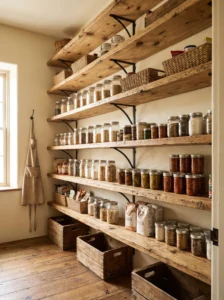
Open shelving is where a farmhouse pantry really gets to show off its materials, since there’s nothing hiding the wood behind cabinet doors. Thick, unfinished or lightly sanded boards, left with visible grain and knots rather than painted smooth, bring in the raw, natural quality that defines this style.
This works in pantries with reasonably good lighting, since open shelving in a dark closet just reads as clutter rather than a display. Pine, reclaimed oak, or fir all hold up well and take a rustic finish nicely — a simple matte or satin sealant protects the wood without dulling its natural texture. Space shelves generously, around twelve to fourteen inches apart, so jars and canisters don’t feel crammed.
Keep the items on display reasonably uniform, since exposed shelving puts everything in full view. A shelf crowded with mismatched boxes undercuts the whole effect. The mistake to avoid is over-sanding the wood until it loses all its character — a little roughness and a visible knot or two are part of what makes it feel real rather than manufactured.
3. Shiplap Walls as a Backdrop
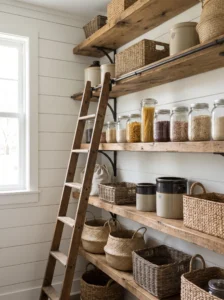
Shiplap has become almost synonymous with farmhouse style, and for good reason — the horizontal lines and visible seams between boards add texture to a wall that would otherwise just be flat drywall. In a pantry, it works especially well as a backdrop behind open shelving, where the boards peek out between jars and baskets.
This works in nearly any pantry, though a smaller room benefits from shiplap in a lighter shade, since dark or heavily grained wood can make a tight space feel closer still. Standard shiplap boards run about six inches wide with a small reveal gap between each one — a detail worth getting right, since too tight a gap loses the classic look and too wide starts looking uneven.
A coat of soft white or warm cream paint is the most common finish, letting the texture do the work rather than the color. Avoid overly glossy paint, which flattens the shadow lines that make shiplap look dimensional in the first place. It’s a relatively inexpensive upgrade for the visual impact it delivers, especially in a small pantry where one accent wall goes a long way.
4. Vintage-Style Glass Jar Storage
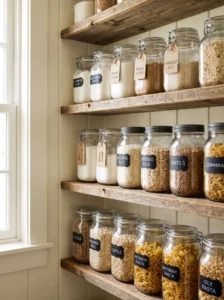
Clear glass jars with metal or cork lids do double duty in a farmhouse pantry — they keep dry goods fresh and turn everyday staples like flour, sugar, and pasta into part of the room’s decor. There’s something about seeing the actual contents, layered in warm neutral tones, that feels more homey than a shelf of printed cardboard boxes.
This works best when jars are reasonably uniform in shape and size, since a shelf of mismatched containers looks cluttered rather than curated. Wire-bail glass jars, sometimes called Fido jars, lean especially rustic thanks to their hinged lids and slightly imperfect, hand-blown look. Group jars by height on a shelf, tallest toward the back, so smaller ones don’t get lost behind bigger ones.
Chalkboard or kraft paper labels tied on with twine reinforce the handmade feel without much effort. The one drawback worth knowing is that glass jars don’t block light as well as opaque containers, so anything prone to fading or going stale quickly — certain spices, for instance — is better kept in a cabinet rather than out on open display.
5. Wire Basket Bins for Produce and Bulk Goods
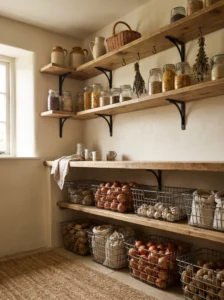
Wire baskets bring in a slightly more utilitarian, farmstead feel compared to woven or fabric bins, and they work especially well for produce like onions and potatoes that need airflow rather than a sealed container. The open weave lets air circulate, which actually extends how long these items stay fresh compared to a closed bin.
This works well on lower shelves, both because produce is heavier than most pantry goods and because it’s easier to check on ripeness at eye level or below. Galvanized steel wire holds up better than a painted finish, which tends to chip with regular handling. Choose baskets with sturdy handles if they’ll be pulled in and out often, since flimsy wire can bend out of shape within a year of daily use.
Line the bottom with a cloth liner if you’re storing something that might catch on the wire grid, like delicate produce or loose grains. The main mistake is overfilling a basket to the point where it’s hard to lift — keeping loads moderate makes daily use far more pleasant than fighting with an overstuffed bin every time you need an onion.
6. Reclaimed Wood Shelving With Visible History
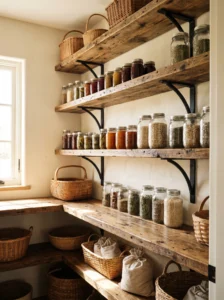
Reclaimed wood — boards salvaged from old barns, fences, or flooring — brings genuine age and history into a pantry in a way that new lumber, no matter how well distressed, can’t quite replicate. Nail holes, weathered grain, and slight color variation between boards all read as authentic rather than staged.
This works best for homeowners who don’t mind a bit of unpredictability, since reclaimed boards vary in thickness and finish more than uniform new lumber. Source material matters here — reputable reclaimed wood suppliers treat boards for pests and stabilize them structurally before sale, which matters both for safety and for making sure the shelf can actually bear weight over time.
A simple oil finish, rather than a heavy stain, tends to preserve the wood’s natural character best, letting the existing patina show through instead of masking it. Avoid over-cleaning or sanding reclaimed boards too aggressively, since that strips away exactly the texture you’re paying for. The result, done well, is shelving that looks like it’s been part of the house for generations, even in a home built last year.
7. Black Iron Hardware Throughout
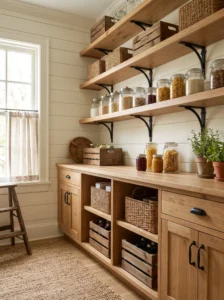
Hardware is a small detail that carries a surprising amount of weight in setting a farmhouse tone. Black iron hinges, handles, hooks, and brackets — with a matte or slightly textured finish rather than polished chrome — show up again and again in farmhouse pantries because they read as sturdy and utilitarian rather than decorative for decoration’s sake.
This works anywhere in the pantry that needs functional hardware: cabinet pulls, shelf brackets, a hook rail for aprons or dish towels. Consistency matters more than any single piece — mixing brass, chrome, and black iron across different fixtures in the same small room tends to look accidental rather than intentional. Pick one finish and carry it through every visible piece of hardware in the space.
Cast or wrought iron holds up to daily handling better than a painted finish that can chip and reveal a different color underneath. Budget for slightly higher-quality hardware here if you can, since it’s one of the few elements in the room getting touched constantly. The mistake worth avoiding is hardware so ornate it starts to feel Victorian rather than farmhouse — simple, sturdy silhouettes work best.
8. Beadboard Paneling on the Lower Walls
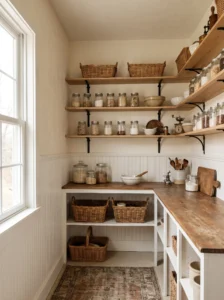
Beadboard — narrow, vertically grooved wood paneling — brings texture to a pantry’s lower walls without competing with open shelving above. It’s a slightly softer, more traditional cousin to shiplap, with a tighter, more uniform pattern that reads as a touch more refined while still fitting comfortably within farmhouse style.
This works especially well applied as wainscoting, running from the floor up to counter or chair-rail height, with a plain painted wall above. It’s a practical choice as much as a decorative one, since beadboard resists scuffs and scrapes from foot traffic or the occasional bumped basket better than plain drywall.
White or soft cream paint is the classic choice, though a muted sage or dusty blue works well for a pantry that wants a bit more color without straying from the farmhouse palette. Seal the paint with a durable, washable finish, since a pantry sees more incidental contact than most other rooms. The mistake to sidestep is pairing beadboard with shiplap in the same small space — one textured wall treatment is usually enough before the room starts to feel busy.
9. Chalkboard Labels and Signage
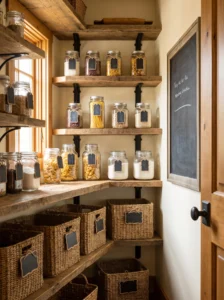
A small chalkboard label clipped or hung on baskets, jars, and shelves adds a handwritten, slightly imperfect touch that fits the farmhouse aesthetic better than printed labels ever could. It also solves a genuinely practical problem — knowing what’s in an opaque bin without having to open it.
This works well throughout the pantry, from jar tags to a larger chalkboard panel mounted on the wall for grocery lists or seasonal notes. Small wood-framed chalkboard tags, tied on with twine or wire, are inexpensive and easy to update as contents change. A larger chalkboard, painted directly onto a panel of wood or a section of wall, works well near the entrance as a running list.
Chalk pens, rather than traditional chalk, tend to write more cleanly and resist smudging, which matters if the labels are handled often. Avoid over-decorating every single surface with a label, though — a chalkboard tag on every jar starts to feel cluttered rather than charming. Reserve labels for items where the extra clarity is actually useful.
10. Galvanized Metal Accents
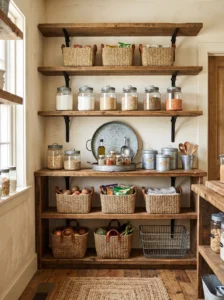
Galvanized metal — buckets, trays, canisters, even a lightweight metal ceiling tile used as a backsplash — brings a cooler, slightly industrial note into an otherwise wood-heavy pantry, and the contrast keeps the room from feeling like one uniform material palette. The silvery, slightly matte texture also photographs well against warm wood tones.
This works particularly well as small functional pieces — a galvanized tray for corralling oils and vinegars, a bucket for utensils or rolled dish towels. Larger galvanized elements, like a full metal backsplash panel, suit pantries with a slightly more farmhouse-industrial lean rather than a softer cottage style.
Galvanized finishes are naturally resistant to rust, which makes them a practical choice near any moisture, though they can develop a slightly duller patina over years of handling — something most people find adds to the charm rather than detracting from it. Avoid mixing too many metal finishes at once; pairing galvanized steel with black iron hardware works, but adding polished brass into the same small room usually reads as mismatched rather than layered.
11. A Butcher Block Prep Counter

A short stretch of butcher block counter, even just two or three feet, turns a pantry from pure storage into a small working space — somewhere to set down a mixing bowl, wrap up leftovers, or stage ingredients before carrying them to the kitchen. It’s a detail that shows up in larger farmhouse pantries and butler’s pantries especially often.
This works best in pantries with at least a few feet of contiguous wall space, ideally near an outlet if the counter will double as a small coffee or baking station. Solid maple or walnut butcher block holds up to daily wear better than a thin veneer version, and a food-safe oil finish, reapplied every few months, keeps the wood from drying out or staining.
Keep the counter clear of permanent clutter so it stays genuinely usable rather than becoming another flat surface for stray mail and mismatched items. The mistake worth avoiding is skipping the oil maintenance schedule — an unsealed or neglected butcher block counter dries out, cracks, and loses the warm glow that makes it worth including in the first place.
12. An Exposed Brick Accent Wall
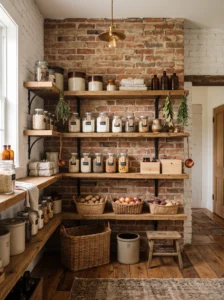
Exposed brick, whether genuinely original to an older home or added as a thin brick veneer in new construction, brings texture and warmth that few other materials match. In a pantry, even a single brick wall creates enough visual interest that shelving and jars in front of it feel layered rather than flat.
This works particularly well in homes with some existing architectural age to lean into, though a veneer application can convincingly replicate the look in a newer build. A soft limewash or whitewash finish over the brick softens the color without hiding the texture entirely, which tends to suit farmhouse style better than raw, deep red brick on its own.
Keep shelving brackets anchored properly into brick, since standard drywall anchors won’t hold — masonry screws or anchors are worth the extra step. Lighting matters here too, since brick can read as dark and heavy without a warm accent light nearby. Done thoughtfully, an exposed brick wall gives a pantry a sense of permanence that newer materials alone can’t quite fake.
13. A Vintage Scale as Decorative Accent

An old kitchen scale — the kind with a round dial or a balance arm — sitting on an open shelf or counter is a small, specific detail that signals genuine farmhouse character rather than a manufactured version of it. These pieces show up often in antique shops and flea markets, and they don’t need to function perfectly to earn their spot.
This works well as a single accent piece rather than scattered throughout the room, since the goal is a considered detail, not a theme park version of farmhouse style. Place it somewhere it won’t get knocked around during daily pantry use — a higher shelf or a spot slightly out of the main traffic path works better than the counter you’re reaching across constantly.
Rust and worn paint on a vintage scale are part of the appeal rather than flaws to fix, so resist the urge to refinish it into something that looks new. The only real mistake here is buying a reproduction that tries too hard to look aged — genuine wear has an irregularity that’s hard to replicate convincingly, and it usually shows.
14. Woven Basket Storage for Softness
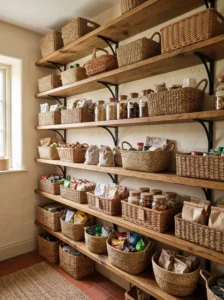
Woven baskets — rattan, seagrass, or wicker — soften a pantry that might otherwise lean too heavily on hard surfaces like wood and iron. They’re especially useful for corralling smaller, loose items that don’t have their own container, like packets of seasoning mixes or bags of snacks.
This works on both open shelving and inside cabinets, giving flexibility depending on how much you want visible versus hidden. Natural, undyed fiber baskets fit the farmhouse palette better than stained or painted versions, which can look slightly too polished for the aesthetic. Choose baskets with sturdy handles for anything you’ll be pulling in and out regularly, since flimsy weave tends to fray with repeated handling.
Keep basket sizes graduated rather than uniform if you’re lining several up on one shelf — a slight variation in scale actually looks more natural and less mass-produced. The mistake to avoid is over-relying on baskets for everything, which can make a pantry feel soft and shapeless without any of the wood or metal texture that gives farmhouse style its backbone.
15. An Antique Ladder for Extra Shelving
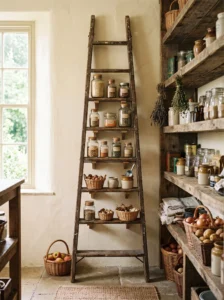
A vintage wooden ladder, leaned against a wall or repurposed with shelves built between its rungs, is one of those farmhouse details that manages to be both decorative and genuinely functional. In a pantry with a bit of extra vertical wall space, it adds a tier of storage that doesn’t require any cutting into the wall itself.
This works best in taller pantries, since a ladder needs real height to look intentional rather than cramped. An old wooden step or orchard ladder, with visible wear and slightly uneven rungs, fits the aesthetic far better than a new one — though a new ladder aged with a simple stain and some deliberate distressing gets close enough for most people’s taste.
Secure the ladder to the wall with a discreet bracket if it’s holding any weight, since a freestanding ladder loaded with jars is a genuine tipping risk. Keep items on the lower rungs, since anything too high becomes impractical to reach safely. It’s a piece that works especially well in a pantry that already leans rustic, tying the whole look together with something that feels found rather than bought new.
16. A Farmhouse Sink in a Butler’s Pantry Setup
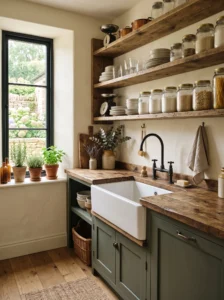
For larger pantries built with a bit of a butler’s pantry function, a farmhouse sink — deep, apron-front, and usually white or cream fireclay — anchors the space and gives it real utility beyond dry storage. It’s a bigger investment than most items on this list, but it transforms a pantry from purely storage into a working extension of the kitchen.
This works only in pantries with existing or accessible plumbing, so it’s typically a renovation-stage decision rather than a simple retrofit. Fireclay or cast iron sinks hold up to heavy daily use far better than a thinner material, and the classic apron front is really the defining farmhouse detail here — a standard undermount sink doesn’t read the same way at all.
Pair the sink with a simple bridge or gooseneck faucet in the same black iron or aged brass finish used elsewhere in the room. The main regret people run into is undersizing the sink to save space, which then limits its usefulness for washing produce or soaking larger pots. If you’re going to include one, go with a genuinely functional size.
17. Muted Sage or Cream Painted Cabinetry
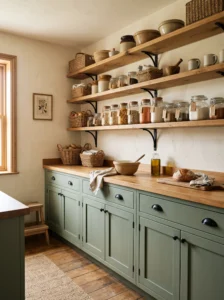
If the pantry includes any closed cabinetry alongside open shelving, a soft, muted paint color — sage green, warm cream, or a dusty blue-gray — reinforces the farmhouse palette far better than stark white or a trendy saturated hue. These muted tones read as timeless rather than tied to a specific decorating moment.
This works well on lower cabinets especially, providing a grounded base beneath lighter open shelving above. Milk paint or a matte chalk-style finish suits the aesthetic better than a high-gloss lacquer, which can look more modern than rustic. Two coats generally give even, durable coverage without needing a heavy-handed application.
Test a sample on the actual cabinet before committing, since these muted colors shift noticeably depending on the room’s lighting — a sage that looks perfect in a paint store can read oddly gray or oddly yellow once it’s on the wall under different bulbs. The common mistake is choosing a color that’s trendy right now rather than genuinely muted and neutral, which risks feeling dated again within just a few years.
18. A Distressed Wood Countertop
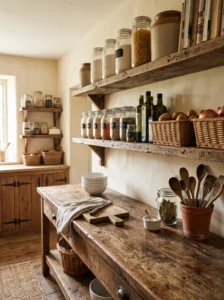
Beyond butcher block, a full distressed wood countertop — intentionally worn with visible knife marks, slight unevenness, and a matte finish — brings a lived-in quality that a pristine surface simply can’t match. This works especially well in pantries that double as a small prep or coffee station.
This suits pantries where the counter sees regular use rather than staying purely decorative, since the distressing only deepens and looks more authentic with real wear over time. Reclaimed barnwood, planed down just enough to be functional while keeping visible texture, is a popular choice, though a new pine or oak counter can be hand-distressed with tools like chains or a wire brush before finishing.
A food-safe wax or oil finish, rather than polyurethane, keeps the surface feeling soft and matte instead of glossy and sealed-looking. Reapply the finish every few months in high-use areas. The mistake to watch for is over-distressing a counter to the point where it looks damaged rather than characterful — restraint keeps it looking intentional rather than accidental.
19. A Mason Jar Storage Wall
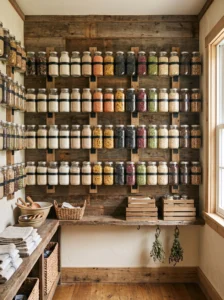
Taking the glass jar idea a step further, a dedicated wall of mason jars — mounted on a board with hose clamps, hung from hooks, or simply lined up on floating shelves — turns an entire section of the pantry into a cohesive, textured display. It’s a bigger commitment than a shelf of jars here and there, but the visual impact is considerable.
This works best on a wall with good structural backing, since a fully loaded jar wall carries real weight once every jar is filled. Standard quart and pint mason jars, in their classic clear glass with metal bands, keep the whole wall looking uniform rather than mismatched. Spacing jars evenly, with consistent gaps, makes a noticeable difference in how organized the finished wall looks.
Keep the jars filled with genuinely useful staples rather than treating the wall as pure decoration — flour, rice, dried beans, pasta, coffee. The main mistake is mounting jars with hardware that isn’t rated for the combined weight once they’re full, which risks the whole board pulling away from the wall. Test the mounting with the jars filled, not empty, before calling it finished.
20. Vintage Wood Crate Storage
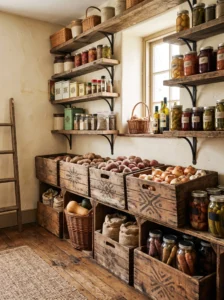
Old wooden crates — the kind originally used for shipping produce or dairy — make excellent open storage bins for a farmhouse pantry, holding everything from root vegetables to rolled linens. Stacked or mounted individually, they bring in real texture and a sense of repurposed history that new bins can’t replicate.
This works particularly well on the floor of a larger pantry, where a few stacked crates can hold bulkier items like bottled water or bulk paper goods. Genuine vintage crates, often stamped with old fruit or dairy brand names, are worth seeking out at flea markets, though reproduction crates get close enough for most farmhouse looks if the real thing isn’t easy to find.
Check any vintage crate for structural soundness before loading it with anything heavy, since decades-old wood can be more fragile than it looks. A light sanding removes splinters without erasing the character, and a simple sealant protects against further wear. The mistake to avoid is stacking crates too high without securing them, since an unanchored stack is an easy tipping hazard in a busy pantry.
21. Rustic Pendant Lighting
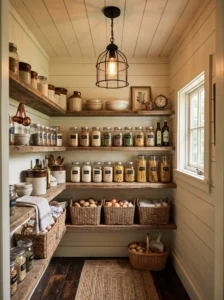
A single pendant light, hung with an exposed bulb or a simple metal cage shade, adds both function and atmosphere to a pantry that might otherwise rely on a flat overhead fixture. It’s a detail that elevates the room from purely utilitarian to genuinely styled, without much cost or effort.
This works best in pantries with at least seven feet of ceiling height, giving enough clearance for the pendant to hang without becoming a hazard to bump into. Black iron cage fixtures or aged brass sockets both fit the farmhouse palette, and a warm-toned Edison-style bulb reinforces the vintage feel far better than a cool white LED would.
Position the pendant over any counter or prep space rather than dead center in a purely storage-focused room, so the light actually does functional work rather than just looking decorative. The common misstep is choosing a fixture sized for a much larger room — a pendant that’s too large for a small pantry overwhelms the space rather than accenting it. Scale the fixture to the room, not to what looked good in a showroom.
22. Cast Iron Hooks for Hanging Storage
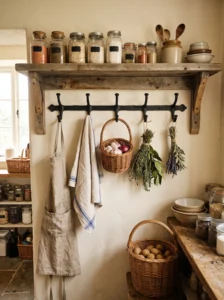
A row of cast iron hooks, mounted along an open wall or the underside of a shelf, gives a farmhouse pantry a place to hang aprons, dish towels, a small basket of garlic, or bundles of dried herbs. It’s a detail that adds both storage and a sense of everyday use, which fits the practical spirit of the style.
This works well near the pantry entrance or along an underused wall section that doesn’t have room for a full shelf. Simple, sturdy hook designs — a plain curved or double-prong shape — read as more authentically farmhouse than anything overly ornate or shaped like a specific object. Space hooks evenly, generally six to eight inches apart, so hanging items don’t overlap and tangle.
Anchor hooks into studs or use proper wall anchors if they’ll carry any real weight, since a loaded hook pulling out of drywall is a common and avoidable failure. Keep what’s hanging genuinely functional rather than purely decorative clutter — a hook holding an actual used dish towel feels more authentic than one holding something purely staged for looks.
23. An Open Plate or Dish Rack
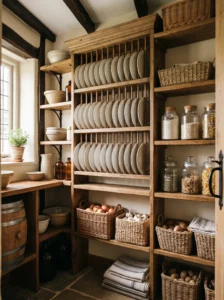
Built into a section of open shelving, a wooden plate rack with grooved slats holds dishes upright and visible, a detail borrowed from traditional English and French country kitchens that fits comfortably into farmhouse style as well. It works especially well in a pantry that shares some overflow storage duty with the main kitchen.
This suits pantries with slightly deeper shelving, since plates need more depth than a typical jar or box to sit securely in the slats. Simple, unfinished or lightly stained wood keeps the rack in line with the rest of the room’s material palette, and grooves spaced to fit standard dinner plate thickness prevent pieces from wobbling.
Keep heavier stoneware or ceramic dishes toward the more structurally supported center of the rack rather than the outer edges. The mistake worth avoiding is overloading a single rack section with plates stacked too tightly, which makes removing one without disturbing the others unnecessarily fiddly. Done well, it’s a detail that turns everyday dishware into part of the room’s display.
24. A Salvaged Door Repurposed as the Pantry Entrance
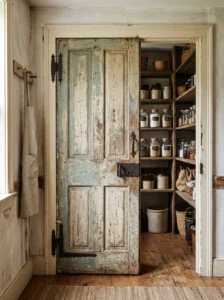
Instead of a standard barn door or a plain panel door, a genuinely salvaged door — reclaimed from an old home, barn, or building — brings history into the pantry that’s hard to fake with new materials. Original hardware, worn paint, and slightly uneven proportions all add up to a piece with real character.
This works best for homeowners willing to adapt their doorway to fit a non-standard salvaged piece, since old doors rarely match modern standard sizes exactly. A bit of trim work around the frame usually solves minor size mismatches without needing to alter the door itself. Leave the original paint or finish largely intact rather than stripping and refinishing it, since the existing wear is the entire point.
Check the door for structural soundness, particularly around the hinges, since decades of use can weaken the wood in ways that aren’t obvious at a glance. This is a more involved sourcing project than most others on this list, often requiring a trip to an architectural salvage yard, but for a pantry that wants to feel genuinely old rather than newly styled, it’s hard to beat.
25. Whitewashed Wood Paneling
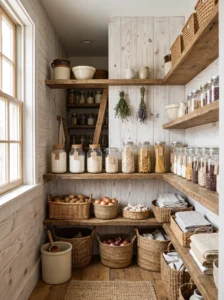
Whitewashing — a thin, translucent white wash that lets wood grain show through rather than fully covering it — softens raw wood without hiding its texture entirely, striking a middle ground between painted and natural finishes. It works well on paneling, shelving, or even ceiling beams in a pantry leaning toward a lighter, more Scandinavian-farmhouse hybrid look.
This suits pantries that want brightness without going fully white or fully natural wood. A mix of water and white paint, thinned to a wash consistency, applied with a brush and wiped back before it fully dries, gives the most control over how much grain shows through. Test on a scrap piece first, since wood species absorb whitewash differently — pine takes it much more readily than oak, for instance.
Seal the finish once it’s dry to prevent yellowing over time, particularly in a pantry that gets any natural light. The common mistake is applying the wash too thick, which ends up looking like flat paint rather than a whitewash — thin, uneven layers, wiped back by hand, give a far more natural, breathable result than one heavy coat straight from a can.
26. A Vintage Bread Box as Display and Storage
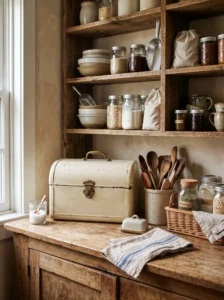
A vintage metal or enamel bread box, whether genuinely old or a well-made reproduction, is a small but effective way to bring in farmhouse character while solving a real storage need — keeping bread fresh and out of sight without sealing it in plastic. Cream, sage, or soft red enamel finishes are especially common in period pieces.
This works well on a counter or open shelf at eye level, somewhere it can function as both storage and a genuine decorative anchor. Check the seal and hinge on any vintage piece before relying on it daily, since older mechanisms can be stiff or slightly warped after decades of use. A light interior clean and a fresh liner solve most hygiene concerns with a secondhand piece.
Keep it to genuine daily use rather than pure display, since an empty bread box on a shelf reads a little hollow compared to one actually doing its job. The main thing to watch for when buying vintage is rust on the interior, which can be difficult to fully remove and may affect food safety depending on severity — inspect closely before committing to a purchase.
27. Decorative Corbels Beneath Open Shelves
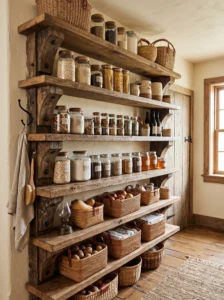
Corbels — the small wood or iron brackets traditionally used to support a shelf or countertop — add a detail-oriented touch of craftsmanship to open shelving that plain, hidden brackets skip entirely. Visible corbels turn a purely functional support into part of the room’s design.
This works especially well under a butcher block counter or a heavier top shelf, where the corbel is doing genuine structural work rather than sitting purely for looks. Turned wood corbels in a distressed or weathered finish fit the farmhouse aesthetic more naturally than smooth, contemporary versions. Black iron corbels offer a slightly more rustic, less ornate alternative for a room already leaning heavily on metal accents elsewhere.
Make sure any corbel used for real support is rated for the load above it — decorative corbels meant purely for looks aren’t always built to bear weight, so check the product specs before assuming one will hold a fully loaded shelf. The visual payoff is genuinely worth the extra step, since exposed corbels give shelving a sense of craftsmanship that a hidden bracket system simply can’t replicate.
28. Farmhouse-Style Curtains Instead of Doors
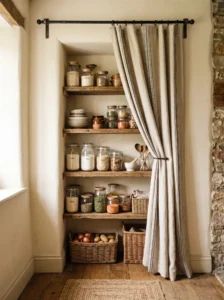
In place of a solid door, a simple fabric curtain — often a soft linen, buffalo check, or ticking stripe — hung on a tension rod or small curtain track offers a softer, more casual entrance to a pantry. It’s a detail that shows up often in cottage-leaning farmhouse spaces where a heavy barn door would feel too formal.
This works especially well for a small pantry nook that doesn’t have room for a swinging or sliding door at all, since a curtain takes up essentially no depth. Natural, slightly textured fabrics fit the aesthetic better than anything with a glossy or synthetic finish. A simple gathered or pleated header, rather than grommets, tends to read as more traditionally farmhouse.
Choose a washable fabric, since a pantry curtain collects more incidental dust and kitchen odors over time than curtains elsewhere in the house. The main drawback is that a curtain offers less sound or smell containment than a solid door, which matters if the pantry is right off a main living space. For a purely visual and low-cost farmhouse touch, though, it’s hard to beat the simplicity.
29. Weathered Signage and Typography
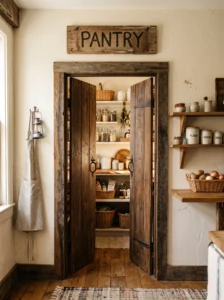
A piece of hand-painted or stenciled signage — a simple word like “Pantry” or “Provisions” in a slightly worn, vintage-style font — adds a graphic element that ties the whole room together without requiring much space or expense. These signs often show up on reclaimed wood or aged metal, echoing the material choices used elsewhere in the room.
This works well mounted above the pantry entrance or on an open wall section that doesn’t already have shelving. Hand-lettered or stencil-painted signs feel more authentic than anything digitally printed and laminated, which tends to look flat and mass-produced by comparison. A muted, slightly uneven paint application — rather than crisp, perfectly even lettering — reinforces the handmade quality.
Keep the wording simple and functional rather than overly cute or wordy, since a short, sturdy phrase reads better at a glance than a long one crammed onto a small sign. The mistake to avoid is treating signage as the room’s main design statement rather than a supporting detail — on its own, a sign doesn’t carry a farmhouse look, but layered with wood, iron, and texture elsewhere, it rounds things out nicely.
30. Terracotta Pots for Herb and Utensil Storage
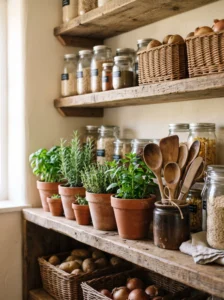
Small terracotta pots, whether holding fresh herbs on a windowsill shelf or standing in for utensil crocks on a counter, bring in an earthy, warm material that complements wood and iron without competing with either. Their slightly rough, matte texture and warm clay color fit naturally into the farmhouse palette.
This works well on any shelf that gets a bit of natural light if you’re using them for actual herbs, or anywhere at counter height if they’re holding wooden spoons, whisks, or other frequently grabbed tools. Unglazed terracotta looks more rustic than a glossy glazed version, and it’s porous enough to help wick excess moisture away from soil if you’re growing anything live in it.
Check drainage if pots are holding actual plants, since terracotta without a drainage hole traps water and can rot roots over time. For dry storage use, like holding utensils, that’s not a concern at all. The mistake worth avoiding is using pots so large they overwhelm a small pantry shelf — smaller and mid-sized pots generally scale better to the room than an oversized statement piece.
Comparison Table: Farmhouse Pantry Style Elements at a Glance
| Type | Best Use | Material | Style/Vibe | Difficulty Level |
|---|---|---|---|---|
| Sliding barn door | Space-saving pantry entrance | Reclaimed wood, iron track | Bold, classic farmhouse | Moderate |
| Open shelving with exposed grain | Everyday dry goods display | Pine, oak, or fir | Warm, natural | Easy to Moderate |
| Shiplap or beadboard walls | Textured backdrop | Wood paneling | Cottage-farmhouse | Moderate |
| Mason jar storage wall | Cohesive pantry staple display | Glass jars, mounted board | Rustic, curated | Moderate |
| Butcher block counter | Small prep or coffee station | Solid maple or walnut | Functional, warm | Moderate to Hard |
| Vintage crates and baskets | Bulk or produce storage | Reclaimed wood, rattan | Repurposed, homey | Easy |
How to Choose the Right Farmhouse Elements for Your Pantry
Trying to include everything on this list at once is the fastest way to end up with a pantry that feels overdone rather than authentic. Start by picking two or three anchor elements — maybe open shelving, a barn door, and black iron hardware — and let those set the tone before layering in smaller details like signage or a vintage scale. Real farmhouse style tends to look collected over time rather than installed all at once.
Sizing and scale matter more than people expect in a small pantry specifically. A barn door or a set of corbels sized for a large mudroom will overwhelm a five-by-six-foot closet pantry, so measure the actual room and choose fixtures proportional to it rather than copying a feature straight from a much bigger space.
On materials, genuine wood, iron, and glass age better and photograph more convincingly than laminate or plastic versions trying to mimic the same look. That said, budget is a real constraint for most people, and a well-chosen reproduction piece — a new barn door hardware kit, for instance — can look just as good as an expensive reclaimed original if the finish and proportions are right.
Durability and maintenance deserve real thought before buying anything, especially for elements that see daily contact — hardware, hooks, and counters in particular. Cheap finishes chip and reveal a different color underneath within a year or two, which undercuts the aged look you’re going for far faster than genuine wear would.
Balancing quality against price usually comes down to prioritizing the pieces you’ll touch or see most — door hardware, open shelving, lighting — and saving money on background elements like decorative crates or accent pots. The most common expensive regret is buying a large, costly piece, like a full salvaged door or a farmhouse sink, without checking that it will actually fit the space’s existing dimensions and plumbing.
Final Thoughts
Farmhouse character in a pantry comes down to layering a handful of genuine, well-chosen details rather than chasing every trend at once. Wood with visible grain, iron hardware with real weight to it, and a few personal touches like vintage jars or a hand-lettered sign go a lot further than trying to check every box on this list in one small room.
Start with the structural choices — shelving, a door treatment, wall texture — since those set the room’s foundation, and add the smaller decorative layers once the bones are in place. A pantry built this way tends to feel collected and lived-in rather than staged, which is really the whole point of farmhouse style in the first place. Whatever combination you land on, the goal is a space that feels warm and useful, not just photogenic.
Frequently Asked Questions
Is a barn door practical for a small pantry, or just decorative?
It’s genuinely practical, since a sliding door saves the floor space a hinged door would need to swing open. As long as there’s enough wall clearance beside the doorway for the door to slide into, it works well even in a tight space.
How much does it cost to add farmhouse-style open shelving to a pantry?
Basic wood shelving with simple brackets can cost relatively little if you’re comfortable installing it yourself, often under a couple hundred dollars for materials in a standard-sized pantry. Reclaimed wood or custom-built shelving runs higher, depending on the source and finish.
Do open shelves in a pantry require more cleaning than closed cabinets?
Yes, somewhat — dust settles on exposed jars and shelving in a way it wouldn’t behind a cabinet door. A quick wipe-down every few weeks keeps things looking fresh without much extra effort.
Is reclaimed wood safe to use for food storage shelving?
Reputable suppliers treat reclaimed wood for pests and stabilize it before selling, which makes it safe for shelving. It’s worth confirming treatment history with the seller, especially for wood sourced from an unknown or informal origin.
What’s the most budget-friendly way to get a farmhouse pantry look?
A coat of paint in a muted farmhouse tone, some open shelving, and a few well-chosen jars or baskets go a long way without major renovation. Hardware swaps, like updating pulls to black iron, are also a low-cost, high-impact change.
How do I keep a farmhouse pantry from looking cluttered?
Stick to a consistent material and color palette, and resist filling every open surface with decor. Uniform containers and a bit of restraint with accent pieces keep the room looking curated rather than crowded.
Will farmhouse pantry styling go out of date quickly?
Muted, natural materials like wood and iron tend to age well compared to trend-driven color choices, so a farmhouse pantry built around those staples generally holds up longer stylistically than one leaning on a specific trending accent color.
What’s the biggest mistake people make with a farmhouse pantry makeover?
Trying to include too many statement pieces at once, which ends up feeling like a theme rather than a genuine style. Choosing a few anchor elements and letting the rest build up gradually tends to look far more authentic.