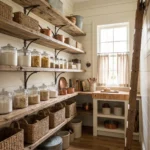
Most kitchens run out of pantry space long before they run out of pantry needs. You buy a few extra cans during a sale, stock up on snacks for the kids, or finally invest in that bulk box of pasta, and suddenly every shelf is packed edge to edge. The frustrating part is that the kitchen usually isn’t actually out of room — it’s out of obvious room.
There’s a difference between the two. Obvious storage is the pantry closet, the cabinet above the fridge, the drawer under the stove. Hidden storage is everything else: the six inches of dead space beside the fridge, the toe-kick nobody thinks about, the back of a door that’s just sitting there doing nothing. These spots get overlooked because they don’t look like storage. They look like gaps, or trim, or wasted architecture.
Once you start hunting for these pockets, though, you notice them everywhere. A house that felt cramped starts to feel workable again, and you didn’t have to knock down a single wall to get there. This list walks through twenty-one places that can quietly absorb extra pantry items — from the practical and easy to the slightly more involved renovation-style options. Some you can set up this weekend with a trip to a home store. Others take a bit of planning or a handy friend. Either way, by the end you’ll probably look at your own kitchen a little differently.
1. The Gap Beside the Refrigerator
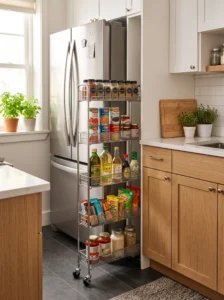
That narrow strip of space between the fridge and the wall or cabinet is one of the most consistently wasted areas in an American kitchen. It’s rarely more than six to ten inches wide, which is exactly why most people assume nothing fits there — but that width is perfect for a slim rolling cart.
A pull-out pantry cart, sometimes sold as a “fridge gap organizer,” slides into that space and holds spices, canned goods, oils, or snack packets on narrow shelves. Because it rolls, you can pull the whole thing out to grab something from the back instead of reaching blindly. Look for one made of coated wire or stainless steel so grease and moisture don’t cause rust over time.
Measure the gap carefully before buying, since even a half-inch miscalculation can mean the cart won’t fit or won’t roll smoothly. Stick to lightweight items on the top shelves and heavier canned goods lower down to keep the cart stable. The one mistake people make here is overloading the top shelf, which makes the whole unit tip forward when it’s pulled out. Keep it balanced and this sliver of space becomes genuinely useful extra pantry real estate.
2. Above the Cabinets (The Soffit-Free Zone)
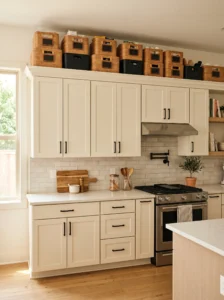
If your kitchen cabinets stop short of the ceiling, that open strip above them is often treated as decorative shelf space for the occasional vase or cookbook. It can hold a lot more than that. Large baskets or matching bins placed up there work well for items you don’t need daily — holiday baking supplies, bulk paper products, or backup stock of pantry staples.
This spot works best in kitchens with at least 12 to 15 inches of clearance above the cabinets, since anything shorter makes it hard to lift bins in and out. Choose uniform baskets in a neutral material like woven rattan or matte black metal so the area looks intentional rather than cluttered. Label the fronts if the baskets aren’t see-through, otherwise you’ll forget what’s stored where within a month.
A small step stool nearby makes this space realistic to use rather than aspirational. The common mistake is stacking mismatched boxes and cans directly on the cabinet tops, which reads as clutter and collects a surprising amount of dust. Contained storage keeps it functional and still lets the space read as finished. This is one of the easiest wins on this list because it usually requires no installation at all.
3. Inside the Kick Plate (Toe-Kick Drawers)
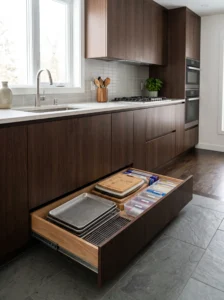
The toe-kick is that recessed strip at the very bottom of your cabinets, usually just a few inches of empty space behind a plain panel. It exists purely for your feet to slide under while standing at the counter, and most of the time it’s completely hollow behind that panel — wasted depth running the entire length of your kitchen.
Toe-kick drawers convert that space into shallow pull-out storage, perfect for flat items like baking sheets, cutting boards, or flattened boxes of crackers and cereal. Some people use them for pet food storage since they’re low, out of the way, and keep bags off the floor. Installation involves cutting the existing panel and fitting a shallow drawer box with a spring-loaded or push-to-open mechanism, so this one is more of a weekend carpentry project than a same-day fix.
Depth is usually limited to three or four inches, so this works best for flat or slim items rather than tall cans. Get the measurements exact, because a drawer that’s even a little too tall will hit the cabinet frame and jam. Done well, though, it’s genuinely one of the most surprising storage upgrades a kitchen can get, since guests almost never notice it’s there until you open it.
4. The Back of the Pantry Door
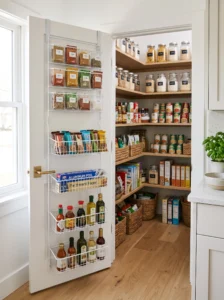
An unused pantry door is basically a vertical shelf that nobody’s using. Over-the-door organizers with clear pockets or wire baskets turn that flat surface into a home for spice packets, snack bars, foil and plastic wrap boxes, or small condiment bottles that otherwise get lost behind bigger items.
This works in nearly any pantry with a swinging door, though you’ll want to check clearance first — a door-mounted organizer adds two to four inches of depth, which can be a problem in a tight galley kitchen where the door swings close to a counter or opposite wall. Over-the-door racks with adjustable shelves are more forgiving than fixed pocket organizers, since you can shift shelves to match whatever you’re storing that season.
Lightweight, frequently grabbed items work best here rather than heavy cans, which can strain the mounting hooks over time. A common mistake is loading the very top pocket with heavy jars, which throws off the balance and makes the whole unit sag. Keep weight even and check the hooks every few months for wear. It’s a low-cost fix — most organizers run under thirty dollars — but it adds a meaningful amount of small-item storage almost overnight.
5. Under the Stairs
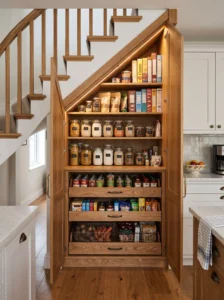
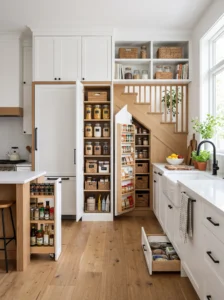
If your kitchen or dining area backs onto a staircase, the triangular space underneath is one of the largest hidden storage opportunities a house can offer, and it’s routinely left as a dusty gap or a spot for the vacuum cleaner. With shelving or custom pull-out drawers, that triangle can hold an entire secondary pantry.
Because the ceiling slopes, shorter shelving works better near the back of the space, with taller items like cereal boxes or paper towel packs kept toward the front where the ceiling is higher. A built-in unit with drawers on rails makes the deep sections usable, since reaching into the back of a fixed shelf under a low slope is nearly impossible without kneeling.
This is a bigger project — it usually means removing drywall, adding a frame, and finishing the interior — so it’s better suited to a homeowner planning a renovation rather than a quick weekend fix. The payoff is worth it in kitchens that are otherwise tight, though. A friend of mine converted her under-stairs triangle into a canned-goods pantry and said it freed up an entire kitchen cabinet that used to be crammed with soup cans and pasta boxes.
6. The Space Above the Microwave
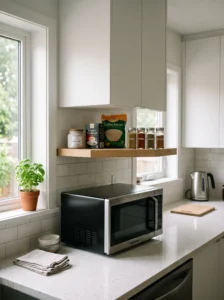
In kitchens where the microwave sits on the counter rather than built into a cabinet, there’s often a gap of unused air between the top of the microwave and the bottom of the upper cabinets. A slim shelf mounted just above it, sized to clear the microwave’s vents, adds a full extra tier of storage in a spot most people walk right past.
This works especially well for items you reach for often but don’t want cluttering the counter — coffee filters, tea boxes, or a couple of frequently used spice jars. Choose a shelf with a lip or small rail on the front edge so nothing slides off when the cabinet door above is opened and closed. Stick to lighter items, since this shelf is usually mounted with small brackets that aren’t rated for heavy loads.
Leave at least two inches of clearance above the microwave’s vents so it doesn’t overheat, and avoid storing anything flammable directly above a unit that runs warm. The main mistake here is treating it as a junk shelf for mail and odds and ends instead of dedicated pantry items, which defeats the purpose fairly quickly. Kept intentional, it’s a tidy little upgrade that barely anyone will clock as “added” storage.
7. Inside a Decorative Bench or Window Seat
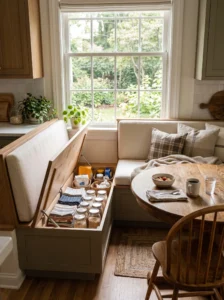
A built-in bench near the kitchen table, or a window seat in a breakfast nook, almost always has hollow space underneath the cushion. Hinged lids turn that hollow into a lid-up storage bin, which is ideal for bulkier, less frequently used pantry items like large stockpots, extra mason jars, or bulk packs of napkins and paper goods.
This spot works best when the bench is already built with a flat, removable or hinged top, since retrofitting a fixed bench is more work than it’s worth. Line the interior with a breathable fabric or a thin layer of cedar to keep out moisture and musty smells, especially if the bench sits near a window with any condensation risk. Keep the heaviest items at the bottom and anything you need occasionally near the top, since lifting a cushion and digging through layers gets old fast.
Avoid storing anything with a strong scent, like onions or certain spices, since fabric-lined bench interiors can hold odors longer than open shelving. Also skip anything that needs to breathe, like fresh produce. Used for the right items, though, this is genuinely one of the more elegant hidden storage solutions, since it doesn’t look like storage at all until someone lifts the seat.
8. The Wall Between Studs
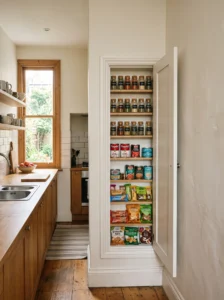
Standard wall construction leaves roughly three and a half inches of empty space between the studs, and in a kitchen wall that isn’t carrying plumbing or major wiring, that space can become a shallow recessed cabinet. Cutting into the drywall between two studs and fitting a slim built-in shelf unit gives you storage that adds zero depth to the room — a real advantage in a narrow kitchen.
This works particularly well on a wall backing onto a hallway or closet rather than another room’s finished wall, since you’ll want to confirm there’s nothing behind it before cutting in. A stud finder and a small inspection hole are worth the extra ten minutes before committing to a full cut. Once opened, a simple wood frame with two or three shallow shelves holds spice jars, small cans, or snack packets neatly.
Trim the opening with a simple frame and either a flush door or an open-front finish, depending on the kitchen’s style. The main risk here is cutting into a stud bay that has wiring or plumbing running through it, so this is a project worth doing carefully rather than quickly. Done right, it’s one of the more clever storage solutions because it genuinely looks like it was part of the original design.
9. Behind a Framed Mirror or Art Panel
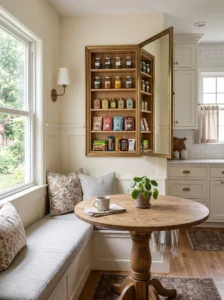
A hinged, wall-mounted cabinet disguised behind a framed mirror or a piece of art isn’t just a bathroom trick — it works just as well in a kitchen, particularly in a breakfast nook or a small eat-in area near the pantry. The frame swings open on a hidden hinge, revealing shallow shelving behind it, similar in concept to a medicine cabinet but styled to blend with the room.
This spot is ideal for smaller, lighter pantry items — tea, small spice tins, packets of hot cocoa, or a stash of snack bars — rather than heavy canned goods, since the hinges on these units are rarely built for serious weight. Mount it at a height where it reads naturally as wall art, usually around eye level, so it doesn’t stick out as an obvious storage hack.
Choosing a frame or mirror that matches the kitchen’s existing decor keeps this from feeling like a gimmick. The most common mistake is picking a design so mismatched from the rest of the room that it draws attention rather than blending in, which somewhat defeats the purpose of hidden storage. Done thoughtfully, though, it’s a fun conversation piece that also happens to be useful.
10. Under a Freestanding Kitchen Island
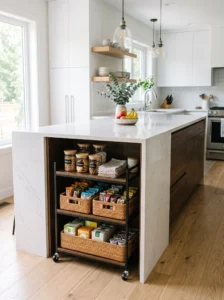
If your island doesn’t already have built-in drawers or shelving underneath, that open leg space is worth reconsidering. A slim rolling cart or a set of matching baskets tucked beneath the overhang gives you extra storage without permanently altering the island itself, which matters if you’re renting or just not ready for a full renovation.
This works best when there’s at least eight to ten inches of clearance between the floor and the island’s underside, enough for a low-profile cart to roll in and out without scraping. Baskets on the floor work too, though they’re harder to keep tidy over time since there’s no structure keeping items contained. A cart with a raised lip on each shelf handles the wobble of daily use much better than open trays.
Keep this space for lighter goods — snacks, napkins, small jars — since heavier items are awkward to bend down and retrieve repeatedly. The mistake to avoid is blocking the natural walking path around the island, which makes the kitchen feel more cramped rather than more organized. Done with restraint, this spot adds real capacity without making the room feel busy.
11. The Side of a Cabinet (Vertical Wall Space)

The exposed end panel of a cabinet run — the flat side facing the room rather than another cabinet — is often just blank wall. Mounting a slim rack, a few hooks, or a magnetic strip there turns dead vertical space into a spot for small jars, spice tins with magnetic bottoms, or hanging baskets.
This works particularly well at the end of a peninsula or island where one side faces open floor space rather than a wall. A magnetic spice rack is one of the easiest options here, since it requires just a few screws and holds a surprising number of small containers without adding bulk to the room. Wire baskets on hooks work well too, especially for produce that needs airflow, like onions or garlic.
Keep whatever you mount here reasonably lightweight, since most of these racks attach with screws into cabinet-grade material that isn’t especially deep. Avoid mounting anything at a height where it could catch a sleeve or bump an elbow during regular kitchen movement — that’s the main complaint people have after installing these. Positioned thoughtfully, it’s an easy, low-cost way to reclaim a wall that was never doing anything before.
12. Inside the Base of a Kitchen Table
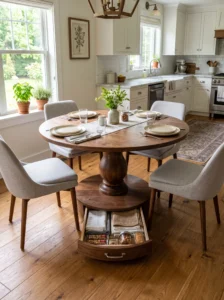
Some kitchen and dining tables have a solid or semi-solid base rather than simple legs, and that base can sometimes be modified or chosen specifically to include hidden storage — a small drawer or shelf built into the pedestal. This isn’t a retrofit for every table, but it’s worth considering if you’re shopping for a new one anyway.
This option works best for households that eat casually in the kitchen and want quick access to things like napkins, placemats, or shelf-stable snacks without walking across the room. A pedestal-style table with a built-in drawer keeps the storage low-profile and doesn’t interfere with legroom the way a bulkier console table might.
If you’re not buying new, a slim under-table drawer kit can sometimes be added to an existing table, though this depends heavily on the table’s construction. Stick to flat, light items here rather than anything bulky, since the drawer depth is usually shallow. The mistake to watch for is choosing a drawer style that catches on chairs when people scoot in and out — test the swing space before committing to hardware placement.
13. Behind an Open Shelving Backsplash
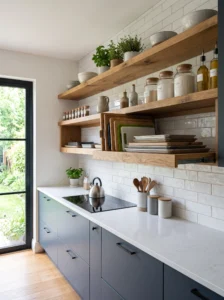
Open shelving mounted slightly forward of the wall, with a small gap behind it, creates a shallow vertical pocket that’s easy to overlook. Some homeowners build this gap on purpose, using slim pull-out trays behind the visible shelf to store flat items like cutting boards, trays, or cookie sheets that would otherwise clutter the open display.
This works well in kitchens that already have open shelving as part of the design, since it doesn’t require adding anything new — just modifying how the shelf is mounted to leave a few extra inches of depth. A shallow pull-out tray on a simple track slides out from behind the shelf brackets, keeping bulky flat items completely out of sight while the open shelf above still displays dishes or jars.
Keep the visible shelf items lightweight and decorative, since the structure is doing double duty holding both the display and the hidden tray behind it. The common mistake is overloading the open shelf itself, which can strain the same brackets supporting the hidden storage below. This is more of a build-from-scratch idea than a retrofit, best suited to someone already planning new shelving.
14. The Space Above a Refrigerator Cabinet Box
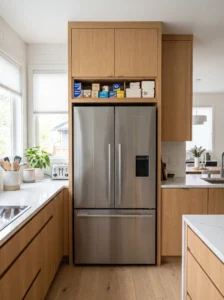
Even in kitchens where the fridge sits inside a cabinet surround, there’s frequently a gap between the top of the fridge and the underside of the cabinet box above it — usually four to six inches, left intentionally for ventilation and door clearance. A slim, low-profile bin or tray fitted into that gap makes use of space that’s otherwise just air.
This works well for lightweight paper goods — napkins, paper towel refills, or foil boxes — since anything heavier is awkward to lift up and over the fridge repeatedly. A step stool is basically required here, so this spot suits taller kitchens or households who don’t mind grabbing a stool for occasional-use items.
Make sure whatever you store doesn’t block the fridge’s ventilation gap, since restricting airflow can affect how efficiently the appliance runs. Avoid storing anything you need daily, since the height makes it inconvenient for frequent access. The mistake people make is treating this like prime real estate for everyday items — it’s better reserved for backup stock you restock every few weeks rather than every day.
15. Inside a Fake Drawer Front
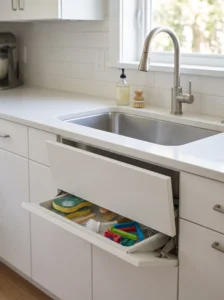
Many kitchens have a decorative, non-functional drawer front — often above the sink, where real plumbing prevents an actual drawer. What looks like a drawer is really just a flat panel screwed to the cabinet frame. With the right hardware, that panel can become a functional tip-out tray, a shallow storage spot perfect for sponges, small scrub brushes, or twist ties and produce bag clips.
This is one of the more budget-friendly upgrades on this list, since sink tip-out kits are inexpensive and widely available, usually installing in under thirty minutes with just a screwdriver. The tray itself is shallow, generally two to three inches deep, so it’s only suited to small, flat items rather than anything bulky.
Measure the width of the existing false front carefully before ordering a kit, since these come in a few standard sizes and a mismatch means the tray won’t sit flush. Avoid storing anything that needs to stay dry, given the proximity to the sink and the occasional splash. This is a small fix, but it’s one of those upgrades that makes a kitchen feel noticeably more considered once it’s done.
16. Under Open Wall Shelves as Pull-Down Storage
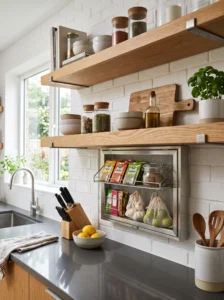
If your kitchen has open shelving with visible brackets, there’s often unused space directly beneath each shelf’s underside — enough for a slim, pull-down or fold-flat rack that stays hidden against the shelf bottom until needed. These fold-down racks are more common in laundry rooms but adapt well to kitchens for holding small jars, spice packets, or produce bags.
This works best on shelves with sturdy brackets rated for extra weight, since a pull-down rack adds load beyond what the shelf itself is already carrying. Choose a rack with a locking mechanism so it doesn’t swing loose during regular kitchen movement, which can be startling if you’re not expecting it.
Keep the items stored light, since this setup relies on hinge hardware rather than a fixed shelf. The main issue people run into is forgetting the rack is there and bumping their head on it while reaching for something on the counter below — mounting it slightly higher than feels necessary usually solves that. It’s a niche solution, but a genuinely clever one in a kitchen that’s already committed to open shelving.
17. The Corner Behind a Swinging Door
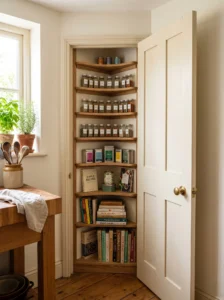
Every kitchen with a hinged door has a triangular sliver of dead space in the corner where the door swings open. It’s rarely more than a foot wide at its widest point, but a slim corner shelf unit, sized to clear the door’s swing radius, can hold small jars, spice tins, or a few cookbooks that would otherwise take up cabinet space.
This works only in kitchens where the door doesn’t swing a full 180 degrees against the wall, so measure the door’s actual swing path before installing anything here. A quarter-round or triangular shelf unit fits the geometry of the corner far better than a standard rectangular one, and mounting brackets are usually just a couple of screws into the wall studs.
Stick to lightweight items, since these corner shelves rarely have deep support behind them. The mistake to avoid is placing anything that sticks out far enough to catch the door on its swing, which over time can knock items loose or scratch the door itself. It’s a small win, but in a kitchen where every inch counts, a formerly useless corner becomes genuinely functional.
18. Inside a Furniture-Style Hutch Disguised as a Sideboard
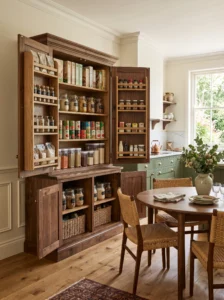
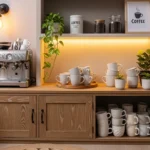
A freestanding hutch or sideboard placed in a kitchen or adjoining dining space doesn’t read as pantry storage at first glance — it looks like a furniture piece. But behind those cabinet doors, adjustable shelving can hold an enormous amount of dry goods, extra dishware, or bulk pantry stock, especially in kitchens that ran out of built-in cabinet space.
This option works particularly well for renters or anyone who doesn’t want to alter existing cabinetry, since a hutch is entirely freestanding and moves with you. Choosing a piece with adjustable shelves rather than fixed ones lets you customize the interior height for tall cereal boxes on one side and shorter cans or jars on the other.
Solid wood or a sturdy engineered wood construction holds up better over years of loading and unloading than a flimsy particleboard piece, even if it costs more upfront. The common mistake is buying a hutch based purely on its exterior look without checking shelf depth and weight capacity, which leads to sagging shelves within a year or two. Chosen well, a hutch can function as a full secondary pantry while still looking like a stylish piece of furniture.
19. The Recess Behind a Range Hood
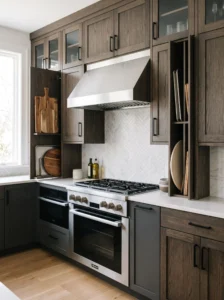
Above many stoves, the cabinet or wall recess surrounding the range hood often has a few inches of unused depth on either side of the hood unit itself. Slim vertical dividers or a narrow tray fitted into that recess can hold flat items like cutting boards, baking sheets, or trays that usually end up wedged sideways in a lower cabinet.
This works best when the range hood is inset into a cabinet surround rather than mounted directly to the wall, since that surround typically has a few extra inches of depth built in for ventilation clearance. A slim pull-out divider, similar to the kind used for baking sheets elsewhere in a kitchen, fits neatly into this gap without interfering with the hood’s function.
Keep anything stored here away from direct contact with the hood’s exterior, since it can run warm during heavy cooking sessions. Avoid anything flammable or anything that could melt or warp with occasional heat exposure. This spot takes a bit of custom measuring since every range hood surround is built slightly differently, but it turns an awkward gap into a genuinely practical storage strip.
20. Behind a Fold-Down Kitchen Table or Murphy Table Panel
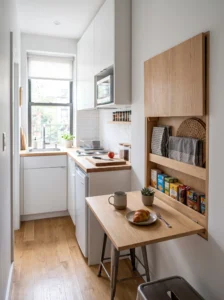
Kitchens with a fold-down table mounted to the wall — common in smaller homes and apartments — often have hollow space behind the mounting panel when the table is folded up. A shallow shelf unit fitted into that hollow can store items you only need occasionally, since retrieving them means folding the table down first.
This works well in compact kitchens already using a fold-down table to save floor space, since the storage essentially rides along with a fixture you already have. A slim shelf, no more than three or four inches deep, keeps the table’s folding mechanism clear while still adding a meaningful amount of storage for lightweight goods like napkins, placemats, or snack boxes.
Test the table’s fold-down motion several times after installing anything behind it, since even a shelf that seems shallow enough can interfere with the hinge mechanism if it’s mounted a fraction too far forward. The mistake here is rushing the installation and skipping that test, which usually means a return trip to adjust everything afterward. Done carefully, it’s a smart way to layer function into a space-saving fixture that’s already doing a lot of work.
21. The Attic Access Panel Above the Kitchen
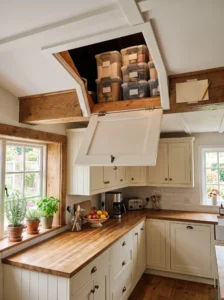
In houses where an attic access panel happens to sit directly above or near the kitchen, that crawlspace — while not glamorous — can hold bulk pantry backstock that doesn’t need frequent access. Think holiday baking supplies, large packs of paper goods, or backup canned goods bought during a sale.
This isn’t a spot for anything you’ll need on a regular basis, given the access involved, but for genuinely occasional items, it’s an enormous amount of otherwise wasted volume. Use sturdy, sealed plastic bins rather than cardboard boxes, since attic spaces experience more temperature swings and humidity changes than the rest of the house, and cardboard breaks down faster than most people expect.
Keep a simple inventory list taped near the access panel so you’re not climbing up every time you can’t remember whether you already have five boxes of holiday cocoa mix stashed up there. Avoid storing anything perishable or heat-sensitive, since attic temperatures can climb well beyond what’s safe for oils, chocolate, or certain spices. It’s not a daily-use spot, but for pure backup capacity, it’s hard to beat.
Comparison Table: Hidden Pantry Storage Options at a Glance
| Type | Best Use | Material | Style/Vibe | Difficulty Level |
|---|---|---|---|---|
| Fridge gap rolling cart | Canned goods, spices, snacks | Coated wire or stainless steel | Sleek, functional | Easy |
| Toe-kick drawer | Flat items, baking sheets, pet food | Wood or laminate drawer box | Seamless, built-in | Moderate to Hard |
| Under-stairs pantry | Bulk dry goods, canned goods | Wood frame with shelving/drawers | Custom, furniture-like | Hard |
| Over-door organizer | Small jars, snack bars, wraps | Vinyl-coated wire or clear pockets | Casual, practical | Easy |
| Sink tip-out tray | Sponges, small tools | Plastic or metal tray | Discreet, minimal | Easy |
| Freestanding hutch | Bulk dry goods, extra dishware | Solid or engineered wood | Furniture-forward | Easy (no install) |
How to Choose the Right Hidden Storage for Your Kitchen
Not every option on this list makes sense for every kitchen, and picking the right one comes down to a few practical factors rather than just what looks appealing in a photo. Start with scale. Measure the actual space you’re working with — gaps, corners, and recesses are almost always narrower or shallower than they look at a glance, and buying a cart or shelf that’s even an inch too wide means a return trip to the store.
Material matters more than people expect. Wire and metal organizers hold up well in humid spots near a sink or stove, while wood pieces, like a hutch or under-stairs build, need a sealed finish if they’re anywhere near moisture. Cardboard and unsealed particleboard are the first things to fail in attic storage or anywhere with temperature swings, so spend a little more for materials that match the environment.
Durability and maintenance go hand in hand. A rolling cart with smooth-gliding wheels will hold up far longer than one with cheap plastic casters that seize up after a few months of grease and dust. Wipe-down surfaces are worth prioritizing near the stove, while fabric-lined storage, like a window seat, is better suited to dry goods that won’t leave stains or odors behind.
On budget, the cheapest option isn’t always the best value. A ten-dollar over-door organizer that sags and breaks within a year costs more in the long run than a slightly pricier version built with sturdier hooks. That said, expensive doesn’t automatically mean better — some of the priciest built-in solutions, like custom toe-kick drawers, are only worth the investment if you’re already planning cabinet work for other reasons.
The biggest buying mistake is choosing storage before measuring the space or considering what you’ll actually store there. A beautiful hutch that can’t hold a standard cereal box, or a fridge gap cart too wide to actually roll into the gap, are both expensive lessons in measuring twice before buying once.
Final Thoughts
A kitchen doesn’t need a full renovation to gain real storage capacity — it needs a closer look at the spaces already there. Gaps beside appliances, the undersides of shelves, the backs of doors, and even attic access points can all quietly hold more than most people assume. Some of these ideas take twenty minutes and a screwdriver. Others are weekend projects, and a few are genuine renovations worth planning around.
What ties them together is a simple shift in how you look at a kitchen: less as a fixed layout, and more as a collection of spaces, some obvious and some not, that can all pull their weight. Start with the easy wins — a fridge gap cart, an over-door organizer, a sink tip-out tray — before moving on to anything that involves cutting into walls or drywall. Small changes add up quickly, and there’s a good chance your kitchen has more room than you think, hiding in plain sight.
Frequently Asked Questions
Is toe-kick drawer storage difficult to install myself?
It’s more involved than most items on this list since it requires cutting the existing panel and fitting a drawer box with working slides. A confident DIYer with basic carpentry tools can usually manage it in a weekend, but if precise measurements aren’t your strong suit, it’s worth hiring a handyman for a clean, jam-free result.
How much weight can an over-the-door organizer hold?
Most quality organizers handle around 15 to 25 pounds when weight is distributed evenly across pockets or shelves. Loading heavy items into just one section, especially the top, puts uneven strain on the mounting hooks and can cause sagging or detachment over time.
Will a fridge gap cart fit any kitchen?
Not always — you’ll need at least six inches of clearance, and the cart also needs enough floor space to roll out fully without hitting an island or opposite counter. Measure the width and the pull-out clearance before buying, since dimensions vary more between models than people expect.
Is attic storage safe for pantry items?
It works for shelf-stable, non-perishable goods stored in sealed containers, but temperature swings make it unsuitable for anything sensitive to heat, like chocolate, oils, or certain spices. Stick to paper goods, bulk dry staples in airtight containers, and holiday supplies you only need once or twice a year.
How much does a sink tip-out tray typically cost?
Most kits run between ten and twenty-five dollars, and installation usually takes less than half an hour with basic tools. It’s one of the most affordable upgrades on this list relative to the storage space it adds.
Do hidden storage solutions affect resale value?
Built-in options like toe-kick drawers or an under-stairs pantry tend to be viewed favorably by buyers since they read as thoughtful, space-efficient design. Freestanding pieces like a rolling cart or a hutch won’t affect resale directly, but they can make a kitchen show better by keeping counters and cabinets less cluttered.
What’s the easiest hidden storage idea to start with?
An over-door organizer or a fridge gap cart are both good starting points since neither requires tools beyond basic assembly, and both can be returned or repositioned easily if they don’t work out. They’re a low-risk way to test whether hidden storage actually fits your habits before investing in a bigger project.
How do I keep hidden storage from becoming a dumping ground?
Assign each spot a specific category of items rather than treating it as overflow space, and do a quick check every few months to pull out anything that’s expired or no longer needed. Storage that isn’t organized with intention tends to become clutter no matter how clever the spot is.