Open the average small bathroom cabinet and you’ll usually find the same scene. Three half-empty bottles of the same shampoo, a hair dryer coiled like a snake, and a tube of something nobody remembers buying. The room is tiny, so everything ends up on the counter, the tank lid, or the edge of the tub. Then the morning rush hits and it all lands in the sink.
Small bathrooms rarely have too much stuff. They have storage in the wrong places. The cabinet under the sink swallows things you need every day, while the blank wall above the door does nothing. Bulky furniture eats floor space when the air above and behind everything is free.
Good storage here works in layers. Daily items stay within arm’s reach, backups go up high or deep, and anything you touch once a month can leave the room entirely. You don’t need a renovation for most of this. A lot of it suits a rental, needs a drill at most once, and costs less than a decent dinner out.
The 19 ideas below cover vertical, over-the-door, over-the-toilet, under-sink, and in-shower options, with sizing, materials, and mistakes to skip. After that come a comparison table, a short buying guide, and answers to the questions people ask most.
1. A Slim Over-the-Toilet Etagere
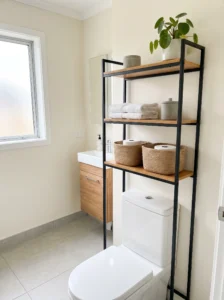
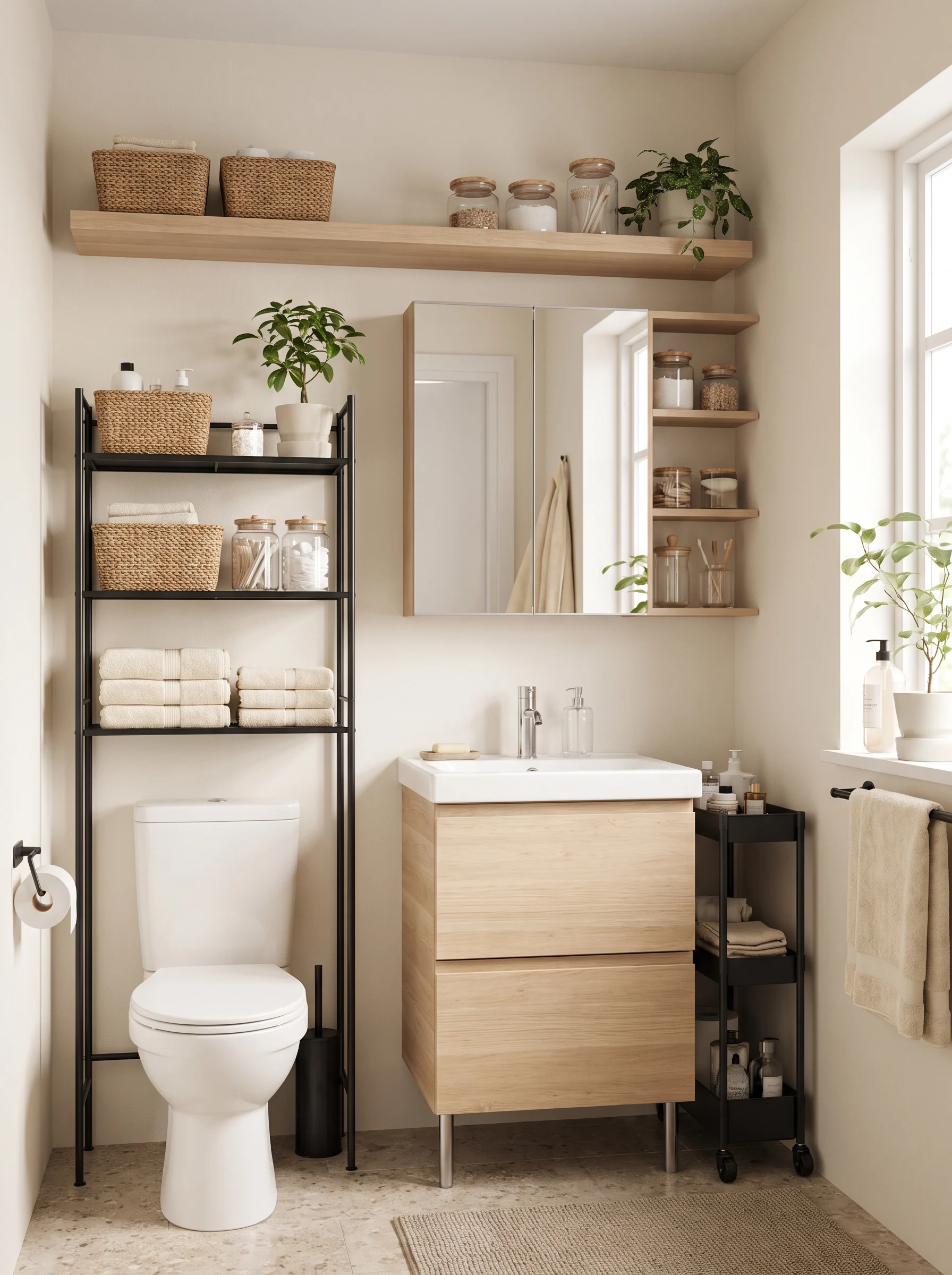
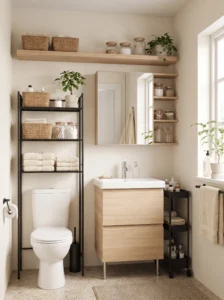
The air above your toilet is prime real estate, and a slim freestanding etagere can claim it without a single drill hole. Aim for a unit around 20 to 24 inches wide and no deeper than 8 inches, so it clears your knees and the flush handle. Three or four tiers is plenty. Powder-coated metal in matte black or brushed brass copes with steam far better than raw particleboard, and sealed bamboo is a good warm-toned alternative.
Load it like a bookshelf, with the weight low. Baskets of spare toilet paper and folded hand towels go on the bottom tiers, while the top holds something light, like a small plant or a candle. Heavy items up high make the whole unit wobble, especially on older tile floors that aren’t quite level.
Measure the gap between the tank and the wall before ordering, because a few designs sit too close and stop the lid from lifting. In a rental where nothing can be mounted, this is often the single most useful purchase. The counter clears, and guests never have to ask where the spare roll lives.
2. Floating Shelves Set Higher Than You’d Expect
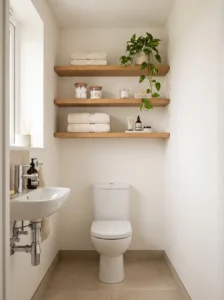
Floating shelves add storage while the floor stays open, which matters in a room only five feet wide. Mount two or three above the toilet or on the wall opposite the vanity, spaced 12 to 14 inches apart so tall bottles fit. Solid wood or thick laminate about 8 inches deep holds more than thin glass and looks less fussy.
Anchor into studs wherever possible. Wall plugs in drywall are fine for light loads, but a stack of damp towels weighs more than it looks. Seal raw wood with a satin polyurethane first, or steam will warp it within a season or two.
Styling should stay restrained: folded towels on one shelf, a few matching jars on another, and a pothos or similar low-light plant on the third. Fill every inch and the wall starts to feel crowded rather than organized.
Try placing one shelf around 60 inches up for backup supplies. You rarely need them, but you’ll be glad to see the spare soap when the last bar runs out, and it keeps eye-level space calm.
3. A Recessed Medicine Cabinet Between the Studs
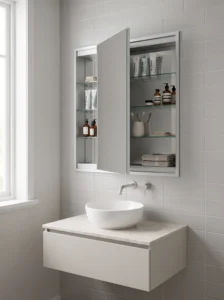
Cutting a cabinet into the wall gives you shelves that add no depth to the room at all. Standard stud spacing leaves a gap around 14 inches wide, and most recessed units are made for exactly that, with about 3 to 4 inches of internal depth. That’s enough for toothpaste, prescriptions, razors, and skincare, which are the things you grab daily.
It works best on an interior wall. Exterior walls hold insulation, and any wall can hide pipes or wiring, so check first and call a pro if you spot anything suspicious. Look for a mirrored door with a stainless or aluminum frame. Cheap steel with a thin coating will rust in a humid room.
Set it at eye level beside or above the sink, and keep the most-used products on the middle shelves. A common error is buying a unit with too few adjustable shelves, so tall bottles end up lying down and rolling about.
Because it sits flush, nobody bumps into it. In a tight room, that’s the gap between a cabinet you love and one that bruises your hip every morning.
4. A Surface-Mounted Mirrored Cabinet for Renters
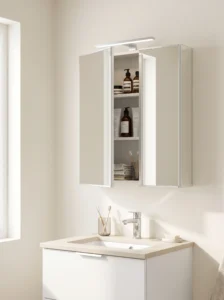
If cutting into a wall isn’t possible, a surface-mounted mirrored cabinet does nearly the same job. Swap the plain mirror over the sink for one with shelves behind it, and you gain storage with no extra floor footprint. Look for a depth of 5 to 6 inches, a width that matches the vanity, and a door that swings clear of the faucet.
Three-door models with side mirrors let you actually see the back of your head, which is a small luxury. Aluminum frames resist rust, and soft-close hinges stop the door from slamming at 6 a.m. Some include a built-in LED strip, which saves you from adding sconces in a place where wiring is awkward.
Sort the contents by routine: morning products on the left, evening on the right. Overfilling is the usual trap, and then the door won’t sit flat.
Keep the top shelf for things you rarely reach for, such as spare toothbrush heads or travel kits. Everything touched daily stays between waist and shoulder height, so the routine feels smooth even when you’re half awake.
5. Pull-Out Organizers Under the Sink
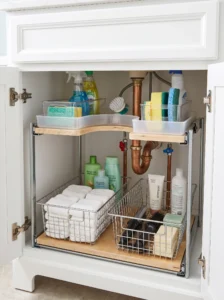
The cabinet below the sink is where small-bathroom storage goes to disappear, because plumbing eats the middle and everything slides behind the pipes. A two-tier pull-out organizer with a U-shaped cutout for the drain solves the problem. Measure the width of the door opening, not just the interior, so the unit actually fits through.
Choose sliding drawers rather than loose bins. Metal wire is strong, though solid plastic is easier to wipe if shampoo leaks. Because the pipe usually leaves two narrow sides, a unit that splits into two halves tends to fit better than a single wide shelf.
Group things by function: cleaning supplies on one tier, spare toiletries and hair tools on the other. Anything that might spill belongs in a shallow tray. Keep bleach and other chemicals behind a child lock.
A frequent mistake is installing a shelf that blocks the shutoff valve. Leave access clear, because you’ll want to reach it fast if something leaks. After the first clear-out, most people discover how many duplicate products were hiding in the dark.
6. Over-the-Door Hooks and Racks
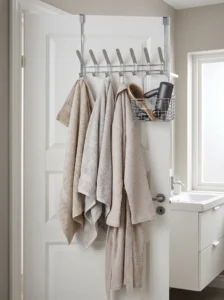
The back of the bathroom door is flat, free, and nearly always empty. Over-the-door hooks and racks use it without any screws, which suits renters, student housing, and anyone who dislikes drilling. Check your door thickness, usually between 1⅜ and 1¾ inches, and choose a model with rubber padding so the paint stays unmarked.
A multi-hook rail handles robes and towels, while a basket-style rack can hold a hair dryer and brushes. Matte black or chrome tends to match most fixtures. Pick a slim design, because a bulky rack can stop the door from closing, particularly if it swings toward a vanity.
Hang the heavy things at the hinge side, and stay within the weight limit printed on the packaging. Wet towels weigh more than you’d think.
One drawback is noise, since a loaded rack knocks against the door. A strip of felt on the back quiets it. In a family bathroom, giving each person one hook is the easiest way to end the “whose towel is this?” debate for good.
7. A Wall Grid Panel With Clip-On Baskets
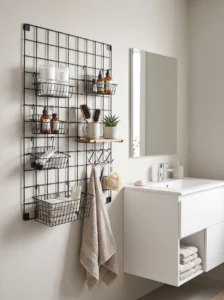
A grid panel turns a bare wall into storage you can rearrange in minutes. Mount a panel roughly 24 by 36 inches, then clip on small baskets, hooks, and a little shelf. When your routine changes, you move the pieces instead of drilling new holes.
Powder-coated steel and brass-plated options look sharp, and woven seagrass baskets add warmth but need a liner in a humid space. Choose baskets with solid backs for small items like cotton pads, because open mesh lets them slip through.
Position it near the vanity, where you do your grooming, rather than behind the door. Everyday items go at hand height, lighter accessories near the top.
The usual error is hanging heavy things on weak hooks. Check the weight rating and use proper wall anchors, especially in tile. The real payoff is flexibility. A new baby, a teenager, or a different skincare habit can all be handled with a quick reshuffle over coffee, with no handyman involved.
8. A Tension-Pole Caddy in the Shower Corner
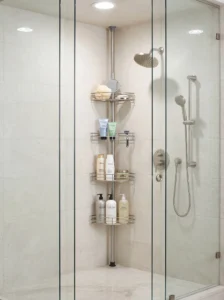
Shower shelves cause more arguments than almost anything else in a bathroom, and a tension-pole caddy is a damage-free fix. It wedges between floor and ceiling, generally fitting heights from about 7 to 10 feet, and gives you three or four tiers right where you need them.
Go for stainless steel or anodized aluminum, because cheap chrome flakes quickly in constant steam. A shelf with a small lip stops bottles from sliding off. Place it in the corner furthest from the water stream, so your products don’t get blasted every time.
It needs a firm ceiling. Heavily textured plaster or a flimsy panel won’t hold the tension. A small rubber pad at the top gives extra grip.
Don’t load the top with full-size bottles, because the pole will start to lean. Keep heavy items at the bottom, and consider decanting shampoo into matching pump bottles, which also lightens the load. The tub ledge finally stays clear, and cleaning takes a fraction of the time.
9. A Built-In Shower Niche
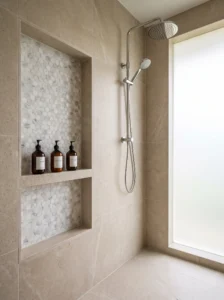
If you’re already tiling, a recessed niche is one of the most satisfying additions you can make, since it hides toiletries inside the wall. Set it around chest height, 48 to 60 inches from the floor, between studs, usually 12 to 16 inches wide. The bottom should slope slightly toward the shower so water drains out, a small detail that prevents mildew.
Use the same tile as the wall for a seamless look, or a contrasting mosaic as an accent. Natural stone shelves look lovely but need sealing. Renters can mimic the idea with adhesive silicone or stick-on shelves, though these hold less weight.
Keep it out of the direct spray. Measure your tallest bottle before deciding on height, because a short opening can’t hold a full-size conditioner. Two shorter niches stacked can be more practical than one tall one.
The payoff is mostly visual. With products tucked inside the wall, the shower looks calm, and the glass stays cleaner because nothing dangles from the fixtures.
10. Magnetic Strips for Tiny Metal Tools
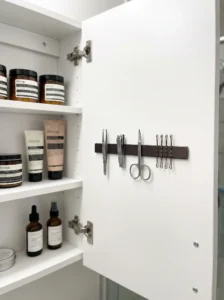
Small metal tools are the hardest things to keep track of, and a magnetic strip handles them in one go. Stick a strip inside a medicine cabinet door or the side of the vanity, and tweezers, bobby pins, nail clippers, and scissors cling there in plain view. An 8 to 12 inch strip is plenty.
Pick one with strong adhesive backing, or screw it in for a firm hold. Inside cabinet doors is best, because steam can weaken adhesive on open walls, and exposed tools bring visual clutter right back.
Group similar items together and leave a small gap between types so you can grab one without dislodging the rest. Keep it away from anything a magnet could harm.
The idea comes from kitchens, where knife strips have been standard for years, and it carries over nicely. Mornings move faster when the tweezers are exactly where you left them, rather than buried under three tubes of lip balm in a drawer.
11. A Leaning Ladder Shelf
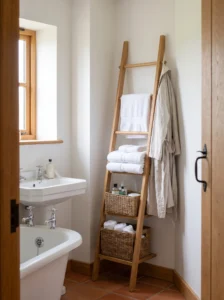
A leaning ladder shelf gives you storage and towel hanging in one piece, with no wall mounting. Because it leans, the footprint is deeper at the bottom, often 14 to 16 inches, which is fine with a spare corner but tricky in a very narrow room.
Oak or walnut warms up an all-white bathroom, while black metal adds a modern edge. Seal any wood well, as humidity will swell it otherwise. Four or five rungs or shelves suit most needs.
Place it beside the tub or in an empty corner opposite the toilet. Drape towels over the rungs, put baskets on the shelves, and keep the lowest shelf for heavier items so the ladder stays steady.
A common mistake is putting it where the door swings into it, so open the door fully before deciding on a spot. In a small space, this is the piece that makes a bathroom feel closer to a spa, since towels displayed properly look intentional rather than messy.
12. A Slim Rolling Cart for Awkward Gaps
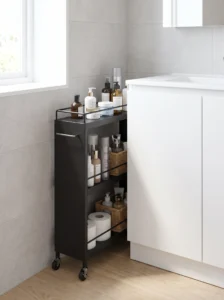
Those odd 6- to 9-inch gaps beside a vanity or toilet are exactly where a slim rolling cart belongs. Three tiers on casters slide out when you need them and tuck away when you don’t, which is handy if you share the room with someone who gets ready at the same time.
Metal frames with mesh or solid shelves work well. Pick locking wheels so the cart doesn’t drift on a damp floor, and look for a handle that makes it easy to pull. Rubber wheels are kinder to soft flooring than hard plastic, which can leave small marks.
Daily items such as moisturizer, hair products, and spare toilet paper go on it, with baskets to keep things looking neat. Park it on the side where you usually stand, so you’re not stretching.
When it’s time to mop, roll it into the hallway and the floor is clear in seconds. That ease of cleaning is something you only appreciate once you’ve tried it.
13. A Toilet Paper Holder With Built-In Storage
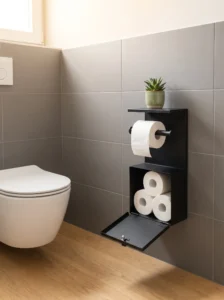
A holder with a shelf or reserve compartment saves more space than you’d expect. Instead of a basket on the floor, a wall-mounted unit holds the active roll, three or four spares, and often a small shelf on top for a phone or air freshener.
Install it within easy reach while seated, roughly level with the front edge of the bowl and slightly ahead of it. Stainless steel and matte black finishes tend to resist rust, whereas cheaper chrome peels with time. A model with a closed back keeps the spare rolls tidy and hides the wall behind.
Don’t mount it too far forward or too low, which is a surprisingly common mistake that makes reaching awkward for everyone, especially kids and older relatives.
Beyond the neat look, it does something practical: the spare rolls are always visible, so nobody gets caught short. A quiet, boring improvement, but it removes one of the most irritating small-bathroom moments.
14. A Holster for Hair Tools
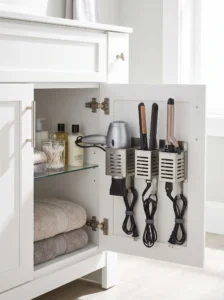
Hair dryers and straighteners hog drawers and tangle cords, so give them a dedicated holster. Mount a silicone-lined or heat-proof holder inside a vanity door, and the tools sit upright with the cords wrapped neatly. Most holders are 4 to 5 inches wide, so check the clearance behind the door.
Metal holders look sleeper and work for dryers, while a mesh pouch handles curling irons and brushes. Let hot tools cool fully before storing them. Don’t hang a holster inside a cabinet that also holds aerosols or flammable cleaners.
Position it at a height where the dryer slips in without effort. If it’s awkward to put away, it ends up on the counter again, so low friction is the secret here.
For a plug-in tool, a spot beside an outlet inside the cabinet is ideal, and a small surge-protected strip can be tucked in. It sounds fussy, but a clear counter makes the whole morning feel more organized, and cords stop snagging on everything.
15. Decanted Jars on the Counter
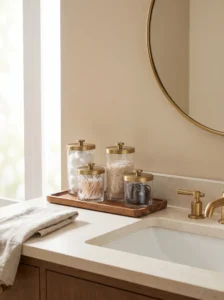
Matching jars can turn necessary clutter into a deliberate display. Cotton balls, swabs, bath salts, and hair ties look tidy in glass or ceramic canisters with lids. Choose jars about 3 to 5 inches wide and limit yourself to three or four, otherwise the counter fills right back up.
Glass looks luxe but can break on tile, so families with small kids may prefer acrylic or ceramic. Lids keep out moisture and dust, which matters for cotton products. A small tray under the group corrals them and makes wiping the counter a single motion.
Stick to one finish, such as clear glass with brass lids, so the display reads as calm rather than busy.
A tip I like: put the refill packs in a basket under the sink, and only top up the jars when they run low. That way, the counter holds one tidy set, and the extra stock stays out of view. You get the look of a boutique spa for a few dollars.
16. A Wall-Mounted Towel Shelf With Hooks
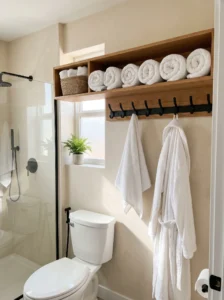
Combining a shelf and hooks keeps towels, a basket, and a few extras on one compact piece. Mount it above the toilet or beside the shower, with the shelf about 8 inches deep and hooks beneath for robes or hand towels. A 24-inch width suits most walls.
Solid wood in a natural finish brings warmth, and powder-coated metal handles steam better. For heavy towels, use brackets that anchor into studs, not just drywall.
Roll bath towels instead of folding them, and they take up less shelf depth while looking more spa-like. Use the top shelf for spares and keep the hooks for the towels currently in use.
Avoid putting it directly above the toilet if your ceiling is very low, because it will make the space feel crowded.
The real benefit is airflow. Towels hanging on hooks dry faster than ones piled in a cupboard, so you’ll notice fewer musty smells over time. That alone makes the setup worth the half hour it takes to install.
17. A Slim Hamper Tucked Behind the Door
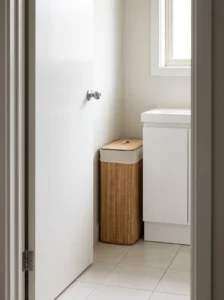
A hamper might not sound like storage, but dirty laundry is one of the biggest sources of floor clutter. A narrow hamper around 10 to 12 inches wide tucks behind the door or beside the vanity and keeps clothes off the floor.
Look for a ventilated basket or a fabric liner, since damp laundry in a sealed bin gets smelly quickly. Woven rattan, bamboo, and canvas all suit bathrooms, as long as they’re lined. A lid helps hide the contents from view.
Make sure the door still opens fully when the hamper is in place. A slim hamper that blocks the door swing defeats the point.
A hanging bag on the back of the door is an option if floor space is nonexistent. The trick is emptying it often. A hamper that fills slowly across a week looks fine, but one that overflows becomes the biggest eyesore in the room, so tie the habit to laundry day.
18. A Corner Shelf Unit
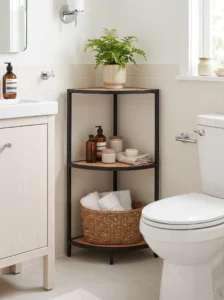
Corners are the most neglected part of any bathroom, and a corner shelf unit puts them to work. A three- or four-tier model with a triangular footprint of about 9 to 12 inches per side fits snugly beside the toilet or in the shower area.
Choose rust-resistant metal or sealed wood. Glass shelves look light but show water spots quickly. A freestanding unit is simplest, though wall-mounted corner shelves free up even more floor space and are handy in a tiny wet room.
Use the lower tiers for towels in a basket and the higher ones for decorative items. Avoid anything heavy on top, because corner units can tip if the load is uneven.
If you share the bathroom, assign a shelf to each person. It keeps products separate, reduces arguments, and means nobody hunts through a communal pile. Corners tend to be dark, so a small battery-powered light or a pale finish will stop the unit from feeling like a shadow in the room.
19. Drawer Dividers and Inserts
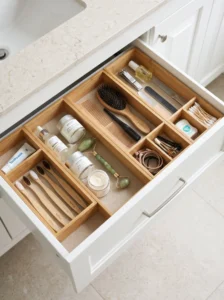
If your vanity has drawers, the fastest upgrade is a set of dividers. Without them, a drawer turns into a tangle of lipsticks, toothbrushes, and cords. With them, every item gets its own compartment and the whole drawer opens to a calm, readable layout.
Measure the interior of each drawer first, then choose inserts that fit with a snug margin. Bamboo and acrylic both look clean, and adjustable dividers let you change the layout later. Non-slip mats prevent things from shifting every time you open the drawer.
Group by use: oral care in one section, skincare in another, hair accessories in a third. Keep the top drawer for items you use daily, and lower drawers for backups.
A common mistake is buying organizers before decluttering. Empty the drawer, throw out expired products, then decide what you need. You’ll probably find that half of what you thought needed space was simply old. The result is a drawer where you can find anything in a second, even before coffee.
Quick Comparison: Which Storage Type Suits You?
| Type | Best Use | Material | Style/Vibe | Difficulty Level |
|---|---|---|---|---|
| Over-the-toilet etagere | Renters needing vertical space | Metal or bamboo | Light, flexible | Easy |
| Recessed medicine cabinet | Daily essentials, owners | Mirror with aluminum frame | Clean, built-in | Advanced |
| Under-sink pull-outs | Cleaning supplies, spares | Wire or plastic | Practical, hidden | Moderate |
| Tension-pole shower caddy | Shower products, no drilling | Stainless steel | Simple, functional | Easy |
| Wall grid panel | Changing routines, small items | Powder-coated steel | Modern, adaptable | Moderate |
| Shower niche | Remodels, seamless look | Tile or stone | Spa-like, polished | Advanced |
How to Choose the Right Storage for Your Bathroom
Start with measuring, then measure again. Record the width of the walls, the depth of the vanity, the door swing, and the clearance around the toilet. In a small room, an extra inch decides whether a piece fits or blocks the door. Mark the footprint on the floor with painter’s tape and walk around it for a day before buying.
Materials matter more here than in any other room, because humidity is constant. Stainless steel, anodized aluminum, sealed bamboo, and powder-coated metal hold up well. Raw MDF and cheap chrome swell or flake within a year or two. If a product doesn’t mention moisture resistance, assume it isn’t.
Think about maintenance honestly. Open shelves collect dust, glass shows water spots, and fabric baskets need washing. Choose what suits the way you actually clean, not just how the product looks in a photo.
On budget, spend where something is hard to replace: wall-mounted pieces, cabinets, and anything that involves plumbing or tile. Baskets, jars, and hooks are cheap to upgrade later. A mid-priced shelf with solid anchoring tends to outlast an expensive one with weak fittings.
The most common regrets are buying before decluttering, ignoring door swings, choosing a bulky unit for a narrow space, and falling for a set of pretty containers that don’t fit your actual products. Check weight limits, read reviews from people with similar room sizes, and keep receipts. A little planning avoids returning an awkward unit and starting again.
Wrapping It Up
A clutter-free small bathroom comes from a few good decisions rather than a pile of new products. Use the vertical space above the toilet, claim the back of the door, make the cabinet under the sink work properly, and give the shower a home for its bottles. Most of these ideas are inexpensive, and many suit renters.
If your room is tiny, start with the least invasive moves: over-the-door hooks, a tension-pole caddy, and a slim cart. If you have more flexibility, a recessed cabinet or a shower niche brings the most lasting change. Mix and match, because small bathrooms rarely need just one solution.
Before spending, declutter. Throw out expired products, combine duplicates, and see what’s left. You may find you need less storage than you thought, and the pieces you do buy will fit better.
Measure the space, tape out footprints, and live with the plan for a few days. Problems show up quickly: a door that catches, a shelf too high for a child, a basket that blocks a drawer. A bathroom that’s easy to keep tidy gets used more calmly, and that quiet ease in the morning is the best sign the storage is working.
FAQs
How do I add storage to a small bathroom without drilling?
Use freestanding pieces such as an over-the-toilet etagere, a ladder shelf, or a slim rolling cart. Over-the-door racks and tension-pole caddies also need no tools. These suit rentals and are easy to move if you rearrange.
What is the best place to put storage in a tiny bathroom?
Go vertical first. The wall above the toilet, the back of the door, and the corners are usually wasted. Keep daily items at hand height and spares on higher shelves.
Which materials are best for humid bathrooms?
Stainless steel, anodized aluminum, sealed bamboo, and powder-coated metal hold up well. Avoid raw MDF and thin chrome, which swell or flake. Always check that wooden items are sealed against moisture.
How much does it cost to organize a small bathroom?
It depends on how much you do yourself. Hooks, baskets, and jars are inexpensive, while a recessed cabinet or a tiled niche costs more because of labor. Start with low-cost pieces and upgrade where you notice problems.
How do I stop products from piling up on the counter?
Give every item a home before it hits the counter. Use a drawer divider, a wall basket, or a mirrored cabinet. Decant frequently used items into matching jars and keep a tray to corral the rest.
What is the biggest mistake when buying bathroom storage?
Skipping measurements. People forget door swings, toilet clearance, and cabinet openings, then end up returning pieces. Tape out the footprint first and check the door opens fully.
Can I use fabric baskets in a bathroom?
Yes, with some care. Choose washable fabric or lined woven baskets, and keep them away from direct water. Replace them if they start to smell musty, because humidity is hard on natural fibers.